Linear Approximation: Estimating Function Values Near a Point
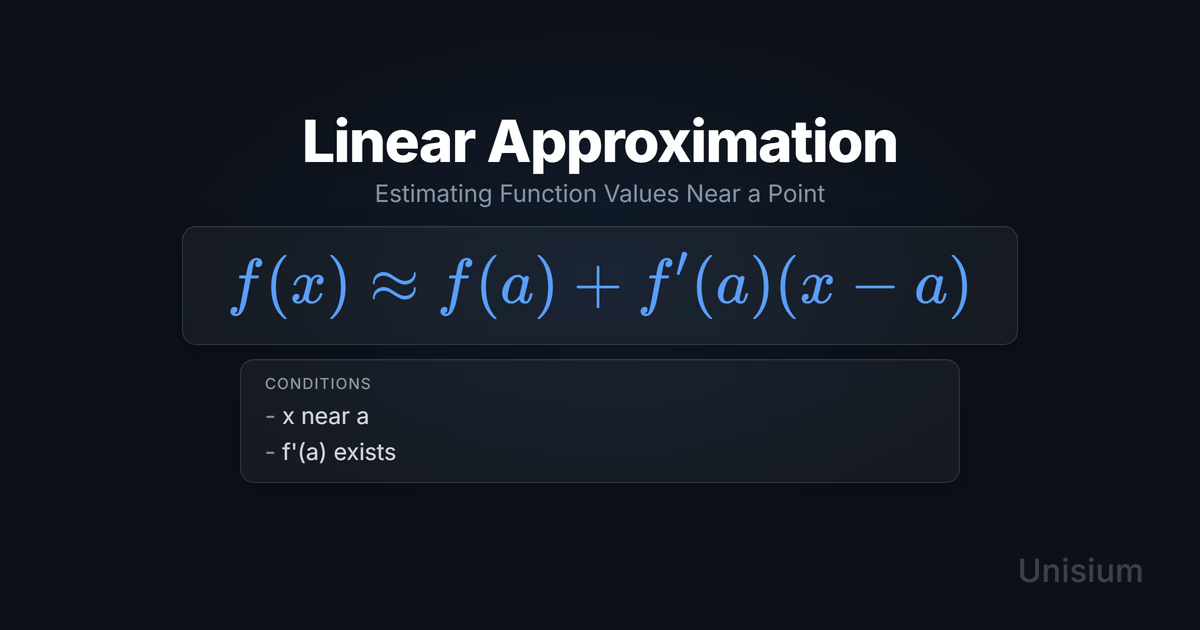
Linear approximation states that near a point , a differentiable function is well described by its tangent line: . The tangent line matches the function’s value and slope exactly at , so for inputs close to the curve barely deviates from the line. The skill that matters is recognizing when “near” is close enough — knowing how the error grows with distance from .
On this page: The Principle | Conditions | Misconceptions | EE Questions | Retrieval Practice | Worked Example | Solve a Problem | FAQ
The Principle
Statement
The linear approximation of at estimates for inputs close to by replacing the curve with its tangent line at that point: . The tangent line agrees with in both output value and slope at , so for small displacements the curve hugs the line closely. Choosing a nearby base point where and are easy to compute exactly turns a hard evaluation into straightforward arithmetic.
Mathematical Form
Where:
- = the input at which the approximation is evaluated
- = the base point where the derivative is known (or easy to compute)
- = the exact function value at the base point
- = the derivative at the base point, supplying the slope of the tangent line
- = the estimated function value near
Alternative Form
In some texts the same formula appears as the linearization :
- Linearization notation: , with
The symbols differ; the content is identical.
Conditions of Applicability
Condition: x near a; f’(a) exists
Practical modeling notes
- “x near a” has no universal threshold. Accuracy degrades as grows, especially when is large near . A rough local-error scale is (heuristic only; a formal bound requires on an interval, not just at ).
- You choose : pick a value where and are easy to compute exactly. Useful choices include perfect squares for , multiples of or for trig functions, and for or .
When It Doesn’t Apply
- Non-differentiable point: If does not exist (corner, cusp, vertical tangent, or discontinuity at ), there is no slope to use. The tangent line equation likewise fails at these same points.
- x far from a: For large displacements, the tangent line diverges from the curve. Use a higher-order Taylor polynomial when a closer estimate is required.
Want the complete framework behind this guide? Read Masterful Learning.
Common Misconceptions
Misconception 1: The approximation gives the exact value
The truth: is exact only at itself, where both sides equal . For inputs other than , the expression is generally an estimate rather than the exact value.
Why this matters: Treating the approximation as exact suppresses the error term. In applied contexts, reporting the approximated value without acknowledging that it is an estimate is a precision error.
Misconception 2: Any base point works equally well
The truth: Accuracy depends jointly on how small is and on how curved is near (controlled by ). A poorly chosen base point that is far from , or one where bends sharply, produces larger errors even for modestly small displacements.
Why this matters: Part of the skill is selecting a convenient that balances ease of computation against the required approximation quality.
Elaborative Encoding
Use these questions to build deep understanding. (See Elaborative Encoding for the full method.)
Within the Principle
- In the formula , which term anchors the approximation to the curve and which term accounts for the slope-driven change from to ?
- If , what does the linear approximation reduce to, and what does that reveal about the shape of immediately near ?
For the Principle
- How do you select the base point ? What properties make one choice of more useful than another for a given target input ?
- What happens to the accuracy of the approximation as moves progressively farther from , and what measure captures how fast the error grows?
Between Principles
- The tangent line equation and the linear approximation share the same algebraic formula. In what way do they frame the same mathematical object from different angles?
Generate an Example
- Name a specific function and base point where the linear approximation replaces a calculation that would otherwise require a calculator. Describe the approximation step explicitly.
Retrieval Practice
Answer from memory, then click to reveal and check. (See Retrieval Practice for the full method.)
State the principle in words: _____Near a, f(x) is approximated by its tangent line: f(x) is approximately f(a) + f'(a)(x-a).
Write the canonical equation: _____
State the canonical condition: _____x near a; f'(a) exists
Worked Example
Use this worked example to practice Self-Explanation.
Problem
Approximate using the linear approximation of at .
Step 1: Verbal Decoding
Target:
Given: , ,
Constraints: is near ; exists for all
Step 2: Visual Decoding
Draw near and mark the base point . Draw the tangent line at ; it rises with slope . Locate slightly right of . (Because is concave down near , the tangent line lies above the curve, so the approximation slightly overestimates.)
Step 3: Mathematical Modeling
Step 4: Mathematical Procedures
Step 5: Reflection
- Verification: At : — the approximation is exact at the base point, as required.
- Magnitude: The actual value ; the error , which is small relative to the answer.
- Graphical meaning: near , so the curve is concave down and the tangent line overestimates, consistent with .
Before moving on: self-explain the model
Try explaining Step 3 out loud (or in writing): why the tangent line at applies here, what each term of the approximation formula represents, and why is the natural choice for estimating .
Mathematical model with explanation
Principle: Linear approximation — , valid when exists and is near .
Conditions: is away from , a small displacement. is a finite real number, so both conditions are satisfied.
Relevance: has no closed exact form. The nearby perfect square makes both and trivially computable, so the problem reduces to arithmetic.
Description: The base value anchors the approximation. The slope multiplied by the displacement adds the first-order correction , yielding the estimate .
Goal: Estimate without a calculator by leveraging known values at the base point .
Solve a Problem
Apply what you’ve learned with Problem Solving.
Problem
Approximate using the linear approximation of at .
Hint (if needed): Recall that and that the derivative of is itself.
Show Solution
Step 1: Verbal Decoding
Target:
Given: , ,
Constraints: is near ; exists for all
Step 2: Visual Decoding
Draw near and mark the base point . Draw the tangent line at ; it has slope and passes through . Locate slightly right of . (Because is concave up, the tangent line lies below the curve, so the approximation underestimates.)
Step 3: Mathematical Modeling
Step 4: Mathematical Procedures
Step 5: Reflection
- Verification: At : — exact agreement at the base point confirmed.
- Magnitude: Actual ; the error , about of the result, consistent with a small displacement.
- Graphical meaning: , so is concave up and the tangent line underestimates: .
Related Principles
| Principle | Relationship to Linear Approximation |
|---|---|
| Tangent line equation | Linear approximation IS the tangent line used as an estimate of |
| Derivative at a point | provides the slope; without it there is no approximation |
| Taylor polynomial definition | Linear approximation is the Taylor polynomial at ; Taylor extends it to add quadratic and higher correction terms |
FAQ
What is linear approximation in calculus?
Linear approximation (also called linearization) uses the tangent line at a base point to estimate nearby function values: . It works because the tangent line matches ‘s value and slope at , so the curve barely departs from the line for inputs close to .
When should I use linear approximation?
Use it when you need an estimate of for an input close to a base point where and are easy to compute exactly. Common choices: is a perfect square for , a multiple of or for trig functions, or for and .
What’s the difference between linear approximation and the tangent line?
They are the same formula. The tangent line is a geometric object—a line through the curve at . Linear approximation uses the same expression as an estimation tool: where .
How accurate is a linear approximation?
Accuracy depends on how fast the curve bends. A rough local-error scale is —use this as a heuristic, not a guaranteed bound (a formal bound requires bounded on an interval). The smaller and near , the better the estimate. For higher precision at larger displacements, use a second-order Taylor polynomial instead.
How does linear approximation relate to the Taylor polynomial?
The linear approximation is identical to the degree- Taylor polynomial centered at . Taylor polynomials extend the idea by adding terms proportional to , , and so on, improving accuracy farther from at the cost of more computation.
Related Guides
- Calculus Subdomain Map — Return to the calculus hub to see where approximation sits after tangent-line work and before higher-order Taylor methods
- Principle Structures — Organize linear approximation in its hierarchical context: derivative at a point → tangent line → linear approximation → Taylor polynomial
- Self-Explanation — Learn to narrate worked solutions step by step
- Retrieval Practice — Keep this formula immediately accessible
- Problem Solving — Apply the Five-Step Strategy to approximation problems
How This Fits in Unisium
Within the calculus subdomain, Unisium treats linear approximation as the first local-estimation use of the tangent line equation: the same line that matches value and slope at becomes a nearby-value model for . The platform links the approximation to the elaborative encoding questions, retrieval cloze prompts, and worked problems in this guide, then tracks which exercises each student has completed. When you attempt a problem tagged linearApproximation, the platform schedules follow-up retrieval at spaced intervals so the formula remains accessible under timed exam conditions.
Ready to master linear approximation? See Unisium’s 14-day free trial or explore the complete learning framework in Masterful Learning.

Masterful Learning
The book behind these guides: a study system for physics, math, & programming built on retrieval, connection, explanation, and problem solving.
Ready to apply this strategy?
Unisium turns these evidence-based techniques into guided study sessions for math and physics. Places are limited during early access. Check current availability to start a trial; joining the mailing list is optional.
See plans and availability Read More GuidesAlready have access? Sign in