Limit of a continuous composition: Push the limit through an outer function
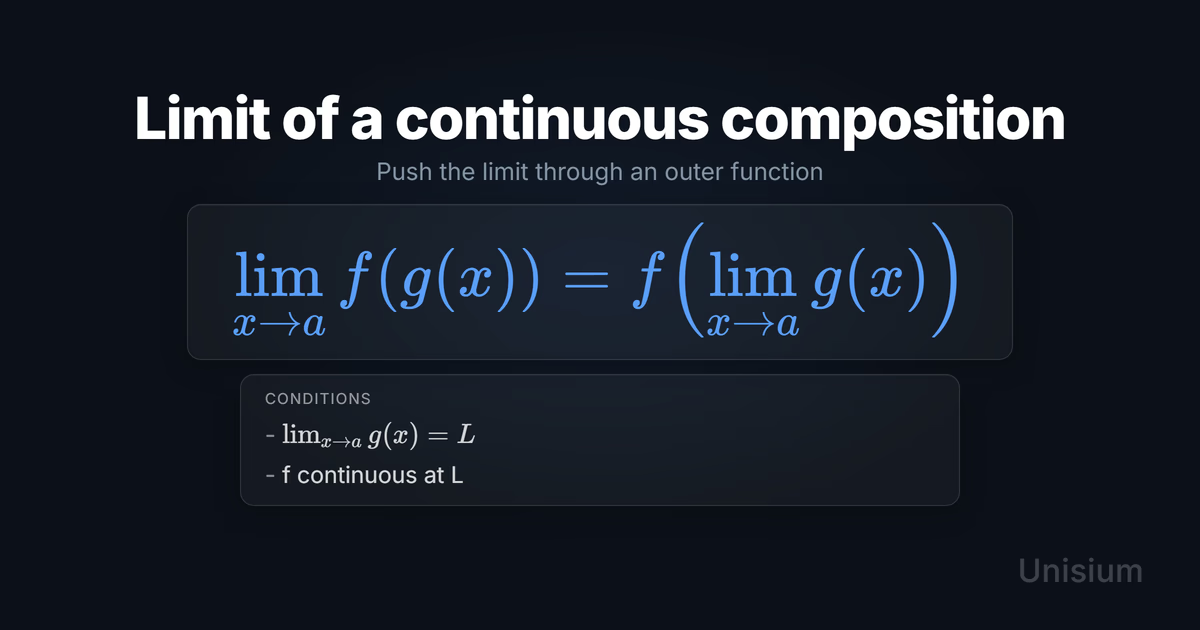
The limit of a continuous composition rule lets you evaluate by first finding the inner limit and then applying to . It applies when that inner limit exists and is continuous at . Domain restrictions and discontinuities block the move, even when the expression has the right composite form.
On this page: The Principle | Conditions | Failure Modes | EE Questions | Retrieval Practice | Practice Ground | Solve a Problem | FAQ
The Principle
The move: Push the limit operator through a continuous outer function, so the limit applies only to the inner expression.
The invariant: This preserves the value of the limit, provided is continuous at the inner limit value .
Pattern:
| Legal ✓ | Illegal ✗ |
|---|---|
| ; continuous everywhere → | when ; floor discontinuous at |
Left: is continuous everywhere — the push is valid. Right: is discontinuous at every integer; since is an integer, the condition fails and the push is blocked even though the expression has the right form.
Conditions of Applicability
Condition: ; f continuous at L
Before applying, check: compute first, then confirm is defined and continuous at .
If the condition is violated: the limit of may differ from , or may not exist, even though .
- must be continuous at — a function with a jump discontinuity, a vertical asymptote, or that is undefined at blocks the push.
- Standard functions such as , , , and polynomials are continuous wherever they are defined. For outer functions with restricted domains, compute first: requires , requires , and rational outer functions require a nonzero denominator at .
Want the complete framework behind this guide? Read Masterful Learning.
Common Failure Modes
Failure mode: apply the push when is not continuous at — for example, when , or when → the value is either undefined or differs from the true limit of the composition.
Debug: state explicitly, then ask “is defined and continuous at this specific value?” For , , and rational outer functions, always verify the domain constraint at .
Failure mode: assume every standard function is safe everywhere, ignoring that domain boundaries disqualify continuity → misses cases like when , or when .
Debug: for any outer function with a restricted domain, compute first — if is outside the domain or at a point where is not continuous, the push is unavailable.
Elaborative Encoding
Use these questions to build deep understanding. (See Elaborative Encoding for the full method.)
Within the Principle
- What does “continuous at ” mean operationally, and why is it the key check rather than “continuous everywhere”?
- Could you apply this rule in reverse — interpreting as ? When would that direction be useful?
For the Principle
- Describe a two-step check you can run before applying the composition rule to any composite limit .
- When the rule cannot be applied because is not continuous at , what alternative strategies allow you to evaluate the limit?
Between Principles
- The limit quotient rule also carries an applicability condition — a nonzero denominator limit. How does that algebraic-nonzero check compare to the continuity-at- check required here?
Generate an Example
- Construct a composite limit where the rule appears applicable but the condition fails, and describe what goes wrong if you push the limit through anyway.
Retrieval Practice
Answer from memory, then click to reveal and check. (See Retrieval Practice for the full method.)
State the move in one sentence: _____Push the limit operator through the outer function: the limit of f(g(x)) equals f evaluated at the limit of g(x), provided f is continuous at that inner limit value.
Write the canonical equation: _____
State the canonical condition: _____
Practice Ground
Use these exercises to build move-selection fluency. (See Self-Explanation for how to use worked examples effectively.)
Procedure Walkthrough
Starting from , reach a single numeric value.
| Step | Expression | Operation |
|---|---|---|
| 0 | — | |
| 1 | Composition rule — , continuous at ✓ | |
| 2 | Evaluate inner limit by direct substitution | |
| 3 | Arithmetic |
Drills
Action label (Format B)
What was done between these two steps? Assume the inner limit exists and verify whether the move is valid.
Reveal
Continuous composition rule applied. is continuous everywhere, so it is continuous at . Condition holds ✓.
Completing the evaluation: .
What was done between these two steps? Verify whether the move is valid.
Reveal
Continuous composition rule applied. is continuous everywhere, so it is continuous at . Condition holds ✓.
Completing the evaluation: .
What was done between these two steps? Is the move valid? Assume the inner limit is .
Reveal
Invalid — the condition fails. (the floor function) is discontinuous at every integer, and is an integer. Since is not continuous at , the composition rule does not apply. The attempted push is blocked.
The true limit requires separate analysis (e.g., one-sided limits) and may or may not equal .
Can the composition rule be applied? Identify the outer function, the inner limit, and check the condition. Assume .
Reveal
No — this is a near-miss. The outer function is , and the inner limit is . But is not defined at (let alone continuous there). Since is not continuous at , the condition fails.
The expression has the right compositional form, but the push is unavailable because is not continuous at . To evaluate this limit, a different technique (substitution, l’Hôpital, or series expansion near ) is required.
Which of these two limits can be evaluated using the composition rule? Assume all inner limits exist. State the condition check for each.
(i) where
(ii) where
Reveal
(i) only. is continuous at (, so it is in the domain). Condition holds ✓ — the push is valid.
For (ii): is outside the domain of (real-valued). is not defined at , so it is not continuous there. The composition rule does not apply.
The same outer function can be eligible or blocked depending on where the inner limit lands.
Forward step (Format A)
Apply the composition rule once. State the condition check explicitly.
Reveal
Outer function (polynomial), continuous everywhere. Inner limit: . Condition: continuous at ✓.
Apply the composition rule once. State the condition check explicitly.
Reveal
Outer function , continuous everywhere. Inner limit: . Condition: continuous at ✓.
Apply the composition rule once. State the condition check explicitly.
Reveal
Outer function . Inner limit: . Condition: continuous at ✓.
Can the composition rule be applied? State the condition check and explain your decision. Assume .
Reveal
No — the condition fails. Outer function . Inner limit: . But has a vertical asymptote at — it is not defined (let alone continuous) at .
The composition rule does not apply. To evaluate this limit, analyze the behavior of near from each side, or apply l’Hôpital if the form permits.
Transition identification (Format C)
In the evaluation chain below, identify which step applies the composition rule. Verify the condition at that step.
Reveal
Step (1) applies the composition rule. Outer function , continuous everywhere. Inner limit: . Condition holds ✓.
Step (2) evaluates the inner limit by direct substitution. Step (3) computes .
Solve a Problem
Apply what you’ve learned with Problem Solving.
Problem: Evaluate , applying the continuous composition rule as the first step. Show the condition check before pushing the limit through.
Full solution
| Step | Expression | Move |
|---|---|---|
| 0 | — | |
| 1 | Composition rule — , continuous everywhere; ✓ | |
| 2 | Sum and constant-multiple rules on inner expression | |
| 3 | Evaluate each basic limit by substitution | |
| 4 | Simplify |
Related Principles
| Principle | Relationship |
|---|---|
| Limit statement | Prerequisite: the inner expression still begins as a limit claim at that must be evaluated first |
| Continuity at a Point | Defines ” continuous at ” precisely — the condition that makes the push valid |
| Function Composition | Functions-side structural prerequisite: this rule applies to composite forms and reuses the same inner/outer organization as composition |
| Derivative Chain Rule | Downstream derivative analogue: after composite limits are fluent, chain rule handles composite derivatives |
| Limit Quotient Rule | Another condition-critical limit rule; its guard is algebraic () rather than a continuity check |
FAQ
What is the limit of a continuous composition rule?
The rule states that when is continuous at . It lets you evaluate the limit of a composite expression by first finding the inner limit, then applying the outer function — as long as the outer function is continuous at the inner limit’s value.
When is the composition rule valid?
Two conditions must both hold: (1) exists, and (2) is continuous at . Standard functions like , , , and polynomials are continuous everywhere on their domains. For , , or rational , you must check whether is continuous at : blocks (not in its domain), but is a valid point for — is continuous at .
What goes wrong if is not continuous at the inner limit?
The value may differ from the true limit — or the true limit may not exist at all. For example, is discontinuous at integers: if , you cannot conclude by pushing through.
How is this different from direct substitution?
Direct substitution evaluates by computing — it works when the entire composition is continuous at . The composition rule is more general: it separates the inner limit computation from the outer function evaluation, so it still applies when is not continuous at but exists and is continuous at that limit.
Does this rule apply when has a domain restriction?
When is a point where is defined and continuous. blocks because is not in the domain. is fine for because and is continuous at . What matters is not whether is interior or boundary in some abstract sense, but whether is continuous at .
How This Fits in Unisium
Within the calculus subdomain, calculus fluency is built by training condition recognition before rule application — not just pattern execution. For the composition rule, that means computing the inner limit explicitly and verifying is continuous there before writing the split form. Through spaced retrieval practice and the action-labeling drills above, that two-step check becomes automatic. The near-miss identification exercises (near for , at integers for ) build the diagnostic awareness that separates fluent calculus from mechanical pattern-matching.
Explore further:
- Calculus Subdomain Map — Return to the calculus hub to see where composite-limit evaluation sits between continuity and derivative composition
- Limit Statement — The prerequisite claim whose inner value you must compute before any push through the outer function
- Continuity at a point — The definition that makes the condition ” continuous at ” precise
- Function Composition — The functions-side structure that gives this rule its inner/outer composite form
- Derivative Chain Rule — The derivative-side successor once you move from composite limits to composite derivatives
- Elaborative Encoding — Build deep understanding of why continuity at is the key guard
- Retrieval Practice — Make the condition and equation pattern instantly accessible
Ready to master the limit of a continuous composition? See Unisium’s 14-day free trial or explore the full learning framework in Masterful Learning.

Masterful Learning
The book behind these guides: a study system for physics, math, & programming built on retrieval, connection, explanation, and problem solving.
Ready to apply this strategy?
Unisium turns these evidence-based techniques into guided study sessions for math and physics. Places are limited during early access. Check current availability to start a trial; joining the mailing list is optional.
See plans and availability Read More GuidesAlready have access? Sign in