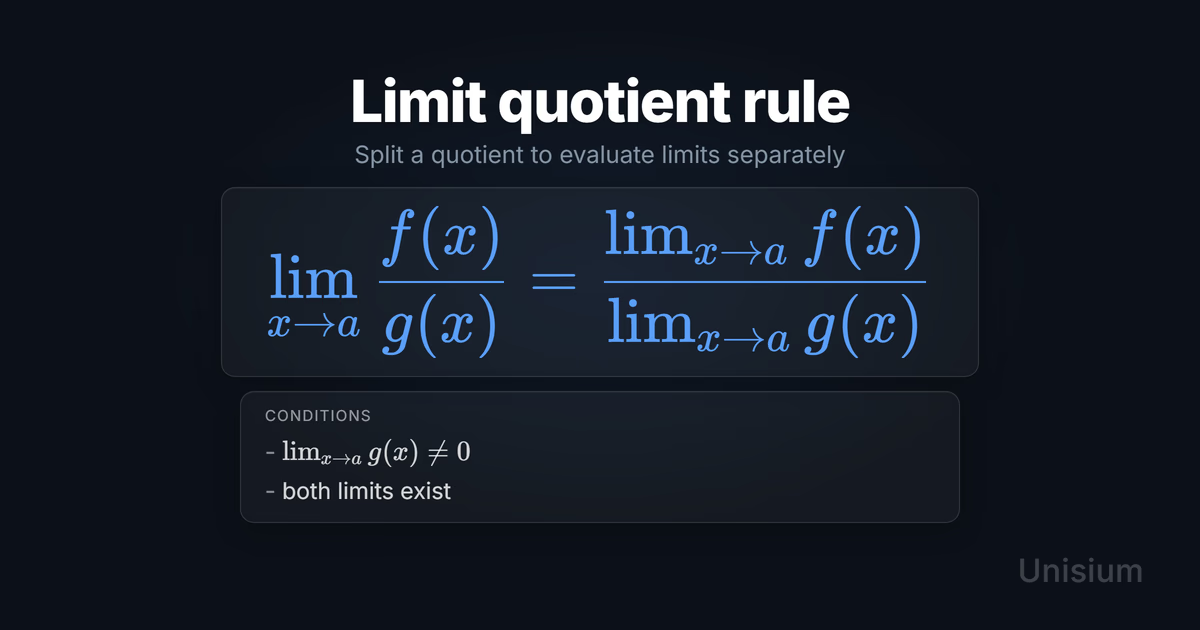
Limit quotient rule: Split a quotient to evaluate limits separately
The limit quotient rule lets you split the limit of a fraction into the quotient of two separate limits — one for the numerator and one for the denominator — provided the denominator limit is nonzero and both limits exist. If the denominator limit is zero, the split is unavailable; applying it mechanically creates a division-by-zero expression, not a valid evaluation step.
On this page: The Principle | Conditions | Failure Modes | EE Questions | Retrieval Practice | Practice Ground | Solve a Problem | FAQ
The Principle
The move: Separate the limit of a quotient into the quotient of the two individual limits.
The invariant: This produces an equivalent limit expression with the same value — provided the denominator limit is nonzero and both limits exist.
Pattern:
| Legal ✓ | Illegal ✗ |
|---|---|
| ; denominator limit → splits to | — denominator limit , rule not applicable |
The left column applies the rule correctly: the denominator limit is , so the condition holds. The right column attempts to split when the denominator limit is zero — the condition is not satisfied, so the split is not available even though the expression has the right form.
Conditions of Applicability
Condition: ; both limits exist
Before applying, check: evaluate first — if it equals zero, the quotient rule does not apply.
If the condition is violated: the split form produces , which is undefined; applying the rule mechanically creates a division-by-zero error, not a resolvable indeterminate form.
- The rule requires that both and exist, and that the denominator limit is nonzero.
- When the denominator limit is zero, this rule is unavailable; you may need factoring and cancellation, rationalization, or — in some or cases — L’Hôpital’s rule.
Want the complete framework behind this guide? Read Masterful Learning.
Common Failure Modes
Failure mode: apply the quotient rule when → the split form becomes , which is undefined; treating the result as a number yields an incorrect answer or hides a division-by-zero error.
Debug: before writing the split, evaluate — if that limit is zero, the quotient rule does not apply. For rational functions, this reduces to checking .
Failure mode: assume “the quotient rule always applies to rational functions” → misses every point of approach where the denominator has a root, which are exactly the cases where the condition fails.
Debug: for a rational function , confirm before splitting; if , factor and cancel first.
Elaborative Encoding
Use these questions to build deep understanding. (See Elaborative Encoding for the full method.)
Within the Principle
- Why does the condition require rather than ? What distinction does this highlight between a function’s value at a point and its limit at that point?
- What does “both limits exist” add beyond the denominator condition — can you construct a case where the denominator limit is nonzero but one of the individual limits does not exist?
For the Principle
- Describe a two-step check you can always run before applying the limit quotient rule to a rational function.
- When a limit of the form is not accessible via the quotient rule, what alternatives exist, and how do you decide which to try first?
Between Principles
- The limit product rule and the limit quotient rule both decompose a compound limit into simpler ones. What extra condition does the quotient rule carry that the product rule does not, and why does that asymmetry exist?
Generate an Example
- Construct a limit of a quotient where the quotient rule fails, and write out the correct evaluation chain that avoids the failed rule.
Retrieval Practice
Answer from memory, then click to reveal and check. (See Retrieval Practice for the full method.)
State the move in one sentence: _____Separate the limit of a quotient into the quotient of the two individual limits, provided the denominator limit is nonzero and both limits exist.
Write the canonical equation: _____
State the canonical condition: _____
Practice Ground
Use these exercises to build move-selection fluency. (See Self-Explanation for how to use worked examples effectively.)
Procedure Walkthrough
Starting from , reach a single numeric value.
| Step | Expression | Operation |
|---|---|---|
| 0 | — | |
| 1 | Quotient rule — verified: | |
| 2 | Sum and constant-multiple rules in each part | |
| 3 | Evaluate each basic limit by substitution | |
| 4 | Arithmetic |
Drills
Action label (Format B)
What was done between these two steps? Verify whether the move is valid. Assume both individual limits exist.
Reveal
Limit quotient rule applied. Condition check: . The condition holds — the move is valid.
Completing the evaluation: .
What was done between these two steps? Is the move valid? Assume the numerator and denominator limits exist.
Reveal
Invalid — the condition fails. , so the limit quotient rule does not apply. The split produces , which is undefined as a fraction — not an indeterminate form the rule can handle.
Correct approach: factor first. for , so the limit is .
What was done between these two steps? Verify whether the move is valid. Assume both individual limits exist.
Reveal
Limit quotient rule applied. Condition check: . The condition holds — the move is valid.
Completing the evaluation: .
Which of these two limits can be split using the limit quotient rule? Assume exists.
(i)
(ii)
Reveal
(i) only. Condition check for (i): . The rule applies.
Condition check for (ii): . The condition fails — the rule does not apply to (ii). This is a near-miss: the expression has the right form (a quotient limit), but the denominator limit is zero.
Forward step (Format A)
Apply the limit quotient rule once. State the condition check explicitly.
Reveal
Condition check: . ✓
Apply the limit quotient rule once. State the condition check explicitly.
Reveal
Condition check: . ✓
Apply the limit quotient rule once. State the condition check explicitly.
Reveal
Condition check: . ✓
Can you apply the limit quotient rule to the expression below? State the condition check and explain your decision.
Reveal
Condition check: . The condition fails. The quotient rule does not apply.
This is a near-miss: the expression is a quotient and both numerator and denominator approach zero as , making it look like a candidate for splitting. It is not — the denominator limit is zero.
Correct evaluation: factor and cancel. for , so .
Transition identification (Format C)
In the evaluation chain below, identify which step applies the limit quotient rule. Verify the condition at that step.
Reveal
Step (1) applies the limit quotient rule. Condition check: . ✓
Step (2) evaluates both limits by direct substitution. Step (3) simplifies the arithmetic.
Solve a Problem
Apply what you’ve learned with Problem Solving.
Problem: Evaluate , applying the limit quotient rule as the first step. Show the condition check before splitting.
Full solution
| Step | Expression | Move |
|---|---|---|
| 0 | — | |
| 1 | Quotient rule — condition: ✓ | |
| 2 | Constant-multiple and sum rules in numerator | |
| 3 | Evaluate each basic limit by substitution | |
| 4 | Arithmetic |
Related Principles
| Principle | Relationship |
|---|---|
| Limit statement | Prerequisite: quotient-rule work still starts from a limit claim at that needs to be evaluated safely |
| Limit product rule | Same decomposition idea for multiplication; carries no denominator-nonzero condition |
| Limit sum rule | Separates a sum into individual limits; requires only that both limits exist |
| Continuity at a Point | Downstream check: once a quotient limit is evaluated and the denominator limit stays nonzero, continuity questions often reduce to comparing that limit with the function value |
| L’Hôpital’s rule | Possible alternative for and cases — does not cover all quotient-rule failures |
FAQ
What is the limit quotient rule?
The limit quotient rule states that , provided and both individual limits exist. It converts a single limit of a fraction into the ratio of two simpler limits.
When is the limit quotient rule valid?
Two conditions must both hold: (1) both and exist, and (2) . If either condition fails, the rule is not available.
What goes wrong if I apply the quotient rule when the denominator limit is zero?
The split form becomes , which is undefined. This is not a resolvable indeterminate form — it is a division-by-zero error. The correct move is to apply a different technique (factoring, rationalization, or L’Hôpital’s rule) before attempting any limit algebra.
How is the limit quotient rule different from the limit product rule?
Both rules decompose a compound limit into simpler ones. The product rule requires only that both limits exist. The quotient rule carries the additional condition that the denominator limit is nonzero — because a limit of zero in the denominator creates a division-by-zero issue that cannot be resolved by separation alone.
Does the limit quotient rule apply at every point of a rational function?
No. For a rational function , the rule applies at if and only if . At the roots of , the denominator limit is zero, the condition fails, and other techniques are required.
How This Fits in Unisium
Within the calculus subdomain, calculus fluency is built through condition-first drilling: before reaching for the quotient rule on a limit statement, you confirm the denominator limit is nonzero. That check becomes automatic through spaced repetition and the retrieval practice drills above — you internalize not just the rule pattern but the guard that makes it safe to apply. The drill formats here (action labeling, forward steps, near-miss identification) match the exact move-selection training that distinguishes fluent calculus from mechanical pattern matching.
Explore further:
- Calculus Subdomain Map — Return to the calculus hub to see where quotient limits sit relative to the rest of the algebraic rule family
- Limit statement — The prerequisite claim the quotient rule is trying to evaluate at a specific approach point
- Limit Product Rule — The closest sibling rule when multiplicative structure has no denominator guard
- Continuity at a Point — A common downstream check once a rational limit is evaluated and compared with the actual function value
- Elaborative Encoding — Deepen your understanding of why the denominator condition matters
- Retrieval Practice — Build instant recall for the condition and equation pattern
- Self-Explanation — Use the worked examples above as structured explanation targets
Ready to master the limit quotient rule? See Unisium’s 14-day free trial or explore the full learning framework in Masterful Learning.

Masterful Learning
The book behind these guides: a study system for physics, math, & programming built on retrieval, connection, explanation, and problem solving.
Ready to apply this strategy?
Unisium turns these evidence-based techniques into guided study sessions for math and physics. Places are limited during early access. Check current availability to start a trial; joining the mailing list is optional.
See plans and availability Read More GuidesAlready have access? Sign in