Squeeze theorem: Evaluating limits by bounding
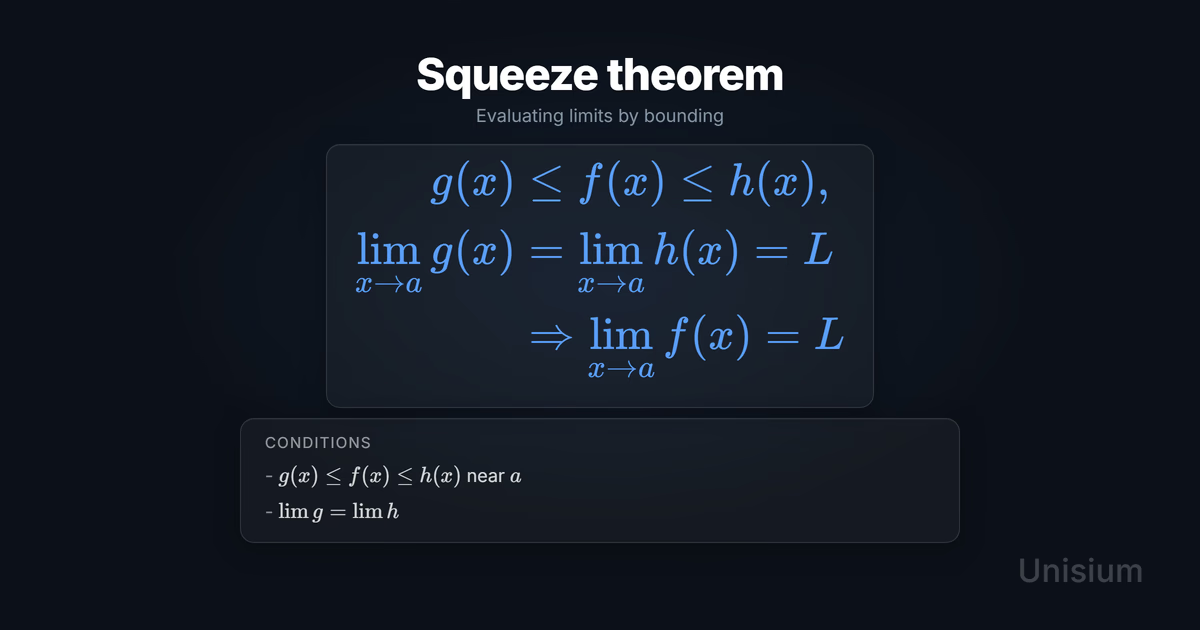
The squeeze theorem lets you evaluate the limit of a function by sandwiching it between two bounding functions and that both converge to the same limit at the point of interest. When both outer limits agree at , is forced to converge there too. Recognizing when to set up bounds and verifying that both outer limits match is the core fluency skill trained by the Unisium Study System.
On this page: The Principle | Conditions | Failure Modes | EE Questions | Retrieval Practice | Practice Ground | Solve a Problem | FAQ
The Principle
The move: Infer the limit of by bounding it between two functions and — both with the same limit — and letting the bounds force to converge.
The invariant: This preserves the limiting value forced by the bounds: once is trapped between two functions both approaching , the only compatible limit for is .
Pattern:
| Legal ✓ | Illegal ✗ |
|---|---|
| near ; — bounds agree, squeeze applies | near ; — bounds disagree, condition fails |
The right column shows the applicability condition failing: the bounding functions converge to different values, so there is no single limit they force toward.
Conditions of Applicability
Condition: ;
Before applying, check: evaluate and independently — they must equal the same value .
- Both bounding inequalities must hold on a full punctured neighborhood of — near from both sides, except possibly at itself. One-sided bounds support only a one-sided limit conclusion.
- If , the theorem does not apply — even tight, valid bounding inequalities cannot produce a limit conclusion when the outer limits disagree.
Want the complete framework behind this guide? Read Masterful Learning.
Common Failure Modes
Failure mode: claim the squeeze applies when → no single value is forced on ; the conclusion is unwarranted.
Debug: before writing the conclusion, verify and are equal — compute both separately and confirm they match.
Elaborative Encoding
Use these questions to build deep understanding. (See Elaborative Encoding for the full method.)
Within the Principle
- Why must both bounding functions converge to the same value ? What exactly prevents from settling at a different limit when the two outer limits agree?
- Can the bounding inequality fail at the point itself and still allow the theorem to apply? Why or why not?
For the Principle
- How do you decide which bounding strategy to use for a given expression? Compare the strategy for with the strategy for near .
- If the bounds only hold for , what can you conclude? What additional work is needed to obtain a two-sided limit statement?
Between Principles
- How does the squeeze theorem complement the limit sum rule and limit product rule? In what situations do algebraic limit rules fail and the squeeze theorem becomes the right tool?
Generate an Example
- Construct a limit where the bounding inequality holds near but . Write out exactly why the squeeze theorem cannot be used, and state what an incorrect application would (wrongly) claim.
Retrieval Practice
Answer from memory, then click to reveal and check. (See Retrieval Practice for the full method.)
State the squeeze theorem in one sentence: _____If g(x) ≤ f(x) ≤ h(x) near a and the limits of g and h at a both equal L, then the limit of f(x) at a also equals L.
Write the canonical pattern: _____
State the canonical condition: _____
Practice Ground
Use these exercises to build move-selection fluency. (See Self-Explanation for how to use worked examples effectively.)
Procedure Walkthrough
Starting from , reach a single numeric value.
| Step | Expression | Operation |
|---|---|---|
| 0 | — | |
| 1 | for | ; multiply through by |
| 2 | Both bounding functions are polynomials; evaluate by substitution | |
| 3 | Squeeze theorem: is sandwiched between two functions sharing limit |
Drills
Action label (Format B)
What rule licenses this conclusion? Name it and state why the condition is satisfied.
for , and , therefore .
Reveal
Squeeze theorem. The function is sandwiched between and . Since everywhere, the lower bound and upper bound are both valid for . Condition check: . ✓
What was done between these two intermediate steps? Name the rule and verify the condition.
Reveal
Squeeze theorem applied. The bounds are valid (since means ) and both converge to the same limit . Condition: . ✓
Is the squeeze theorem applicable here? Explain your decision.
for all near . Given: and .
Reveal
No — the condition fails. The lower bound approaches while the upper bound approaches . The squeeze theorem requires ; here , so the theorem does not apply. Even though is bounded, no conclusion about follows from these bounds. This is a near-miss: the bounding inequality holds, but the shared-limit condition is violated.
Forward step (Format A)
Apply the squeeze theorem to evaluate the limit. Set up your bounds first.
Reveal
Use for : this gives , so .
. Both bounds share limit . ✓
By the squeeze theorem: .
Apply the squeeze theorem to evaluate the limit.
Reveal
Bound using . Divide by (inequality direction preserved):
. Both share limit . ✓
By the squeeze theorem: .
A student claims the squeeze theorem proves . Is the claim valid?
Proposed bounds: for . No information is given about for .
Reveal
Invalid for the two-sided limit. The bounds only hold for , not on a full punctured neighborhood of . The squeeze theorem operates on a full neighborhood (both sides unless a one-sided limit is the goal). With only one-sided bounds, the correct conclusion is the right-hand limit: . To claim , matching bounds for are also required.
Apply the squeeze theorem to evaluate the limit.
Reveal
Use for : since , this gives .
. Both share limit . ✓
By the squeeze theorem: .
Apply the squeeze theorem to evaluate the limit.
Reveal
Bound using . Divide by :
. Both share limit . ✓
By the squeeze theorem: .
Transition identification (Format C)
In the evaluation chain below, which step applies the squeeze theorem? State how you recognize it.
To evaluate , the following steps are taken:
(A) Use to write for .
(B) Compute and .
(C) Conclude .
Reveal
Step (C) applies the squeeze theorem. That is the step that draws the limit conclusion from established bounds. Steps (A) and (B) provide the two prerequisites — the bounding inequality and the matching outer limits. The squeeze theorem is the rule that combines those two pieces into the final conclusion.
Which of the following setups satisfies all conditions for the squeeze theorem? Assume and is defined for all near .
(i) for all near ;
(ii) for all near ;
(iii) for only; no bound given for
(iv) for all near ; ,
Reveal
(i) and (ii) satisfy all conditions. Both have valid bounding inequalities holding near from both sides, and both pairs of bounding functions share the same limit (). The squeeze theorem gives in each case.
(iii) fails because the bounds only hold one-sided (). The squeeze theorem requires a full punctured neighborhood. Only can be concluded.
(iv) fails because . The outer limits disagree, violating the shared-limit condition — the most common near-miss when using this theorem.
Solve a Problem
Apply what you’ve learned with Problem Solving.
Problem: Evaluate using the squeeze theorem. Set up appropriate bounds, verify that both outer limits agree, and state the conclusion.
Full solution
| Step | Expression | Move |
|---|---|---|
| 0 | — | |
| 1 | Bound cosine using its range | |
| 2 | for | Divide through by ; direction preserved |
| 3 | Both bounds are rational with vanishing numerator; evaluate by limit at infinity | |
| 4 | Squeeze theorem: is bounded between two functions both converging to |
Related Principles
| Principle | Relationship |
|---|---|
| Limit statement | The target claim that squeeze ultimately establishes: bounding is one route to proving that a two-sided limit statement is true |
| Limit sum rule | Algebraic decomposition for sums; only works when individual limits exist — squeeze fills the gap when a factor oscillates without a standalone limit |
| Limit product rule | Decomposes a product limit; also requires each factor to have a finite limit — squeeze handles the case where one factor has no limit on its own |
| L’Hôpital’s rule | Different technique for and indeterminate forms; complementary tool, not a substitute for bounding |
FAQ
What is the squeeze theorem?
The squeeze theorem (also called the sandwich theorem or pinching theorem) states that if is bounded between and near a point , and both and approach the same limit , then must also approach . It is a standard tool for evaluating many oscillatory limits — such as — where direct substitution and algebraic decomposition rules do not apply.
When does the squeeze theorem apply?
Two conditions must hold simultaneously: (1) the inequality must hold on a punctured neighborhood of — near from both sides, except possibly at itself; and (2) both and must equal the same value .
What happens if the bounding functions have different limits?
If , the squeeze theorem is not applicable. The bounds do not force to converge to any particular value, even if the bounding inequality itself holds. The shared-limit condition is not optional — it is what makes the squeeze argument work.
How do I find the right bounds?
The most common strategy uses and for all . When or , bound the oscillating factor between and , then multiply through by (or if can be negative near ). Both resulting bounds will share the same limit whenever as .
How is the squeeze theorem different from L’Hôpital’s rule?
L’Hôpital’s rule handles indeterminate quotient forms (, ) by differentiating numerator and denominator. The squeeze theorem handles limits where is hard to differentiate or has no quotient structure, by bounding it between simpler functions. For , the squeeze theorem is the natural tool; L’Hôpital’s rule is not directly applicable since the function does not form a differentiable quotient at .
Does the squeeze theorem work for one-sided limits?
Yes. If the bounding inequality holds only for (or only for ), you can conclude the corresponding one-sided limit. For the full two-sided limit , the bounding inequality must hold on a full punctured neighborhood of .
How This Fits in Unisium
In Unisium, calculus fluency means knowing when to reach for a technique — not just executing it once chosen. The squeeze theorem trains a specific diagnostic habit: when direct substitution fails and algebraic decomposition rules are unavailable, ask whether can be bounded. Through retrieval practice and the drill formats above, you build automatic recognition of the bounding setup and the two-condition check, so the theorem becomes a tool you deploy confidently rather than vaguely recall.
Explore further:
- Calculus Subdomain Map — Return to the calculus hub to see where squeeze sits inside the broader limits cluster
- Limit statement — The theorem’s job is to justify a limit statement when direct substitution and basic algebra are not enough
- Elaborative Encoding — Build deep understanding of why the shared-limit condition is necessary
- Retrieval Practice — Make the condition and bounding pattern instantly accessible
- Self-Explanation — Use the worked example above to practice explaining each bounding step out loud
Ready to master the squeeze theorem? See Unisium’s 14-day free trial or explore the full learning framework in Masterful Learning.
Masterful Learning
The book behind these guides: a study system for physics, math, & programming built on retrieval, connection, explanation, and problem solving.
Ready to apply this strategy?
Unisium turns these evidence-based techniques into guided study sessions for math and physics. Places are limited during early access. Check current availability to start a trial; joining the mailing list is optional.
See plans and availability Read More GuidesAlready have access? Sign in