Indefinite Integral as Antiderivative: Finding Every F with F' = f
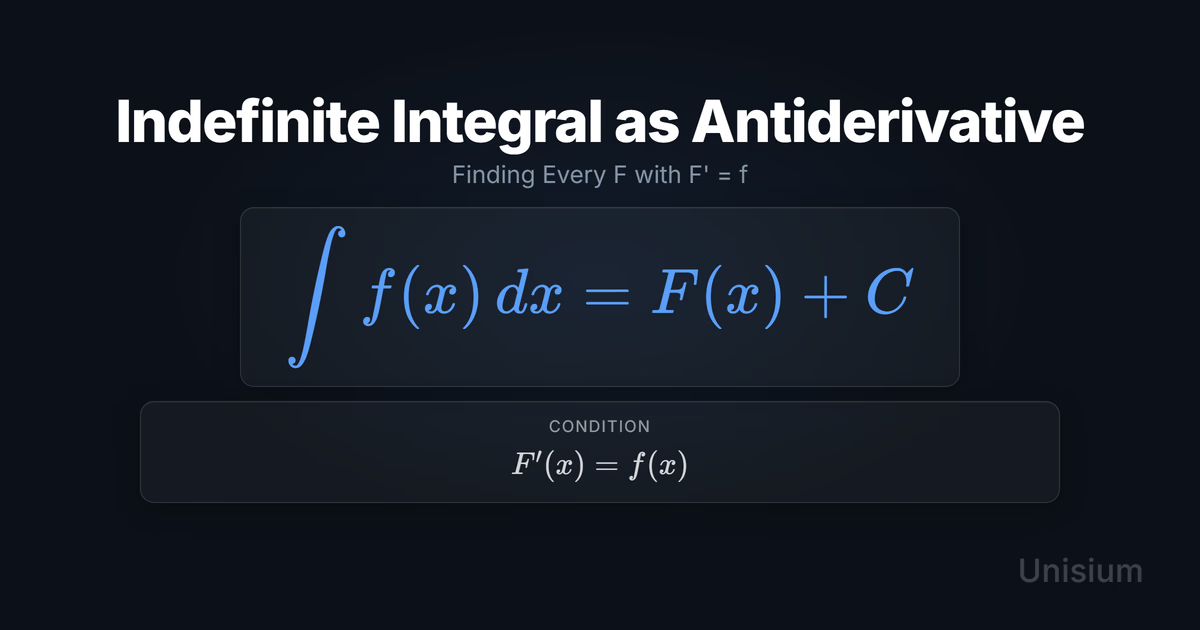
The indefinite integral as antiderivative states that means: find every function whose derivative equals . The condition defines as an antiderivative of , and represents the complete family—since any two antiderivatives of the same function differ only by a constant. This equation is the entry point to integral calculus and the concept underlying the Fundamental Theorem.
On this page: The Principle | Conditions | Misconceptions | EE Questions | Retrieval Practice | Worked Example | Solve a Problem | FAQ
The Principle
Statement
The indefinite integral collects all antiderivatives of : every function whose derivative equals on an interval. Writing names one specific antiderivative and acknowledges that every other antiderivative differs from only by a constant . The result is not a number but a family of functions, where parameterizes every member of that family.
Mathematical Form
Where:
- = the integrand — the function to be antidifferentiated
- = the variable of integration
- = confirms is the independent variable; the result must be differentiated with respect to to verify
- = any one antiderivative of : a function satisfying on the interval
- = an arbitrary constant representing every vertical shift of that also satisfies
Alternative Forms
The same relation appears in two verification-oriented forms:
- Verification form: — differentiate any proposed antiderivative and check that the original integrand is recovered
- Antiderivative condition: — the defining equation that must satisfy; holds on every connected interval where is defined
Conditions of Applicability
Condition:
Practical modeling notes
- The condition must hold for all in a connected interval where is defined, not just at isolated points. A function satisfying at a single point is not thereby an antiderivative.
- On a disconnected domain (for instance, ), the constant can take different values on each connected piece; the “general antiderivative” on the full domain is on one piece and on the other.
- The marker in the notation carries information: and both denote an antiderivative of , but the output is written as a function of and respectively.
Practical caveats
- No elementary closed form: Every continuous function on an interval has an antiderivative, but that antiderivative may not be expressible using elementary functions. is the standard example: exists and satisfies on any interval, but no elementary formula for exists. The principle applies; only the notation cannot be completed in closed form.
- Disconnected domain: If is defined on a disconnected domain, the antiderivative is not fully captured by a single constant . Each connected piece can carry its own constant, independently. This is a refinement of the principle’s range of application, not a failure.
- Variable mismatch: assumes the entire integrand is expressed in the variable . If a substitution is needed first, the principle applies to the transformed integrand once the variable is consistent throughout.
Want the complete framework behind this guide? Read Masterful Learning.
Common Misconceptions
Misconception 1: ” is just a formality that can be omitted”
The truth: is structurally meaningful. Omitting it specifies a single antiderivative, not the general one. The complete answer to is the family , not the particular function .
Why this matters: In initial-value problems you must solve for using the given condition. Dropping makes that step impossible and produces the wrong particular solution.
Misconception 2: “The indefinite integral is a number”
The truth: The indefinite integral is a family of functions. The definite integral evaluates to a number (net signed area). They are distinct objects connected by the Fundamental Theorem: .
Why this matters: Confusing the two leads to errors when applying the Fundamental Theorem and to misuse of evaluation notation.
Misconception 3: ” is uniquely determined once is known”
The truth: Infinitely many antiderivatives of exist on a connected interval; they form a one-parameter family parameterized by . Any two antiderivatives of on a connected interval differ by a constant.
Why this matters: Treating as unique causes students to check only one candidate and overlook that all others are equally valid—an issue that surfaces when comparing answers written in different-looking but equivalent forms.
Elaborative Encoding
Use these questions to build deep understanding. (See Elaborative Encoding for the full method.)
Within the Principle
- In , what role does play? How does it specify which variable should be differentiated with respect to when verifying the result?
- If satisfies , then so does . Why does the equation encode both functions rather than listing them separately?
For the Principle
- Given a proposed antiderivative , what operation and what check would you use to decide whether belongs to the family ?
- If is defined on a disconnected domain, what changes about the meaning of the constant in the general antiderivative? Why is it no longer a single constant?
Between Principles
- The antiderivative definition says defines one antiderivative . The indefinite integral says . What does the add beyond the definition, and why is it absent from the bare antiderivative definition?
Generate an Example
- Describe a function whose antiderivative cannot be written in closed form. What does that tell you about the existence of , and how would you approach numerically in that case?
Retrieval Practice
Answer from memory, then click to reveal and check. (See Retrieval Practice for the full method.)
State the principle in words: _____The indefinite integral of f equals F(x) + C, where F is any antiderivative of f — a function satisfying F'(x) = f(x).
Write the canonical equation: _____
State the canonical condition: _____
Worked Example
Use this worked example to practice Self-Explanation.
Problem
Find .
Step 1: Verbal Decoding
Target:
Given:
Constraints: ; polynomial integrand; domain
Step 2: Visual Decoding
Sketch — a parabola opening upward, with value at the origin and growing steeply for large . On a separate axis, sketch a family of smooth curves that all share the same slope pattern as the parabola: they rise where the parabola is positive and rise more steeply as moves away from zero. Label the slope at a sample input to make the shared slope pattern visible. (Any two curves in this family are vertical shifts of each other; that geometric fact is what the encodes.)
Step 3: Mathematical Modeling
Step 4: Mathematical Procedures
Step 5: Reflection
- Verification: Differentiate : ✓
- Connection to concept: Recognizing reverses the power rule; the confirms this is the full family, not just one member.
- Domain check: is defined on all of ; the antiderivative exists on the same domain.
Before moving on: self-explain the model
Try explaining Step 3 out loud (or in writing): why the indefinite integral as antiderivative is the right model here, what the equation is asserting about , and why Step 4 begins by computing rather than performing algebraic manipulation.
Mathematical model with explanation
Principle: Indefinite Integral as Antiderivative — where .
Conditions: is a polynomial defined everywhere; antiderivatives exist on all of .
Relevance: The problem asks for the family of all antiderivatives of . The principle encodes exactly that question — find with , then append .
Description: A candidate must satisfy . By the power rule, , so is one solution. Appending gives all solutions on .
Goal: Identify a single antiderivative by recognizing its derivative, then write to represent the complete family.
Solve a Problem
Apply what you’ve learned with Problem Solving.
Problem
Determine .
Hint (if needed): Think about which standard function has derivative equal to .
Show Solution
Step 1: Verbal Decoding
Target:
Given:
Constraints: ; trigonometric integrand; domain
Step 2: Visual Decoding
Sketch over one full period . On a second axis, sketch a smooth curve that is increasing where , decreasing where , and has horizontal tangents at and . Label the slope of this candidate antiderivative at one or two sample inputs to confirm it matches the value of at those points. (The target antiderivative’s graph rises and falls in lockstep with the sign of the integrand.)
Step 3: Mathematical Modeling
Step 4: Mathematical Procedures
Step 5: Reflection
- Verification: ✓
- Graphical meaning: has slope at every point; the antiderivative rises and falls in exact step with the integrand’s sign.
- Connection to concept: Recognizing is the key antiderivative identification; the principle then supplies to complete the family.
Related Principles
| Principle | Relationship to Indefinite Integral as Antiderivative |
|---|---|
| Antiderivative definition () | Prerequisite — the indefinite integral notation is the antiderivative definition extended to the full family by appending |
| Fundamental Theorem of Calculus (Part 2) | Applies the antiderivative to evaluate definite integrals: ; the indefinite integral supplies |
| Power rule for integration | A first antiderivative rule for powers of : integrate by raising the exponent, dividing by the new exponent, and checking |
| Power rule for derivatives () | Reversed in practice — knowing lets you identify for polynomial integrands by inspection |
See Principle Structures for how these relationships fit hierarchically.
FAQ
What is the indefinite integral as antiderivative?
The indefinite integral states that integrating produces the family of all antiderivatives of —all functions satisfying on an interval, parameterized by the arbitrary constant .
Why does the indefinite integral include ?
If , then for any constant , because constants differentiate to zero. The represents every such vertical shift, making the result the complete antiderivative family rather than just one member.
What is the condition for this principle?
The condition is : must be a function whose derivative equals on the interval. The notation is valid precisely when this equation holds.
How do I verify an antiderivative?
Differentiate your proposed result and confirm that . The constant vanishes on differentiation; the remaining expression must reproduce the original integrand exactly.
What is the difference between an indefinite integral and a definite integral?
The indefinite integral is a family of functions. The definite integral is a number (net signed area from to ). They are connected by the Fundamental Theorem: .
Can every continuous function be antidifferentiated in closed form?
No. Every continuous function on an interval has an antiderivative, but that antiderivative may not be expressible using elementary functions. For example, has no elementary antiderivative; the notation is well-defined conceptually but cannot be written in closed form.
Related Guides
- Principle Structures — See how the indefinite integral as antiderivative fits in the hierarchy of calculus principles
- Self-Explanation — Practice explaining each antiderivative identification step as you work through problems
- Retrieval Practice — Build fluency with antiderivative recognition through frequent low-stakes recall
- Problem Solving — Apply the Five-Step Strategy to integration problems systematically
How This Fits in Unisium
Unisium structures the indefinite integral as antiderivative as a representational principle: the equation is the definition you model, and differentiating to verify is the confirming procedure. The platform surfaces this principle in elaborative encoding exercises—asking what represents on a disconnected domain, or why the indefinite and definite integrals are distinct objects—as well as in retrieval prompts and structured problem sets. Mastering this principle now makes every subsequent integration technique (substitution, integration by parts, partial fractions) interpretable as a method for identifying , not just a sequence of symbol manipulations.
Ready to master the indefinite integral as antiderivative? See Unisium’s 14-day free trial or explore the full learning framework in Masterful Learning.

Masterful Learning
The book behind these guides: a study system for physics, math, & programming built on retrieval, connection, explanation, and problem solving.
Ready to apply this strategy?
Unisium turns these evidence-based techniques into guided study sessions for math and physics. Places are limited during early access. Check current availability to start a trial; joining the mailing list is optional.
See plans and availability Read More GuidesAlready have access? Sign in