Definite integral (Riemann sum form): Area as a Limit of Sums
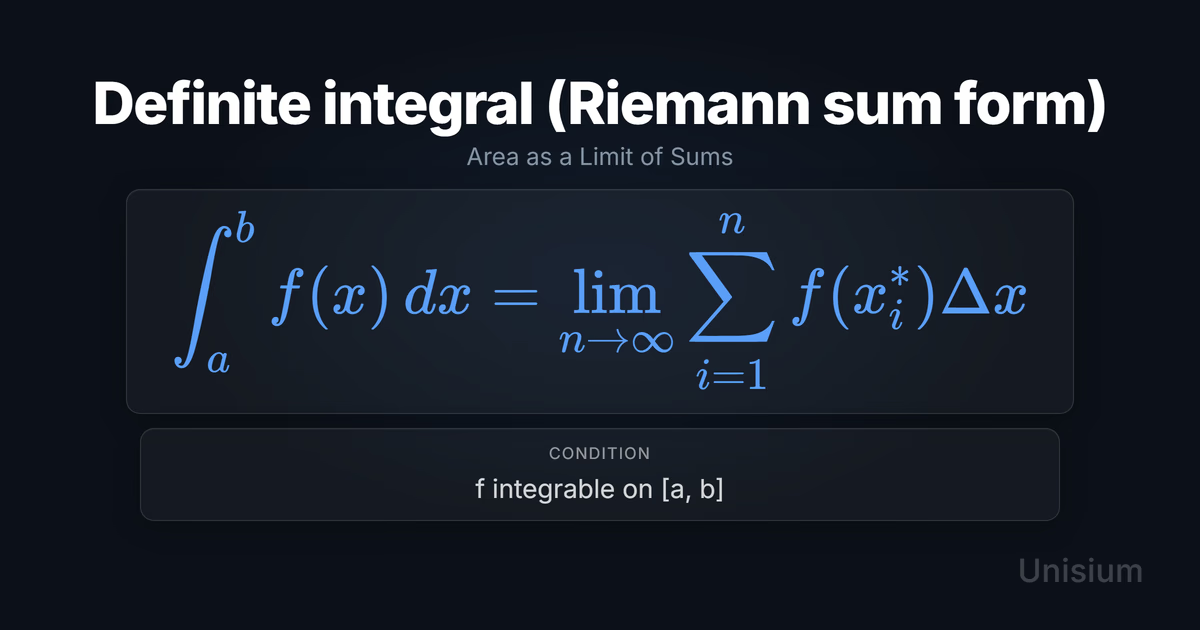
The definite integral (Riemann sum form) defines as the limit of a Riemann sum: partition into equal subintervals, form the sum of rectangle areas, and let . The condition is that is integrable on , which holds for all continuous functions and most piecewise-continuous ones. When the limit equals the geometric area under the curve; in general it is a signed accumulation, and the Fundamental Theorem evaluates it exactly using antidifferentiation.
On this page: The Principle | Conditions | Misconceptions | EE Questions | Retrieval Practice | Worked Example | Solve a Problem | FAQ
The Principle
Statement
The definite integral is defined as the limit of a Riemann sum. The interval is partitioned into equal subintervals of width ; within each subinterval a sample point is chosen and the product gives the signed contribution of one thin rectangle. Adding all rectangles yields a Riemann sum , and the definite integral is the limit of that sum as . When on this limit equals the geometric area between the graph and the -axis; in general it is a signed accumulation.
Mathematical Form
Where:
- , = lower and upper limits of integration (); define the interval of integration
- = the integrand; the function evaluated at sample points across
- = the variable of integration
- = the infinitesimal width element; corresponds to in the limit
- = number of equal subintervals in the partition
- = width of each subinterval
- = any sample point in the -th subinterval; when is integrable the limit does not depend on the specific rule used to choose
- = the Riemann sum; the finite approximation that converges to the integral
Alternative Forms
The most common explicit convention for computation uses right endpoints:
- Right-endpoint sum: — substitutes ; the most frequent form in explicit limit derivations
Conditions of Applicability
Condition: f integrable on [a, b]
Practical modeling notes
- The condition is satisfied by every function continuous on . It is also satisfied by bounded functions with finitely many jump discontinuities (piecewise-continuous functions), provided they remain bounded throughout the interval.
- “Integrable” means the limit of the Riemann sum exists and is the same regardless of how sample points are chosen within each subinterval. If is unbounded or discontinuous too frequently, the limit may fail to exist and the Riemann definition does not apply.
- The equal-width partition is the most convenient choice for explicit limit computations. For non-equal partitions, the analogous condition is that the maximum subinterval width must approach ; the integral value is the same whenever integrability holds.
When It Doesn’t Apply
- Unbounded integrand: If blows up at a point in — for example, near — the Riemann sum diverges. Use an improper integral to handle such cases.
- Too many discontinuities: A function with infinitely many oscillations on may not be Riemann-integrable; the limit of the Riemann sums may fail to exist.
Want the complete framework behind this guide? Read Masterful Learning.
Common Misconceptions
Misconception 1: “The definite integral always gives a positive area”
The truth: The definite integral gives signed area. When lies entirely below the -axis on , the integral is negative. When positive and negative contributions cancel, the integral can be zero even though is nonzero.
Why this matters: Setting up area, net-displacement, or net-flow integrals incorrectly by assuming positivity leads to sign errors. Recognizing the signed character determines whether to split the interval at zero-crossings to compute geometric area.
Misconception 2: “A Riemann sum and the definite integral are the same thing”
The truth: A Riemann sum is a finite approximation that depends on and the sample-point choice. The definite integral is the limit of that sequence as . They agree only in that limit.
Why this matters: Treating a finite Riemann sum as exact introduces numerical error. The value of the definition is precisely that the limit eliminates the approximation, converting a discrete process into an exact value.
Misconception 3: “The choice of sample points changes the integral”
The truth: When is integrable, all valid sample-point choices — left endpoints, right endpoints, midpoints, or any point within each subinterval — produce the same limit. The flexibility is built into the definition.
Why this matters: Students who always use right endpoints may assume the integral changes with the rule, and then hesitate to choose the most algebraically convenient option when evaluating limits explicitly.
Elaborative Encoding
Use these questions to build deep understanding. (See Elaborative Encoding for the full method.)
Within the Principle
- In , what role does play geometrically, and why does it appear in every term of the sum?
- If for some sample point, what sign does the term contribute to the Riemann sum, and how does that appear in the final value of ?
For the Principle
- How would you recognize that a quantity accumulating continuously over should be modeled as rather than as a simple product of rate and time?
- A student argues: “I will always use right endpoints because they are easiest.” Is that mathematically valid for computing ? What condition on is required for the choice of sample points not to matter?
Between Principles
- The limit statement involves a single input approaching a fixed value. How is the limit in structurally different — what is converging, and to what?
Generate an Example
- Describe a physical quantity — such as displacement, mass, or charge — that can be expressed as for some specific , , and . State what , , and represent in your context, and explain why letting recovers the exact value.
Retrieval Practice
Answer from memory, then click to reveal and check. (See Retrieval Practice for the full method.)
State the principle in words: _____The definite integral of f from a to b is the limit of a Riemann sum as the number of subintervals grows without bound; when f is nonnegative this limit equals the area under the curve.
Write the canonical equation: _____
State the canonical condition: _____f integrable on [a, b]
Worked Example
Use this worked example to practice Self-Explanation.
Problem
Evaluate directly from the Riemann sum definition, using right-endpoint sample points.
Step 1: Verbal Decoding
Target:
Given: , ,
Constraints: polynomial integrand on a closed bounded interval; equal-width partition; right-endpoint sample points
Step 2: Visual Decoding
Sketch on : a line through the origin rising to . Divide into equal subintervals of width . At the right endpoint of subinterval , draw a rectangle of height . (The staircase of rectangles covers the triangular region under the line; the fit tightens as grows.)
Step 3: Mathematical Modeling
Step 4: Mathematical Procedures
Step 5: Reflection
- Verification: The region under on is a right triangle with base and height ; area ✓
- Limiting behavior: As , the error term ; the staircase of rectangles converges to the exact triangular region.
- Interpretation: on , so every rectangle contributes positively and the integral equals the geometric area.
Before moving on: self-explain the model
Try explaining Step 3 out loud (or in writing): why the Riemann sum definition is the right model here, what and represent geometrically, and why taking the limit converts the finite approximation into an exact value.
Mathematical model with explanation
Principle: Definite Integral (Riemann Sum Form) — .
Conditions: is continuous (hence integrable) on .
Relevance: The problem asks for the exact signed area under by applying the definition directly. The Riemann sum form is the definition, so using it here is not a shortcut — it is the foundational computation the principle is designed to support.
Description: With a right-endpoint partition, the -th sample point is and the rectangle height is . Substituting yields , a finite sum that can be evaluated in closed form using .
Goal: Factor constants out of the sum, apply the closed-form identity, simplify the resulting rational expression in , and take the limit as .
Solve a Problem
Apply what you’ve learned with Problem Solving.
Problem
Evaluate directly from the Riemann sum definition, using right-endpoint sample points.
Hint (if needed): The sum of squares formula is .
Show Solution
Step 1: Verbal Decoding
Target:
Given: , ,
Constraints: polynomial integrand on a closed bounded interval; equal-width partition; right-endpoint sample points; sum-of-squares identity provided
Step 2: Visual Decoding
Sketch on : a parabola from to , curving below the diagonal . Partition into equal subintervals of width . The right endpoint of subinterval is , giving rectangle height . (The parabola lies strictly below the diagonal on , so the staircase covers strictly less area than the triangular region.)
Step 3: Mathematical Modeling
Step 4: Mathematical Procedures
Step 5: Reflection
- Verification: The antiderivative of is ; ✓
- Magnitude/plausibility: The parabola lies strictly below on , so ✓
- Limiting behavior: As , the terms in the numerator become negligible; the dominant ratio confirms the result.
Related Principles
| Principle | Relationship to Definite Integral (Riemann Sum Form) |
|---|---|
| Indefinite Integral as Antiderivative | Supplies via ; the Fundamental Theorem then evaluates the Riemann-sum definition as |
| Fundamental Theorem of Calculus (Part 2) | Directly connects this limit-of-sums definition to antidifferentiation, enabling exact evaluation without explicit limit computation |
| Limit Statement | Prerequisite — the definite integral is a specific instance of a limit: the limit of a sequence of Riemann sums indexed by |
See Principle Structures for how these relationships fit hierarchically.
FAQ
What is the definite integral (Riemann sum form)?
The definite integral is defined as : partition , form rectangle areas using sample-point heights, and take the limit as the partition becomes infinitely fine. When this limit equals the geometric area under the curve; in general it is a signed accumulation.
What does “f integrable on [a, b]” mean in practice?
It means the Riemann sum limit exists and is the same regardless of how sample points are chosen within each subinterval. Every function continuous on satisfies this, as does any bounded function with at most finitely many jump discontinuities. Functions that are unbounded or oscillate infinitely may not.
Does the choice of sample points change the value of ?
No — when is integrable, all valid choices (left endpoints, right endpoints, midpoints, or any point within each subinterval) produce the same limit. In textbook derivations the right-endpoint convention is standard because it simplifies the algebra; any choice gives the correct answer.
What is the difference between a Riemann sum and a definite integral?
A Riemann sum is a finite approximation that depends on and the chosen sample points. The definite integral is the exact value obtained by taking . The Riemann sum approximates; the integral is the limit of that approximation.
When does equal the geometric area under the curve?
Only when on all of . If dips below the -axis, the integral is signed: below-axis portions contribute negatively. To compute total geometric area, split the interval at the zeros of and sum the absolute values of each piece.
How is the definite integral related to the indefinite integral?
The definite integral is a number (the signed area from to ). The indefinite integral is a family of functions. The Fundamental Theorem of Calculus connects them: if , then .
Related Guides
- Principle Structures — See where the definite integral (Riemann sum form) fits in the calculus hierarchy
- Indefinite Integral as Antiderivative — The Fundamental Theorem evaluates definite integrals using antiderivatives found here
- Fundamental Theorem of Calculus (Part 2) — The main successor that turns the definite-integral object into endpoint evaluation once an antiderivative is known
- Self-Explanation — Practice explaining why each Riemann sum step is valid as you work through problems
- Problem Solving — Apply the Five-Step Strategy to integration problems systematically
How This Fits in Unisium
Unisium structures the definite integral (Riemann sum form) as a representational principle: the equation is the definition to model, and computing the limit of an explicit Riemann sum is the confirming procedure. Elaborative encoding exercises ask why the signed-area interpretation fails when changes sign, what integrability rules out, and how this definition connects to the Fundamental Theorem. Retrieval prompts and structured problem sets then build the fluency needed so the definition is immediately accessible in exam contexts. Mastering this principle makes every subsequent integration technique — substitution, integration by parts, numerical methods — interpretable as a method for evaluating or approximating the same limit.
Ready to master the definite integral? See Unisium’s 14-day free trial or explore the full framework in Masterful Learning.

Masterful Learning
The book behind these guides: a study system for physics, math, & programming built on retrieval, connection, explanation, and problem solving.
Ready to apply this strategy?
Unisium turns these evidence-based techniques into guided study sessions for math and physics. Places are limited during early access. Check current availability to start a trial; joining the mailing list is optional.
See plans and availability Read More GuidesAlready have access? Sign in