Left-hand limit statement: f(x) Approaching L from the Left
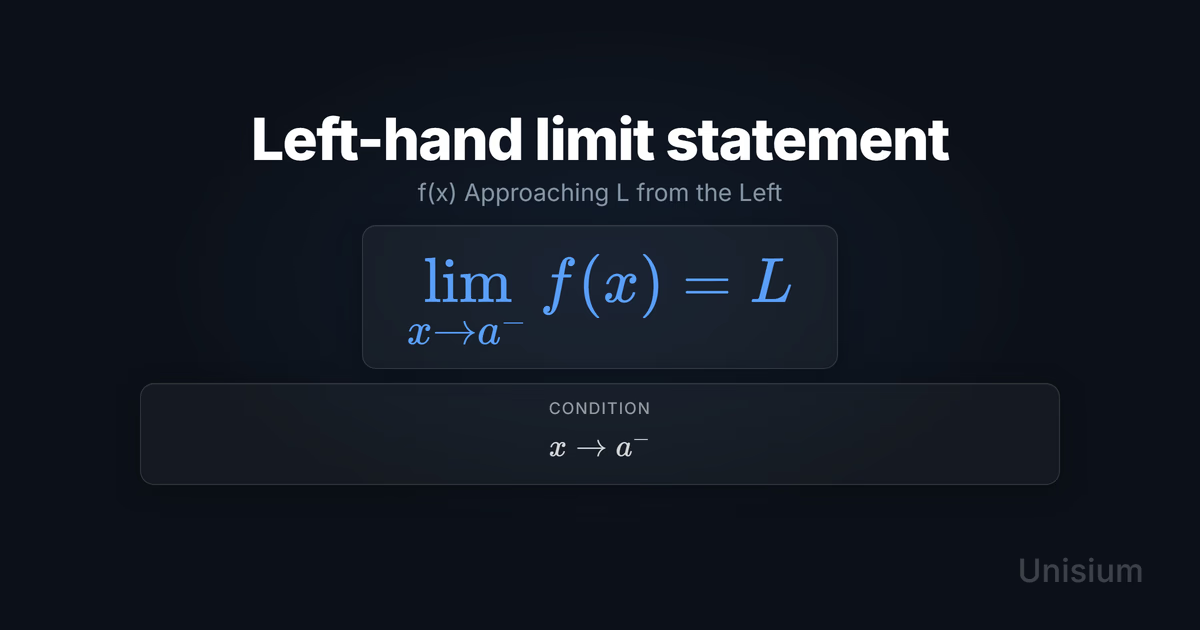
Left-hand limit statement is the representational claim that approaches a value as approaches exclusively from the left—through values —written . It is a strictly weaker claim than the two-sided limit statement: it encodes left-side approach only, tells you nothing about , and the two-sided limit can fail to exist even when this statement holds. Mastering it requires elaboration, retrieval practice, self-explanation, and problem solving—the core strategies in the Unisium Study System.
A left-hand limit can be finite and well-defined—and the two-sided limit can still fail to exist. Both facts are fully compatible. The left-hand statement is complete on its own terms; the two-sided question requires a separate right-hand check.
On this page: The Principle | Conditions | Misconceptions | EE Questions | Retrieval Practice | Worked Example | Solve a Problem | FAQ
The Principle
Statement
The left-hand limit statement is the representational claim that gets arbitrarily close to as approaches through values strictly less than . The superscript on specifies the direction of approach: from the left only. The statement is strictly weaker than the two-sided limit statement—it encodes only left-side approach behavior and makes no claim about what does for or at itself.
Mathematical Form
Where:
- = the input variable approaching from below ()
- = the target input value (the point of approach)
- = the function evaluated for slightly less than (need not be defined at )
- = the left-hand limit value that approaches
Alternative Forms
In different contexts, this appears as:
- Verbal form: “the limit of as approaches from the left equals ”
- Arrow notation: as
Conditions of Applicability
Condition:
The left-hand limit claims approach behavior restricted to the left side of . Only values of with contribute; what happens for is irrelevant to this statement.
Practical modeling notes
- The two-sided limit exists if and only if and both hold with the same value .
- For piecewise-defined functions, identify which branch is active for and evaluate the limit using that branch’s formula.
When It Doesn’t Apply
- No left-hand limit exists: If oscillates without settling as (e.g., near from the left), the left-hand limit statement fails to hold—there is no finite . This is a failure within the statement’s scope, not an error of scope.
- Statement is not sufficient: When a problem requires , the left-hand limit alone is insufficient—not inapplicable. Compute and separately; the two-sided limit is a different statement that requires agreement from both sides.
- Natural domain boundary (different statement type): When is defined only for , the left-hand limit is the relevant one-sided statement. In many introductory treatments, the right-hand limit is unavailable and the two-sided limit is not asserted. The important point is that the left-hand statement stands on its own and does not need right-side behavior.
Want the complete framework behind this guide? Read Masterful Learning.
Common Misconceptions
Misconception 1: The left-hand limit must equal f(a)
The truth: is about approach behavior from below; is the function’s value at . These can differ, and need not even be defined.
Why this matters: On piecewise functions, the left branch often yields a different output than the rule defining . Confusing limit with function value leads to incorrectly claiming continuity at a jump discontinuity.
Misconception 2: If the left-hand limit exists, the two-sided limit exists too
The truth: The two-sided limit requires both one-sided limits to exist and agree. A jump discontinuity gives finite one-sided limits that differ, so the two-sided limit does not exist even though each one-sided limit is perfectly well-defined.
Why this matters: Students who skip checking the right-hand limit will incorrectly assert two-sided convergence at every finite jump—a systematic error on continuity and differentiability problems.
Misconception 3: The left-hand limit reveals something about behavior to the right of
The truth: is defined entirely by what does for . Values of for play no role—they cannot raise, lower, or falsify the left-hand claim.
Why this matters: A common error is computing and , then revising the left-hand value because “the function is heading somewhere different.” The left-hand statement is already complete—it does not care about the right side.
Elaborative Encoding
Use these questions to build deep understanding. (See Elaborative Encoding for the full method.)
Within the Principle
- What do , , and the superscript each contribute to the statement ? Which part of the notation restricts the direction of approach?
- If every output of is scaled by a positive constant , how does change in the left-hand limit? Does the direction of approach affect this scaling?
For the Principle
- When a problem gives you a piecewise function, how do you decide which branch to use when evaluating ?
- What does it tell you about a function if its left-hand and right-hand limits at are both finite but unequal?
Between Principles
- The two-sided limit statement requires agreement from both sides. How is the left-hand limit a strictly weaker claim, and when does that weaker claim become the most you can assert?
Generate an Example
- Describe a piecewise-defined function where , , and the two-sided limit at does not exist. What features must the left and right branches have?
Retrieval Practice
Answer from memory, then click to reveal and check. (See Retrieval Practice for the full method.)
State the left-hand limit statement in words: _____The left-hand limit statement says that f(x) approaches L as x approaches a from the left, through values x < a.
Write the canonical equation for the left-hand limit statement: _____
State the canonical condition: _____
Worked Example
Use this worked example to practice Self-Explanation.
Problem
Evaluate .
Step 1: Verbal Decoding
Target:
Given: ,
Constraints: piecewise-defined; approach from the left
Step 2: Visual Decoding
Draw a 1D -axis. Mark . Indicate an arrow approaching from the left. Sketch the left branch near with an open circle at , and show the right branch with a closed point at .
Step 3: Mathematical Modeling
Step 4: Mathematical Procedures
Step 5: Reflection
- Graphical meaning: As approaches 3 from the left along , the output approaches 8—an open circle sits at on the left branch.
- Domain check: , confirming the left-hand limit and the function value at can differ.
- Limiting case: Moving the breakpoint to any gives , driven entirely by the left branch regardless of the right-branch rule.
Before moving on: self-explain the model
Try explaining Steps 3–4 out loud (or in writing): what the left-hand limit statement claims, why the left branch governs for , and why direct substitution into that branch is valid even though .
Mathematical model with explanation (what “good” sounds like)
Principle: We write the left-hand limit statement —the representational claim that approaches a specific finite value as moves toward from the left.
Conditions: The condition is satisfied: we restrict attention to the left approach (), where the branch governs.
Relevance: The function has a jump at , so the two-sided limit does not exist. The left-hand limit isolates left-side behavior and gives a definite value.
Description: Because is a polynomial (continuous everywhere), direct substitution of into the left branch is valid, yielding .
Goal: Find such that .
Solve a Problem
Apply what you’ve learned with Problem Solving.
Problem
Evaluate where .
Hint (if needed): What is the domain of ? What does that imply about the right-hand limit?
Show Solution
Step 1: Verbal Decoding
Target:
Given: ,
Constraints: domain of is ; is not defined for
Step 2: Visual Decoding
Draw a 1D -axis. Mark . Indicate an arrow approaching from the left. Sketch the upper semicircle near and mark a closed circle at .
Step 3: Mathematical Modeling
Step 4: Mathematical Procedures
Step 5: Reflection
- Graphical meaning: The semicircle meets the -axis at , so as approaches the right endpoint of the domain.
- Domain check: Since is not defined for , the right-hand limit does not exist and the two-sided limit cannot be asserted. The left-hand statement is the correct and complete claim here—not a fallback.
- Interpretation: , so the left-hand limit matches the function value at the endpoint. This does not establish the two-sided continuity-at-a-point criterion, because there are no nearby domain values with .
Related Principles
| Principle | Relationship to Left-Hand Limit Statement |
|---|---|
| Limit statement | Parent: the two-sided limit exists iff both one-sided limits exist and equal |
| Right-hand limit statement | Symmetric counterpart: ; together with the left-hand limit, determines two-sided convergence |
| Continuity at a Point | Adds ; both one-sided limits matching is the equivalent two-sided test for continuity |
| Piecewise Branch Selection | Structural prerequisite from functions: a left-hand limit on a piecewise boundary still starts by choosing the branch valid for inputs just to the left |
See Principle Structures for how to organize these relationships visually.
FAQ
What is the left-hand limit statement?
The left-hand limit statement is the formal claim that approaches the value as approaches through values strictly less than . It captures one-sided approach behavior and does not require to be defined at or for to equal .
When do you write ?
Write the left-hand limit statement when you want to make a claim exclusively about ‘s behavior for . Three common situations: (1) the function’s domain has as a right endpoint, so only left-side approach is available; (2) the problem asks explicitly for the left-approaching value; (3) you are testing whether a two-sided limit exists and need both one-sided claims separately.
What is the difference between the left-hand limit and the two-sided limit?
The two-sided limit requires approach from both directions to converge to the same value. The left-hand limit only considers . When the two-sided limit exists it always equals both one-sided limits, but each one-sided limit can exist individually even when the two-sided limit does not.
What are the most common mistakes with one-sided limits?
The top three: (1) using the wrong branch of a piecewise function—applying the rule when computing a left-hand limit; (2) assuming the left-hand limit equals ; (3) asserting the two-sided limit based only on the left-hand limit without checking the right-hand side.
How do I evaluate a left-hand limit on a piecewise function?
Identify the branch active for , then evaluate the limit of that formula as . Because the left-hand limit ignores everything at and to the right of , all other branches are irrelevant.
Related Guides
- Calculus Subdomain Map — Return to the calculus hub to see how one-sided limits support continuity checks and derivative definitions
- Piecewise Branch Selection — The functions-side move that matches how you choose the active branch before taking a left-hand limit on a piecewise boundary
- Principle Structures — Organize the left-hand limit within the broader calculus hierarchy
- Self-Explanation — Learn to explain each branch-selection and substitution step out loud
- Retrieval Practice — Make the left-hand limit definition instantly accessible
- Problem Solving — Apply the Five-Step Strategy to one-sided limit problems systematically
How This Fits in Unisium
Within the calculus subdomain, Unisium builds the left-hand limit as the first refinement after the two-sided limit statement. Practice sessions use elaborative encoding questions to anchor the direction-of-approach distinction, spaced retrieval prompts to keep the notation fluent, and structured Five-Step worked examples to develop the judgment for selecting the correct piecewise branch under time pressure.
Ready to master the left-hand limit? See Unisium’s 14-day free trial or explore the complete learning framework in Masterful Learning.

Masterful Learning
The book behind these guides: a study system for physics, math, & programming built on retrieval, connection, explanation, and problem solving.
Ready to apply this strategy?
Unisium turns these evidence-based techniques into guided study sessions for math and physics. Places are limited during early access. Check current availability to start a trial; joining the mailing list is optional.
See plans and availability Read More GuidesAlready have access? Sign in