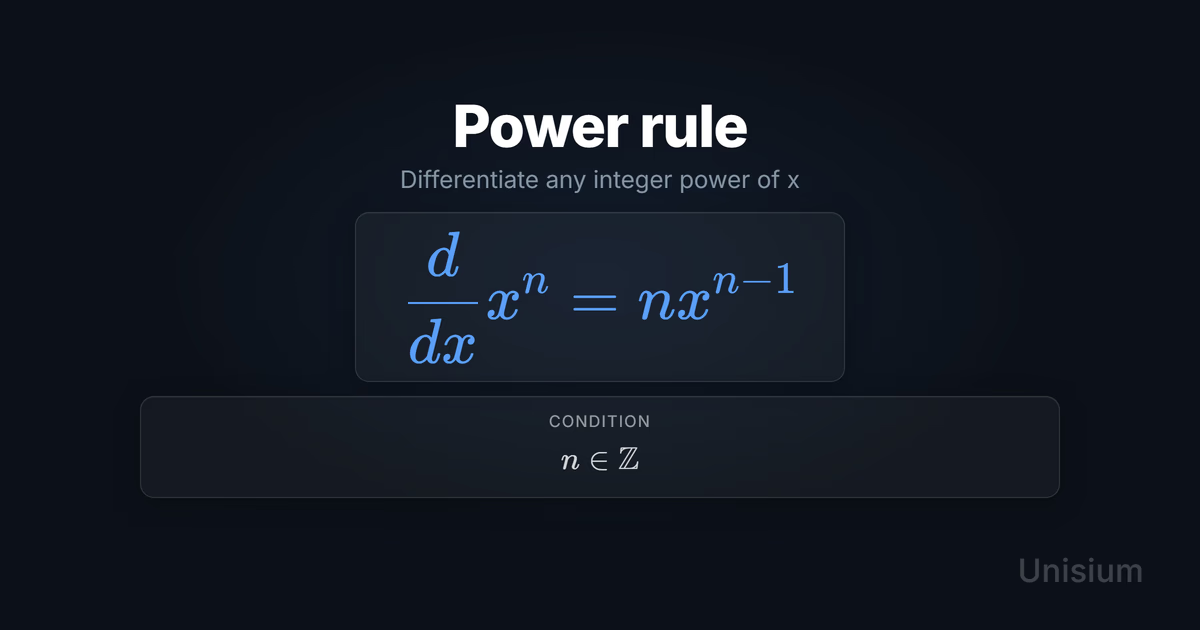
Power rule: Differentiate real powers of x
The power rule differentiates for any real constant exponent on : bring down as a coefficient and reduce the power by one, giving . Some integer and rational powers extend to other real inputs, but the rule applies only where the chosen real-valued power function is differentiable. A variable exponent such as needs the exponential derivative rule.
On this page: The Principle | Conditions | Failure Modes | EE Questions | Retrieval Practice | Practice Ground | Solve a Problem | FAQ
The Principle
The move: Bring the constant exponent down as a coefficient and reduce the power by one.
The invariant: The base remains . The old constant exponent becomes the coefficient, and the new exponent is one less.
Pattern:
| Legal ✓ | Illegal ✗ |
|---|---|
| for | ; the exponent is the variable, not a constant |
Left: is constant, so the power rule applies on the stated domain. Right: has a constant base and variable exponent, so the power rule does not apply.
Conditions of Applicability
Condition: ;
Before applying, check: confirm the expression has the form , where is a real constant. The domain gives the clean general rule for every real exponent.
- Fractional, negative, and irrational constant exponents are included on . For example, .
- Some powers have larger real domains. The function is real and differentiable for every real , while is not differentiable at . Check the real-valued domain and differentiability before extending the rule beyond .
- The rule does not cover expressions with a variable exponent such as or . Use the derivative of rule for a positive constant base, with as its important special case.
Want the complete framework behind this guide? Read Masterful Learning.
Common Failure Modes
Failure mode: apply the power rule to (constant base, variable exponent) by treating as the exponent to bring down → produces instead of .
Debug: ask “does the expression have the form with constant, and is it differentiable on the domain I am using?” If the exponent involves , use an exponential or logarithmic differentiation rule instead. If the base is a function of , the chain rule is also needed.
Elaborative Encoding
Use these questions to build deep understanding. (See Elaborative Encoding for the full method.)
Within the Principle
- What does “bring the exponent down” mean algebraically, and why does the coefficient become exactly rather than some other value?
- Why does the power reduce by exactly in the result? What does the limit definition for reveal about where that comes from?
For the Principle
- How do you decide whether the power rule applies to a given expression before differentiating?
- What changes about the procedure when the exponent is negative versus positive, and what stays the same?
Between Principles
- The derivative constant multiple rule lets you pull a constant factor out of a derivative. How do those two rules combine when differentiating ?
Generate an Example
- Construct an expression with a constant exponent that needs a domain check before the power rule can be used, and explain the check.
Retrieval Practice
Answer from memory, then click to reveal and check. (See Retrieval Practice for the full method.)
State the move in one sentence: _____Bring the exponent down as a coefficient and reduce the power by one: the derivative of x^n is n times x^(n-1).
Write the canonical equation: _____
State the canonical condition: _____
Practice Ground
Use these exercises to build move-selection fluency. (See Self-Explanation for how to use worked examples effectively.)
Procedure Walkthrough
Starting from , reach a simplified derivative expression.
| Step | Expression | Operation |
|---|---|---|
| 0 | Not yet | |
| 1 | Power rule with ; bring down as coefficient and reduce the exponent by 1 | |
| 2 | Arithmetic: | |
| 3 | Rewrite negative exponent as fraction |
Drills
Forward step (Format A)
Apply the power rule once.
Reveal
is constant. Bring the exponent down and reduce by one:
Apply the power rule once.
Reveal
is constant. Bring down as the coefficient and reduce by one:
Equivalently: .
Apply the power rule once.
Reveal
is constant.
Can the power rule be applied? Identify the base and exponent, then check the condition.
Reveal
No. The expression has a constant base () and a variable exponent (). The power rule applies to when is constant. Here the roles are reversed.
The correct derivative uses the exponential rule: .
Can the power rule be applied on ? Check the condition and explain your decision.
Reveal
Yes. The exponent is a real constant and the stated domain is :
The function is also defined at , but its derivative there is not finite. That is why the domain check still matters.
Which expressions can be differentiated directly using the power rule on ? Identify which have the form with constant .
(i) \quad (ii) \quad (iii) \quad (iv)
Reveal
(i), (iii), and (iv).
- : base , constant exponent ✓
- : constant base, variable exponent. The form is , not ✗
- : base , constant exponent ✓
- : base , constant exponent ✓ on
The structural check is whether the expression has the form with constant. The domain check determines where the resulting real-valued derivative statement is valid.
Action label (Format B)
What was done between these two steps? Verify whether the move is valid.
Reveal
Power rule applied. The exponent is constant. It was brought down as a coefficient, and the power was reduced by one: .
What was done between these two steps? Verify whether the move is valid.
Reveal
Power rule applied. The exponent is constant. Coefficient: . Exponent: . Result: .
What was done between these two steps? Verify whether the move is valid.
Reveal
Power rule applied. The exponent is constant. The rule gives coefficient , so the derivative is .
Consistency check: is a constant function, and the derivative of any constant is .
What was done between these two steps? Is it valid?
Reveal
Invalid: the power rule does not apply here. The expression has a constant base () and a variable exponent (). Treating as a constant exponent to bring down is a structural error; the formula produces a wrong result.
The correct derivative is , obtained from the exponential derivative rule.
Transition identification (Format C)
In the chain below, identify which step applies the power rule. Verify the condition at that step.
Reveal
Step (1) applies the power rule. The exponent is constant. It is brought down as a coefficient, and the power is reduced by one.
Step (2) is arithmetic: .
Solve a Problem
Apply what you’ve learned with Problem Solving.
Problem: Differentiate using the power rule. Write the result in negative-exponent form and as a fraction, then verify the value of .
Full solution
| Step | Expression | Move |
|---|---|---|
| 0 | Not yet | |
| 1 | Power rule with constant ; bring down and reduce the exponent by 1 | |
| 2 | Arithmetic: | |
| 3 | Rewrite negative exponent: | |
| 4 | Evaluate at to verify ✓ |
Related Principles
| Principle | Relationship |
|---|---|
| Derivative at a point | The limit definition from which the power rule is derived; shows why the exponent reduces by exactly |
| Derivative sum rule | Companion for polynomials and linear combinations: the sum rule splits the terms, then the power rule differentiates the monomials |
| Derivative constant multiple rule | Frequent partner in the same derivative chain: constants are pulled out before the power rule is applied to |
| Power rule for integration | The inverse antiderivative move: integrate by raising the exponent and dividing by the new exponent, except when |
| Derivative chain rule | Successor for composite powers: once the inside stops being just , the power rule usually survives as the outer step of a chain-rule move |
FAQ
What is the power rule?
The power rule states that for any real constant on . Bring the exponent down as a coefficient and reduce the power by one. Some powers extend to larger real domains when the function remains real-valued and differentiable.
When does the power rule apply?
The clean general condition is with constant and . Fractions, negative numbers, and irrational numbers can all be exponents. If the exponent itself varies with , use a different derivative rule.
Does the power rule work for negative exponents?
Yes. For example, , equivalently . Because the original function is undefined at , the derivative statement is used on intervals that exclude zero.
Does the power rule work for fractional exponents?
Yes. For example, . On , the general real-exponent rule applies directly. For zero or negative inputs, check how the real power is defined and whether it is differentiable there.
How is the power rule different from the exponential rule?
The power rule applies to with a constant exponent. The exponential rule applies to with a variable exponent. They produce different results: versus .
How This Fits in Unisium
In Unisium, derivative fluency is built by training move selection before execution. For the power rule, that means checking whether the exponent is constant and whether the real-valued function is differentiable on the working domain. The drills above contrast power functions (, constant exponent) with exponential functions (, variable exponent) so the rule choice becomes reliable.
Explore further:
- Calculus Subdomain Map: Return to the calculus hub to see where the power rule sits inside the first derivative cluster
- Derivative at a point: The limit definition that justifies derivative rules from first principles
- Elaborative Encoding: Build deep understanding of why the exponent reduces by exactly 1
- Retrieval Practice: Make the power rule equation and condition instantly accessible
Ready to master the power rule? See Unisium’s 14-day free trial or explore the full learning framework in Masterful Learning.

Masterful Learning
The book behind these guides: a study system for physics, math, & programming built on retrieval, connection, explanation, and problem solving.
Ready to apply this strategy?
Unisium turns these evidence-based techniques into guided study sessions for math and physics. Places are limited during early access. Check current availability to start a trial; joining the mailing list is optional.
See plans and availability Read More GuidesAlready have access? Sign in