Derivative Constant Multiple Rule: Factor Constants Out of Derivatives
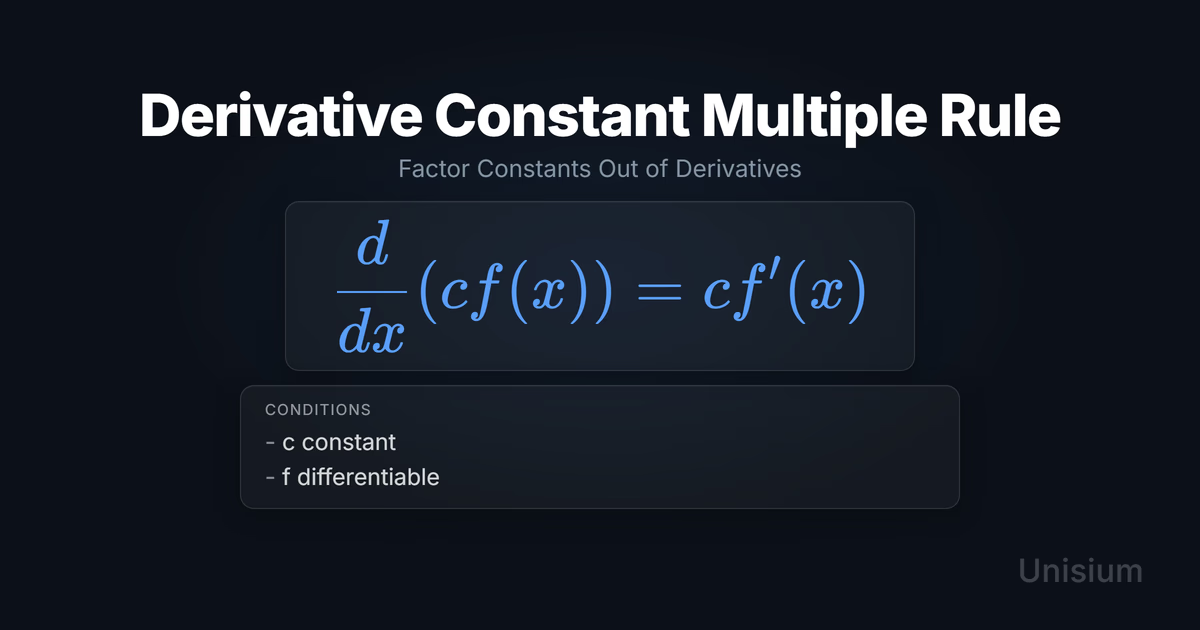
The derivative constant multiple rule lets you replace with . It applies when is constant with respect to and is differentiable. If the factor depends on , this move is illegal; use the product rule instead.
On this page: The Principle | Conditions | Failure Modes | EE Questions | Retrieval Practice | Practice Ground | Solve a Problem | FAQ
The Principle
The move: Differentiate a constant-scaled function by factoring the constant outside the derivative operator.
The invariant: This gives the correct derivative because multiplying a differentiable function by a constant scales its rate of change by that same constant — the limit definition of the derivative is linear in the function, so the constant factor passes straight through.
Pattern:
| Legal ✓ | Illegal ✗ |
|---|---|
| — 5 is constant | — depends on |
The key question before applying this rule: “Does this factor depend on the variable of differentiation?” If not, the move is legal. If it does, the condition fails — use the product rule instead.
Conditions of Applicability
Condition: c constant; f differentiable
Before applying, check: Is the factor you plan to pull out truly independent of the variable of differentiation? Confirm that is differentiable at the point (or on the interval) in question.
- must not depend on : Numbers like , , , , and are constants. Expressions like , , or are not — they change with .
- must be differentiable: If is not differentiable at the relevant point, the derivative does not exist there, and the right-hand side of the rule is undefined.
Want the complete framework behind this guide? Read Masterful Learning.
Common Failure Modes
Failure mode: treating any multiplicative factor as a constant and pulling it outside the derivative → applying the rule to a variable factor such as or , which produces a wrong derivative.
Debug: ask “does this factor depend on the variable of differentiation?” If yes, the constant multiple rule does not apply — use the product rule instead.
Elaborative Encoding
Use these questions to build deep understanding. (See Elaborative Encoding for the full method.)
Within the Principle
- What does represent in , and why can it be moved outside the limit that defines the derivative?
- In what sense are and the same function — does the rule hold at every point in the domain of , or only at specific points?
For the Principle
- How would you test whether a factor in a product is a constant before applying this rule?
- If you cannot apply the constant multiple rule, which rule handles a product of two functions of ?
Between Principles
- The derivative sum rule and the constant multiple rule are often used together. When differentiating , which rule do you apply first, and why?
Generate an Example
- Construct a case where a student might mistakenly treat a variable factor as a constant, state the incorrect answer they produce, and show what the correct rule application gives.
Retrieval Practice
Answer from memory, then click to reveal and check. (See Retrieval Practice for the full method.)
State the move in one sentence: _____Pull a constant factor outside the derivative operator: the derivative of c times f(x) equals c times the derivative of f(x).
Write the canonical pattern: _____
State the canonical condition: _____c constant; f differentiable
Practice Ground
Use these exercises to build move-selection fluency. (See Self-Explanation for how to use worked examples effectively.)
Procedure Walkthrough
Differentiate , labeling each rule applied.
| Step | Expression | Operation |
|---|---|---|
| 0 | — | |
| 1 | derivative sum rule | |
| 2 | constant multiple rule (pull and outside) | |
| 3 | power rule | |
| 4 | arithmetic |
Drills
Format A — Forward step: apply the rule
Differentiate:
Reveal
Pull the constant 6 outside (6 is independent of ; is differentiable):
Differentiate:
Reveal
Pull the constant outside:
Differentiate:
Reveal
Pull the constant 2 outside ( is differentiable everywhere):
Differentiate:
Reveal
is an irrational number but still a constant — independent of :
Which of the following can be differentiated directly using the derivative constant multiple rule? Assume is constant with respect to .
Reveal
Items 1 and 3 only.
- Valid — is independent of and is differentiable.
- Invalid — depends on ; use the product rule.
- Valid — is constant with respect to and is differentiable.
- Invalid — both factors depend on ; use the product rule.
Format A — Near-miss: identify whether the rule applies
A student wants to differentiate by writing . Is this a valid application of the constant multiple rule? If not, what is the correct approach?
Reveal
No — the constant multiple rule does not apply here. The factor depends on , so it is not a constant. The condition ” constant” is violated.
The correct rule is the product rule:
A student differentiates and writes , claiming the constant multiple rule applies with ”.” Identify the error.
Reveal
Error: is not a constant — it depends on , so the condition ” constant” fails. This looks like the constant multiple rule (two factors in a product) but the rule is not applicable.
Correct approach — product rule:
Format B — Action label: name the rule applied
What rule was applied between these two steps?
Reveal
Derivative constant multiple rule. The constant factor (independent of ) was pulled outside the derivative operator. The condition is satisfied: is constant, and is differentiable.
What rule was applied between these two steps?
Reveal
Derivative constant multiple rule. is a constant (negative constants are still constants). After pulling out , applying the power rule gives .
Two rules were used in the step below. Name both.
Reveal
- Derivative sum rule — the derivative of a sum equals the sum of the derivatives.
- Derivative constant multiple rule — the constants 3 and 5 were pulled outside each derivative term.
Both rules are applied in a single combined step here. You can apply them in either order.
Format C — Transition identification: locate the rule in a chain
The steps below differentiate in full. Identify which step number uses the constant multiple rule, and which uses the derivative sum rule.
| Step | Expression |
|---|---|
| 0 | |
| 1 | |
| 2 | |
| 3 | |
| 4 |
Reveal
- Step 0 → 1: derivative sum rule (splits the derivative over a sum of three terms).
- Step 1 → 2: constant multiple rule (pulls constants 2 and outside their respective derivative operators) plus the constant rule ().
- Steps 3–4: power rule then arithmetic — the constant multiple rule is not re-applied.
Solve a Problem
Differentiate showing each rule explicitly.
Reveal full solution
| Step | Expression | Operation |
|---|---|---|
| 0 | — | |
| 1 | derivative sum rule | |
| 2 | constant multiple rule; constant rule | |
| 3 | power rule | |
| 4 | arithmetic |
Answer:
Related Principles
| Principle | Relationship |
|---|---|
| Derivative sum rule | Used alongside the constant multiple rule to differentiate each term of a sum independently |
| Power rule | Typically applied immediately after pulling out the constant to differentiate |
| Product rule | Required when the factor depends on — the contrast case for this rule |
FAQ
What makes a factor “constant” for this rule? A factor is a constant if it does not depend on the variable you are differentiating with respect to. Numbers like , , , , and qualify. Expressions involving — such as , , or — do not.
Can I pull out , , or other irrational numbers? Yes. and are constants in the same sense as or . is a straightforward application of this rule.
What if the constant is negative? Negative constants are still constants. . The sign carries through the rule without any modification.
How does this rule differ from the product rule? The product rule handles a product of two functions of : . The constant multiple rule is a simpler special case where one factor is constant — applying the product rule to gives , which is exactly this rule, so they are consistent.
Can the rule be applied when differentiating with respect to a different variable? Yes. If is independent of the variable of differentiation, the rule applies. For example, as long as does not depend on .
How This Fits in Unisium
Inside the calculus subdomain, the derivative constant multiple rule is one of the first moves a calculus student needs to automate. In the Unisium app, it appears paired with the sum rule and power rule in early derivative drill sets — you will apply it dozens of times before moving to the product rule and chain rule. Building the habit of checking “is this factor constant?” before this move pays forward: the same check distinguishes valid from invalid moves at every level of the course. To see how systematic drill practice accelerates that automaticity, read Masterful Learning.
Explore further:
- Calculus Subdomain Map — Return to the derivative hub view and see where the linearity rules sit relative to power, product, quotient, and chain
- Derivative Sum Rule — The companion split step used right before or right after constant multiples in most polynomial derivatives
- Power Rule — The next move that usually acts on the remaining term once the constant factor is outside the derivative
Masterful Learning
The book behind these guides: a study system for physics, math, & programming built on retrieval, connection, explanation, and problem solving.
Ready to apply this strategy?
Unisium turns these evidence-based techniques into guided study sessions for math and physics. Places are limited during early access. Check current availability to start a trial; joining the mailing list is optional.
See plans and availability Read More GuidesAlready have access? Sign in