Average value of a function: Integrating to Find the Mean
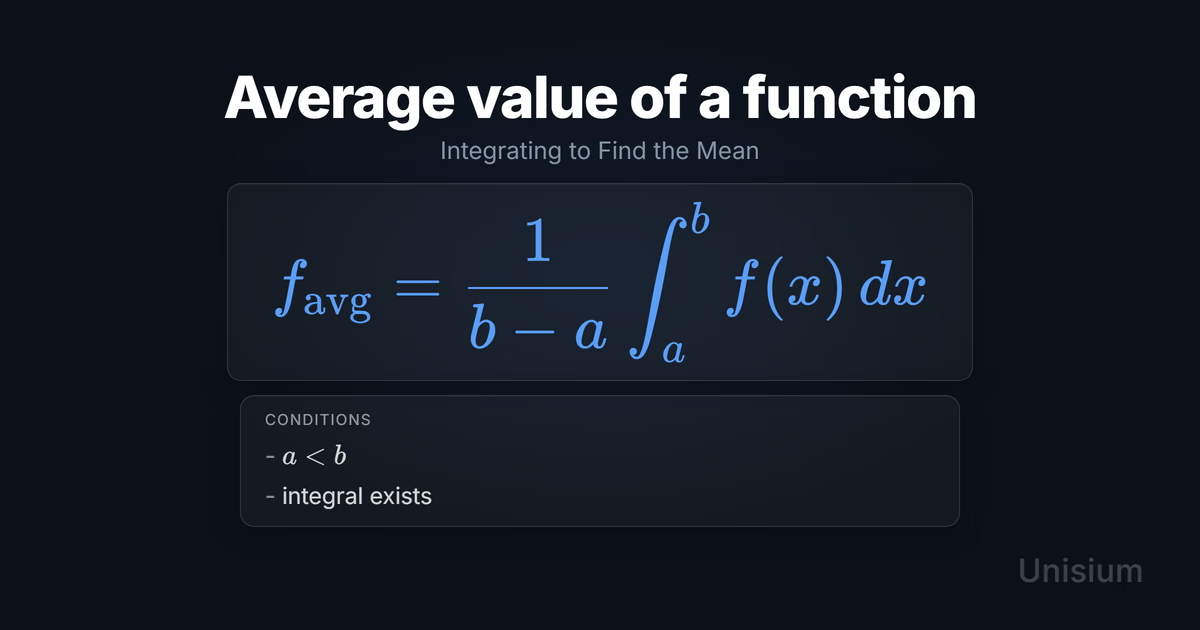
Average value of a function on is the definite integral of over the interval divided by its length: . It is the continuous analogue of an arithmetic mean, turning accumulated output into a mean height. It applies when and the integral exists.
On this page: The Principle | Conditions | Misconceptions | EE Questions | Retrieval Practice | Worked Example | Solve a Problem | FAQ
The Principle
Statement
The average value of a function on a closed interval is defined by integrating over that interval and dividing by the interval’s length . It is the continuous analogue of the arithmetic mean: just as you average numbers by summing them and dividing by , you average a continuous function by integrating it and dividing by the length of its domain. The result is a single number with the same units as the output of .
Mathematical Form
Where:
- = the function whose mean output is sought, defined on
- , = the endpoints of the interval, with
- = the length of the interval (the normalization factor)
- = the net signed area under the graph of from to
- = the average output value; the height of the rectangle on whose area equals
Alternative Forms
In different notations, the same definition appears as:
- Integral form: — the integral equals the area of a rectangle of width and height
- Mean-value notation: — the overbar is common in physics and engineering contexts
Conditions of Applicability
Condition: ; integral exists
Practical modeling notes
- "" means the interval has positive length. If the formula produces , which is undefined. If the formula is not standard; in that case, rewrite using to restore the ordering before applying.
- “Integral exists” means the definite integral is a finite real number. For continuous this is guaranteed. For with a non-integrable singularity on (e.g., on an interval containing ), the integral diverges and the average value is undefined.
- In first-year calculus, both conditions are almost always met automatically. You compute the antiderivative of , evaluate at the endpoints, and divide by .
When It Doesn’t Apply
- Zero-length interval (): The normalization factor is zero; the formula is undefined. The definition requires a positive-length interval.
- Integral does not exist as a finite value: If has a non-integrable singularity on (for example, on an interval containing ), the integral diverges and the average value is undefined.
- Higher-dimensional regions: For functions of two or more variables, the average over a region is found by dividing the multiple integral by the region’s area or volume, not by a single .
Want the complete framework behind this guide? Read Masterful Learning.
Common Misconceptions
Misconception 1: “The average value equals the average of the endpoint values”
The truth: is the trapezoid approximation to the average—it is exact only when is linear on . For any non-linear function the two quantities differ, and the integral formula is the correct definition.
Why this matters: Using endpoint averaging instead of the integral formula gives the wrong answer on any curved graph. A function that rises steeply near and is nearly flat near will have an average value much closer to than the midpoint of and .
Misconception 2: “The average value is evaluated at the midpoint”
The truth: is the midpoint value, not the average value. The Mean Value Theorem for Integrals guarantees that some point satisfies , but is not necessarily the midpoint—it depends on the shape of .
Why this matters: Substituting the midpoint into is a distinct operation (midpoint rule quadrature) that approximates the average; it does not compute it. Treating them as identical skips the integration step entirely.
Elaborative Encoding
Use these questions to build deep understanding. (See Elaborative Encoding for the full method.)
Within the Principle
- In the formula , why does the factor appear? What would represent if you doubled the interval length while keeping and its integral the same?
- The formula produces a number with the same units as . If is measured in degrees Celsius and in hours, what are the units of , and what does the integral represent dimensionally?
For the Principle
- How do you decide to apply the average value formula rather than computing at a few sample points? What makes the continuous integral definition more appropriate than averaging finitely many values?
- Suppose is negative on the entire interval . Is positive, negative, or zero? Does the formula still apply?
Between Principles
- The Mean Value Theorem for Integrals states that if is continuous on , there exists with . How does this connect the existence of the average value to the continuity condition, and why does continuity (rather than just integrability) matter for the MVT conclusion?
Generate an Example
- Construct a function on whose average value is , but whose values are less than for most of the interval. What forced the average up despite the function being small most of the time?
Retrieval Practice
Answer from memory, then click to reveal and check. (See Retrieval Practice for the full method.)
State the principle in words: _____The average value of f on [a,b] is the definite integral of f from a to b, divided by the interval length b-a.
Write the canonical equation: _____
State the canonical condition: _____
Worked Example
Use this worked example to practice Self-Explanation.
Problem
Find the average value of on the interval .
Step 1: Verbal Decoding
Target: on
Given: , ,
Constraints: closed bounded interval; polynomial integrand; positive interval length; integral exists
Step 2: Visual Decoding
Sketch on . Draw a horizontal line at height and mark the rectangle of width with that height. Label the interval endpoints and . (The rectangle’s area must equal the area under the curve on .)
Step 3: Mathematical Modeling
Step 4: Mathematical Procedures
Step 5: Reflection
- Magnitude/plausibility: and ; the average value of lies strictly between these, which is consistent with the parabola rising throughout the interval.
- Graphical meaning: By the Mean Value Theorem for Integrals, the horizontal line crosses the parabola at —the guaranteed point where .
- Dimensional analysis: has the same units as ; the integral has units of , and dividing by (units of ) restores units of , as required.
Before moving on: self-explain the model
Try explaining Step 3 out loud (or in writing): why the formula instantiates to , what geometric object the integral represents, and how dividing by turns that area into a height.
Mathematical model with explanation
Principle: Average value of a function — .
Conditions: ✓; is continuous on , so the integral exists ✓.
Relevance: The problem asks for the mean output of over the interval—not a rate of change, not a maximum—so the average value formula is the direct tool.
Description: With , , and , the general formula reduces to . Applying the power rule for antiderivatives gives . Evaluating at and and subtracting yields the net integral . Dividing by converts the area into the equivalent rectangle height.
Goal: Find the single height such that the rectangle on with that height has the same area as the region under from to .
Solve a Problem
Apply what you’ve learned with Problem Solving.
Problem
Find the average value of on the interval .
Hint (if needed): The antiderivative of is .
Show Solution
Step 1: Verbal Decoding
Target: on
Given: , ,
Constraints: closed bounded interval; trigonometric integrand; positive interval length; integral exists
Step 2: Visual Decoding
Sketch one arch of over . Draw a horizontal line at height and mark the rectangle of width with that height. Label the endpoints and and the peak at . (The rectangle’s area must equal the area of the arch.)
Step 3: Mathematical Modeling
Step 4: Mathematical Procedures
Step 5: Reflection
- Verification: Multiply back: , which matches ✓.
- Magnitude/plausibility: ; the sine arch has a peak of and touches at both ends, so an average below and well above is geometrically reasonable.
- Domain check: ✓; is continuous on ✓; both conditions satisfied.
Related Principles
| Principle | Relationship to Average Value of a Function |
|---|---|
| Definite integral (Riemann sum definition) | The average value formula is built on the definite integral; the integral must exist for the formula to produce a finite value |
| Indefinite integral as antiderivative | Used in practice to evaluate via , making average-value computations tractable |
| Mean Value Theorem for Integrals | A consequence: if is continuous on , there exists such that , linking average value to continuity |
See Principle Structures for how these relationships fit hierarchically.
FAQ
What is the average value of a function?
The average value of on is . It is the continuous generalization of the arithmetic mean: instead of summing finitely many values and dividing by their count, you integrate over the interval and divide by the interval’s length.
How is the average value different from averaging the endpoint values?
is the trapezoid estimate—accurate only when is linear. The average value formula integrates every output of , not just the two endpoints, and therefore correctly weights the function’s behavior throughout the interval.
When does the average value formula apply?
When (the interval has positive length) and the definite integral exists as a finite number. For any continuous function on a closed bounded interval both conditions are automatically satisfied.
Does the function need to be non-negative for the formula to work?
No. The formula applies to any integrable function, including those that are negative on part or all of . If is negative throughout, will be negative—that is the correct average output.
What is the Mean Value Theorem for Integrals?
If is continuous on , the MVT for Integrals guarantees the existence of at least one with . This says the average value is genuinely attained somewhere inside the interval—not just a theoretical number, but a value the function reaches.
Why is the formula and not just ?
The integral gives the net signed area under , which has units of . To recover a quantity with the same units as (a mean output), you divide by (units of ). Geometrically, this converts area into the height of the equal-area rectangle.
Related Guides
- Calculus Subdomain Map — Return to the calculus map to see how average value depends on definite integrals and connects to the application layer
- Principle Structures — Organize the average value formula in a hierarchical framework alongside the definite integral and related theorems
- Fundamental Theorem of Calculus (Part 2) — The usual successor used to evaluate the definite integral once an antiderivative is known
- Self-Explanation — Practice explaining each step of average-value computations, from model setup to evaluation
- Retrieval Practice — Make the formula and its conditions instantly accessible before exams
- Problem Solving — Apply the Five-Step Strategy to average-value problems systematically
How This Fits in Unisium
Unisium structures the average value of a function as a representational principle: the equation is the definition you model and the conditions ; integral exists are the gates you check before applying it. The platform surfaces this principle through elaborative encoding questions, retrieval prompts, and problem sets so you develop the habit of asking “what is the formula computing?” rather than reaching for a numerical shortcut. Because the average value connects directly to the definite integral, the Mean Value Theorem for Integrals, and antiderivative evaluation, mastering it here strengthens your fluency across applied calculus.
Ready to master the average value of a function? See Unisium’s 14-day free trial or explore the full learning framework in Masterful Learning.

Masterful Learning
The book behind these guides: a study system for physics, math, & programming built on retrieval, connection, explanation, and problem solving.
Ready to apply this strategy?
Unisium turns these evidence-based techniques into guided study sessions for math and physics. Places are limited during early access. Check current availability to start a trial; joining the mailing list is optional.
See plans and availability Read More GuidesAlready have access? Sign in