First derivative test (local maximum): Infer a local peak from a positive-to-negative sign change
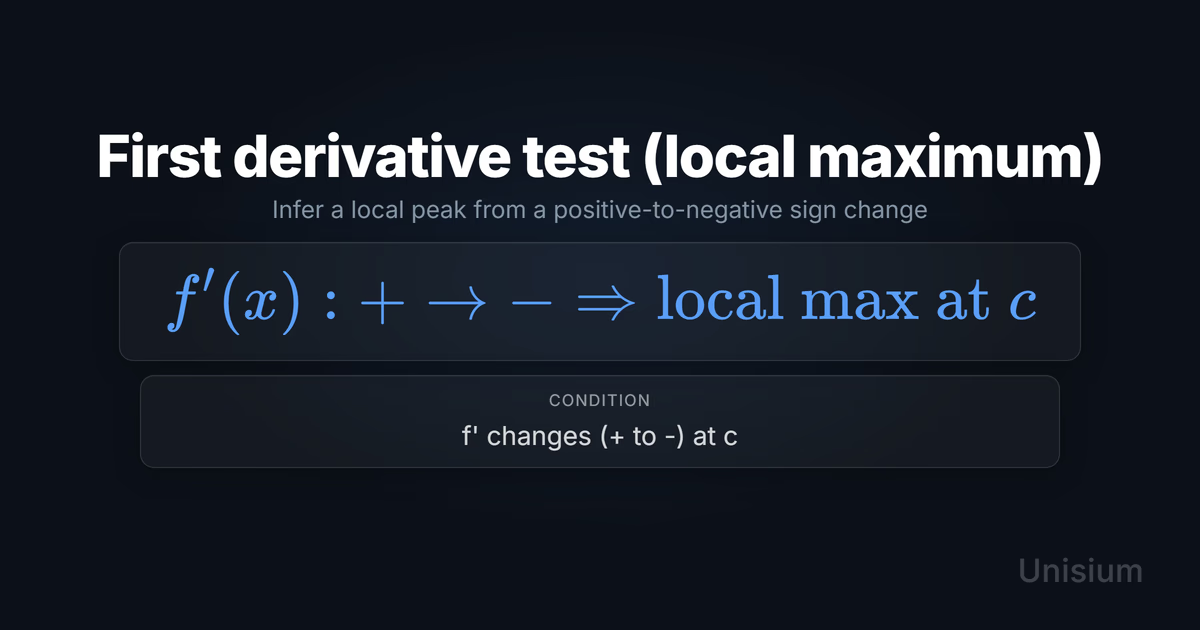
First derivative test (local maximum) lets you infer that a function has a local maximum at a point when its derivative changes from positive to negative there. The conclusion is justified only when the derivative sign really switches at , so the core habit is checking the sign on both sides before concluding “local max.” The near-miss is treating as enough; the theorem needs the sign of to switch from to around .
On this page: The Principle | Conditions | Failure Modes | EE Questions | Retrieval Practice | Practice Ground | Solve a Problem | Related Principles | FAQ | How This Fits
The Principle
The move: Infer that has a local maximum at from a positive-to-negative sign change in around .
The invariant: The derivative sign pattern keeps the same local-behavior meaning throughout the step: increasing before and decreasing after supports a local maximum at .
Pattern:
| Valid ✓ | Not valid ✗ |
|---|---|
| just left of and just right of has a local maximum at | just left of and just right of has a local maximum at |
Left: the derivative sign shows rising into and falling after it, so the peak conclusion is justified. Right: the sign pattern is reversed, so the tempting “local max” conclusion is invalid; that pattern supports a local minimum instead.
Conditions of Applicability
Condition: f’ changes (+ to -) at c
A critical point alone is not enough. The derivative must be positive just left of and negative just right of for the local-maximum conclusion to follow.
Before applying, check: inspect the sign of immediately left and right of ; if the signs are then , the theorem is available.
If the condition is violated: the theorem does not justify a local maximum; the point may be a local minimum or may fail to be an extremum at all.
- The test is about the sign of near , not only about the single value .
- A sign change supports the opposite conclusion: a local minimum.
- You can get the needed sign information from a sign chart, interval test points, or a factorized derivative.
- The derivative facts usually come from rules such as the power rule and the derivative sum rule before you apply the test itself.
Want the complete framework behind this guide? Read Masterful Learning.
Common Failure Modes
Failure mode: treat “critical point” or as enough for a local maximum → you conclude a peak at a point where the function either keeps increasing or turns into a local minimum.
Debug: ignore the point value first and inspect the sign of on both sides of ; the theorem needs , not merely .
Elaborative Encoding
Use these questions to build deep understanding. (See Elaborative Encoding for the full method.)
Within the Principle
- Why does a sign change in mean the function rises before and falls after ?
- Why is checking only weaker than checking the sign of on both sides of ?
For the Principle
- When you have a candidate critical point, what is the quickest reliable process for deciding whether the first derivative test can prove a local maximum there?
- Why is a sign chart around a stronger basis for this theorem than checking only the single value ?
Between Principles
- How does this sign-change test differ from using the derivative at a point definition, which tells you what a derivative means but does not by itself classify a point as a local maximum?
Generate an Example
- Create one derivative sign chart that justifies a local maximum and one near-miss sign chart that looks structured but does not justify that conclusion.
Retrieval Practice
Answer from memory, then click to reveal and check. (See Retrieval Practice for the full method.)
State the move in one sentence: _____Infer that f has a local maximum at c when f' changes from positive to negative at c.
Write the canonical equation: _____
State the canonical condition: _____f' changes (+ to -) at c
Practice Ground
Use these exercises to build move-selection fluency. (See Self-Explanation for how to use worked examples effectively.)
Procedure Walkthrough
Starting from and the candidate point , determine whether has a local maximum there.
| Step | Expression | Operation |
|---|---|---|
| 0 | - | |
| 1 | Differentiate and factor to expose the sign pattern | |
| 2 | Sign analysis on intervals around | |
| 3 | changes at | State the canonical condition |
| 4 | has a local maximum at | First derivative test |
| 5 | , so the local maximum point is | Evaluate the function at the classified point |
Drills
Format B: Action label
What principle justifies the step below, and is the move valid?
Reveal
First derivative test (local maximum). The move is valid because the derivative changes from positive to negative at .
What principle is being attempted below, and is the move valid?
Reveal
The attempted move is the first derivative test for a local maximum, but it is not valid. The sign pattern is , which supports a local minimum, not a local maximum.
What principle is being attempted below, and is the move valid?
Reveal
The attempted move is again the first derivative test for a local maximum, but it is not valid. There is no sign change, so the theorem does not justify any local-maximum conclusion.
What principle is being attempted below, and is the move valid?
Reveal
The attempted move is the first derivative test for a local maximum, but it is not valid. The theorem needs a sign change around , not just the single-point fact .
Format C: Transition identification
Which transition uses the first derivative test directly?
Reveal
Transition (3) uses the first derivative test directly.
- (1) is sign analysis.
- (2) summarizes the sign pattern.
- (3) turns that verified condition into the local-maximum conclusion.
Which transition is not justified by the first derivative test?
Reveal
Transition (2) is not justified. The derivative is positive on both sides of , so there is no change to trigger the theorem.
Which proposed conclusion steps are eligible for the first derivative test (local maximum)?
- just left of and just right of has a local maximum at
- just left of and just right of has a local maximum at
- just left of and just right of has a local maximum at
- has a local maximum at
Reveal
Eligible step: 1 only.
- 1 matches the canonical condition exactly.
- 2 supports a local minimum instead.
- 3 has no sign change.
- 4 gives only a critical-point candidate, not the theorem condition.
Which transition uses the theorem directly?
Reveal
No transition uses the theorem correctly. Transition (3) is the attempted theorem step, but it is invalid because the sign pattern is , not .
Format A: Forward step
Apply the first derivative test once.
Reveal
The derivative changes from positive to negative at , so has a local maximum at .
Apply the first derivative test once after reading the derivative sign near the candidate point.
Reveal
Near , the factor stays positive. The factor is negative just left of and positive just right of , so the leading minus sign makes positive just left of and negative just right of .
Therefore has a local maximum at .
Should you apply the first derivative test for a local maximum here? Explain briefly.
Reveal
No. The derivative is nonnegative on both sides of and does not change from positive to negative there, so the condition for the local-maximum version of the test is not met.
Solve a Problem
Apply what you’ve learned with Problem Solving.
Problem: Starting from , determine whether is a local maximum using the first derivative test.
Full solution
| Step | Expression | Move |
|---|---|---|
| 0 | - | |
| 1 | Differentiate and factor | |
| 2 | Test the sign of on both sides of | |
| 3 | changes at | Verify the canonical condition |
| 4 | has a local maximum at | First derivative test |
| 5 | , so the local maximum point is | Evaluate the function at the classified point |
Related Principles
| Principle | Relationship |
|---|---|
| Derivative at a point (definition) | Supplies the derivative values whose sign you inspect around the candidate point |
| Power rule | Often computes the polynomial derivative before you build the sign chart |
| Derivative sum rule | Helps differentiate sums before the local-max classification step |
FAQ
What is the first derivative test for a local maximum?
It is the rule that lets you conclude has a local maximum at when changes from positive to negative at . The theorem turns a derivative sign pattern into a local-behavior conclusion.
When is the first derivative test for a local maximum valid?
It is valid when the derivative changes at the candidate point . In practice, that means checking the sign of on both sides of , not only at the point itself.
Is enough to prove a local maximum?
No. A zero derivative at a point only marks a critical-point candidate. You still need the sign of to switch from positive to negative to justify the local-maximum conclusion.
What if the derivative changes from negative to positive instead?
Then the local-maximum conclusion is wrong. That sign change supports a local minimum, because the function is decreasing before and increasing after it.
How is this different from the second derivative test?
The first derivative test uses the sign of on both sides of the point. The second derivative test uses curvature information at the point itself, so it is a different route to classifying critical points.
How This Fits in Unisium
In Unisium, the first derivative test is trained as a move-selection principle: you compute or inspect , check the local sign pattern, and only then convert that pattern into a local-maximum conclusion. That works naturally with retrieval practice, self-explanation, and the broader logic of Masterful Learning, where the point is recognizing when a theorem is both applicable and useful. To build that fluency under time pressure, practice directly in the Unisium app.
Explore further:
- First derivative test (local minimum) - Contrast the local-maximum pattern with the local-minimum version
- Principle Structures - See where first-derivative reasoning sits in the wider calculus map
- Elaborative Encoding - Use deeper questions to understand why the sign change matters
- Retrieval Practice - Make the condition and conclusion faster to recall

Masterful Learning
The book behind these guides: a study system for physics, math, & programming built on retrieval, connection, explanation, and problem solving.
Ready to apply this strategy?
Unisium turns these evidence-based techniques into guided study sessions for math and physics. Places are limited during early access. Check current availability to start a trial; joining the mailing list is optional.
See plans and availability Read More GuidesAlready have access? Sign in