Substitution rule (u-substitution): Rewrite integrals by changing variables
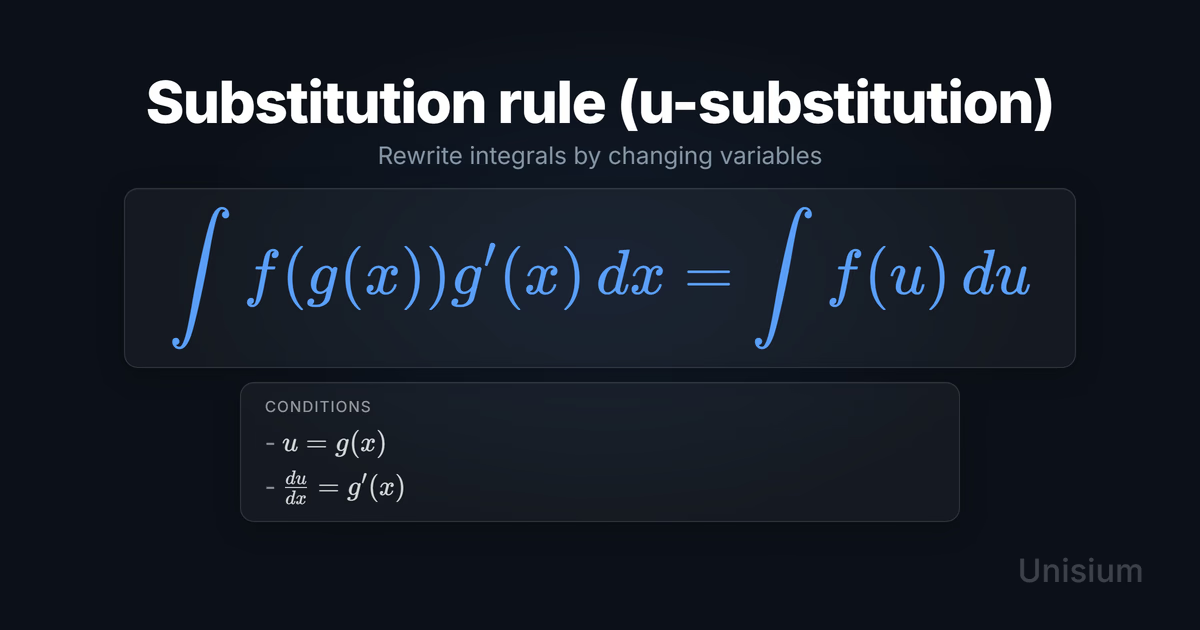
The substitution rule rewrites an integral in a new variable so the chain-rule structure becomes easier to integrate: choose , replace the matching differential, and integrate in . It applies when you can set and match to the integrand; choosing is not enough unless the matching factor is present or honestly accounted for.
On this page: The Principle | Conditions | Failure Modes | EE Questions | Retrieval Practice | Practice Ground | Solve a Problem | Related Principles | FAQ | How This Fits
The Principle
The move: Replace a repeated inner expression with a new variable , convert the matching differential, and integrate in the simpler variable.
The invariant: This rewrites the integral as an equivalent antiderivative problem under a valid change of variable.
Pattern:
| Applies directly ✓ | Does not apply directly ✗ |
|---|---|
Left: choosing gives , so the needed differential is present. Right: the inner expression is visible, but its derivative factor is missing, so the direct substitution step is not justified yet.
Conditions of Applicability
Condition: ;
Before applying, check: identify a candidate inner expression , then confirm the integrand contains the matching differential factor needed to replace by .
If the condition is violated: a direct change of variables drops or invents a factor, so the rewritten integral is not equivalent to the original one.
- The usable pattern is not just “something complicated inside another function.” The matching derivative factor has to be present, up to a constant multiple you can account for honestly.
- Constant factors are allowed if you keep them visible, as in after .
- If the derivative factor is missing entirely, as in , substitution does not apply directly to the whole integral even though the inner expression is obvious.
- Compare this move with the derivative chain rule: differentiation multiplies by the inner derivative, while substitution recognizes that same factor during integration.
Want the complete framework behind this guide? Read Masterful Learning.
Common Failure Modes
Failure mode: switch to because an inner expression looks convenient, but ignore whether the matching differential is present → the new integral is not equivalent to the original one, so the antiderivative is wrong.
Debug: after choosing , point to the exact factor in the integrand that becomes . If you cannot point to it, the substitution is not licensed yet.
Elaborative Encoding
Use these questions to build deep understanding. (See Elaborative Encoding for the full method.)
Within the Principle
- Why does replacing by only work when the differential factor is accounted for at the same time?
- In what sense is the rewritten -integral the same antiderivative task rather than a new problem with new meaning?
For the Principle
- When you scan an integrand, what tells you that an inner expression is genuinely usable for substitution instead of merely noticeable?
- How do constant multiples change the bookkeeping in a valid substitution without changing whether the move is available?
Between Principles
- How does this rule reverse the chain structure created by the derivative chain rule, and how does it differ from applying the integral power rule directly?
Generate an Example
- Create one integral where -substitution applies in one step and one near-miss where the inner expression is visible but the differential factor is missing. Explain what condition check separates them.
Retrieval Practice
Answer from memory, then click to reveal and check. (See Retrieval Practice for the full method.)
State the move in one sentence: _____Choose u = g(x), replace the matching differential g'(x) dx by du, and integrate the simpler u-expression.
Write the canonical equation: _____
State the canonical condition: _____
Practice Ground
Use these exercises to build move-selection fluency. (See Self-Explanation for how to use worked examples effectively.)
Procedure Walkthrough
Starting from , reach a finished antiderivative.
| Step | Expression | Operation |
|---|---|---|
| 0 | - | |
| 1 | Let , so and rewrite the integral in | |
| 2 | Integrate the simpler -expression | |
| 3 | Substitute back to the original variable |
Drills
Forward step (Format A)
Apply substitution directly and finish the antiderivative.
Reveal
Let , so . Then
Apply substitution directly and finish the antiderivative.
Reveal
Let , so and . Then
Does substitution apply directly to the whole integral? Explain before writing anything else.
Reveal
No. The obvious inner expression is , but choosing gives , and the factor is not present.
The near-miss is structural: the inside is visible, but the matching differential is missing, so the direct substitution step is not justified.
Which integrals are direct substitution matches?
(i) \quad (ii) \quad (iii) \quad (iv)
Reveal
(i) and (iii).
- (i) works with and ; the constant factor is manageable.
- (iii) works with and .
- (ii) has a visible inner expression but no matching differential.
- (iv) is integrable, but substitution is not the intended direct move here because there is no inner expression to change variables around.
Apply substitution directly and finish the antiderivative.
Reveal
Let , so and . Then
Action label (Format B)
What was done between these two steps?
Reveal
Substitution with coefficient bookkeeping. Let , so . Then , which leaves
What tempting move was attempted here, and why does it not apply directly?
Reveal
An invalid direct substitution was attempted.
If , then . The needed differential factor is missing, so the rewritten integral is not equivalent to the original one.
What substitution was used in this step, and why is it valid?
Reveal
Let , so . The numerator matches the new differential exactly, which makes the step valid:
Transition identification (Format C)
Which transition uses substitution directly?
Reveal
Transition (1) uses substitution directly.
- (1) rewrites the integral with and .
- (2) is the power rule in the new variable.
- (3) substitutes back.
Which transition is invalid, and why?
Reveal
Transition (1) is invalid.
Choosing would require , but the integrand has only . Because the matching differential is missing, the first rewrite is not justified and the whole chain collapses.
Solve a Problem
Apply what you’ve learned with Problem Solving.
Problem: Compute
and simplify the result.
Full solution
| Step | Expression | Move |
|---|---|---|
| 0 | - | |
| 1 | Let , so | |
| 2 | Power rule in the new variable | |
| 3 | Simplify the coefficient | |
| 4 | Substitute back |
Check: differentiating gives , so the antiderivative is consistent.
Related Principles
| Principle | Relationship |
|---|---|
| Derivative chain rule | Differentiation creates the inner-derivative factor that substitution later recognizes and reverses during integration |
| Integral power rule | Often supplies the antiderivative after substitution has rewritten the integral into a simpler power of |
| Indefinite integral as antiderivative | Clarifies the object substitution preserves: a family of functions whose derivative returns the original integrand |
FAQ
What is the substitution rule for integrals?
It rewrites an integral by choosing a new variable and replacing the matching differential with . The goal is to turn the original integral into a simpler antiderivative problem in .
When can I use u-substitution directly?
Use it directly when you can identify an inner expression and the integrand contains the matching differential factor, possibly up to a constant multiple you can handle explicitly. Seeing the inside alone is not enough.
What if the derivative factor is missing?
Then the direct substitution step is not valid for the whole integral. You may need a different technique, a larger strategy, or no elementary antiderivative at all.
Do I always substitute back to x at the end?
For indefinite integrals, yes. The final antiderivative should be written in the original variable unless the context explicitly says otherwise.
How is substitution related to the chain rule?
They are inverse-looking structures. The chain rule differentiates by multiplying by , while substitution spots that same inner-derivative factor during integration and uses it to change variables.
How This Fits in Unisium
In Unisium, substitution is trained as move selection, not as a reflexive “let equal something complicated” slogan. You learn to test whether the matching differential is really present, reject near-misses early, and reinforce that judgment through retrieval practice, self-explanation, and the broader logic of Masterful Learning. After you can spot valid substitutions on sight, practice the same recognition directly in the Unisium app.
Explore further:
- Principle Structures - See where substitution sits in the calculus principle hierarchy
- Substitution rule (definite integral) - Extend the same matching pattern to definite integrals where the bounds change with the variable
- Elaborative Encoding - Build deeper understanding of why the differential match matters
- Retrieval Practice - Make the pattern and condition instantly accessible
Masterful Learning
The book behind these guides: a study system for physics, math, & programming built on retrieval, connection, explanation, and problem solving.
Ready to apply this strategy?
Unisium turns these evidence-based techniques into guided study sessions for math and physics. Places are limited during early access. Check current availability to start a trial; joining the mailing list is optional.
See plans and availability Read More GuidesAlready have access? Sign in