Functions: The Principle Map
This guide maps the step-level principles you’ll use when working with functions: declaring functions by rule, evaluating by substitution, handling piecewise rules, composing and inverting functions, representing transformed functions, and rewriting between exponential and logarithmic forms.
Students usually get lost with functions when they cannot tell whether a step is evaluating an input, specifying a rule, combining functions, transforming a graph, or using an inverse; this map organizes those moves by purpose so each step has a reason.
Here for retrieval practice? Jump to the practice section.
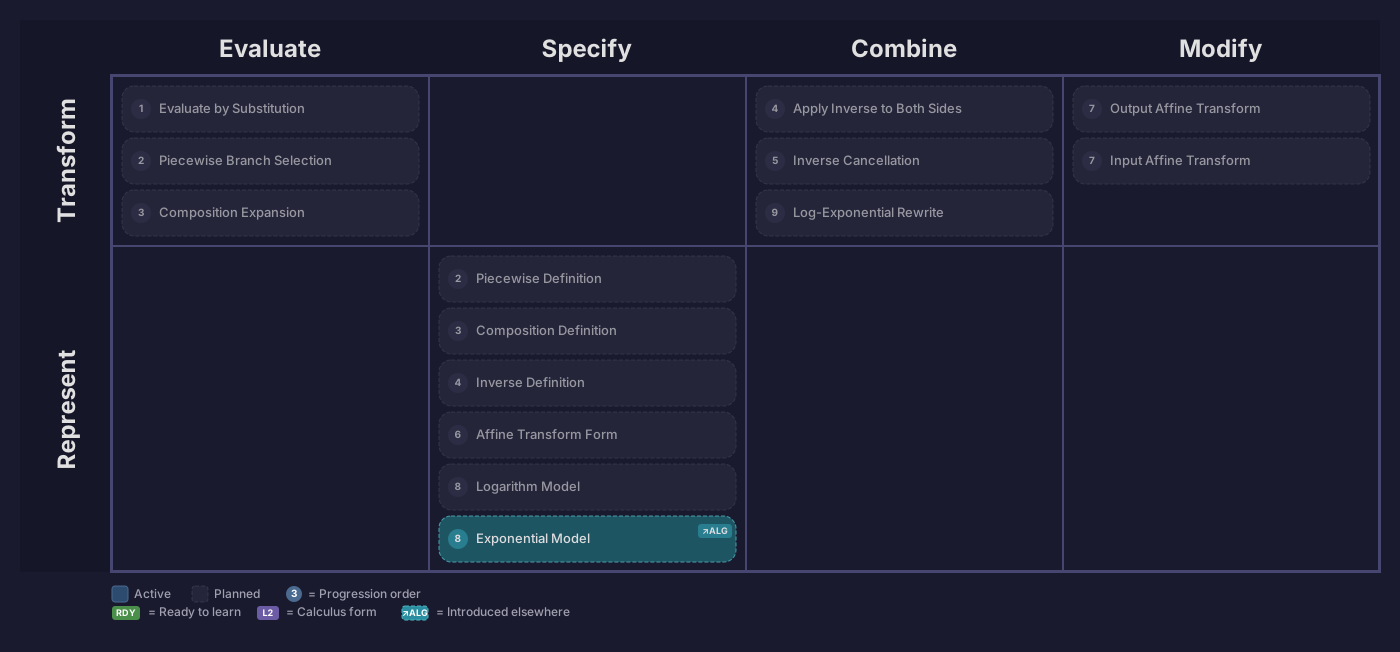
This reference map shows the functions principles as one inspectable structure. Use it to distinguish steps that evaluate, specify, combine, or modify functions, and to see whether each principle transforms an expression or represents a function relationship.

Names-only reference map: a complete reference map of function principles organized by purpose (evaluate, specify, combine, modify) and role (representational or transformational).
On this page
- Why Learn Functions?
- Prerequisites
- The Principle Map
- Practice recalling the principles
- Core Principles
- What’s Next?
- How This Fits in Unisium
Why Learn Functions?
Functions are the bridge from arithmetic and algebra to advanced mathematics and modeling. They let you describe how one quantity depends on another—temperature over time, position versus velocity, cost as a function of production volume. Every time you build a model, optimize a system, or analyze change, you’re working with functions.
In calculus, you’ll differentiate and integrate functions. In statistics, you’ll fit function models to data. In physics, position and velocity are functions of time. In computer science, algorithms transform inputs to outputs using function-like rules. Functions are the language of quantitative relationships across STEM.
This guide maps the principles that make you fluent with functions: how to state functions by rule, evaluate them, combine them, invert them, and represent transformed versions of them. Master these, and you’ll be ready for calculus, modeling, and deeper mathematical reasoning.
Prerequisites
Mathematics:
- Algebra (expression manipulation, equation solving, inequalities)
- Basic interval/inequality fluency (useful in later function topics)
Prior Subdomains:
- Algebra
Notation: Throughout this guide, denotes the set of allowed inputs for , and (the range of ) denotes the set of output values produces for inputs in .
The Principle Map
The Functions principle map organizes principles along two axes:
- Horizontal (Purpose): Three categories representing what you’re doing—Evaluate (compute values), Specify (define function forms), and Combine (inverse machinery and rewrites).
- Vertical (Principle role): Represent principles define objects and relationships; Transform principles justify the rules and moves you execute.
Represent appears above Transform: first establish the objects and relationships in the model, then use valid transformations in the procedure. The learning sequence moves across both rows.
Progression numbers provide a recommended learning sequence. If you are building function fluency from scratch, follow them in order; if you are reviewing, use the tables as a map to the exact move or object you need.
Practice recalling the principles
This flashcard tool helps make the main function principles stronger and easier to access from memory. You practice recalling each principle’s equation or form and its conditions before revealing the answer.
Use it if you often recognize function rules after seeing them, but struggle to remember which form or move to use, what it means, or when it applies. Start with the first part of the map, then add more purposes or principle roles when you want a broader review.
Why this works
This practice format is adapted from research on structured retrieval practice of physics principle structures. The direct studies were in introductory physics, but the learning move is the same here: retrieve the principle’s equation/form and conditions before relying on the completed map. The broader strategy is explained in the Retrieval Practice guide.
Research basis:
- Gjerde, Holst, & Kolstø (2020). Retrieval practice of a hierarchical principle structure in university introductory physics: Making stronger students. Physical Review Physics Education Research, 16(1), 013103.
- Gjerde, Havre Paulsen, Holst, & Kolstø (2022). Problem solving in basic physics: Effective self-explanations based on four elements with support from retrieval practice. Physical Review Physics Education Research, 18(1), 010136.
- Gjerde, Marisaldi, Oksavik, Olafsson, Spångberg, & Holst (2025). Mandatory retrieval test to incentivize retrieval practice of physics principles. Physical Review Physics Education Research, 21(1), 010119.
Equation/form
Conditions
No principles match those filters. Choose at least one purpose, principle role, and layer.
Core Principles
Conditions tell you when a principle applies. They’re intentionally concise—think of them as the main assumptions. You’ll refine what they really mean through practice.
Progression numbers indicate the global learning order. Tables below are grouped by purpose (Evaluate/Specify/Combine), so progression numbers may not be monotone within each table.
Evaluate: Compute Values (Progression 2-4)
| Principle | Equation | Condition | |-----|-----------|----------|-----------| | Evaluate by Substitution | | | | Piecewise Branch Selection | | | | Composition Expansion | | ; |
These are the core computational moves: substitute values, select the right branch, expand compositions at specific points.
Specify: Define Function Forms (Progression 1-8)
| Principle | Equation | Condition | |-----|-----------|----------|-----------| | Function Rule Definition | | domain restrictions stated or implied by the rule | | Piecewise Definition | | regions cover domain; overlap agrees | | Composition Definition | | ; | | Inverse Definition | | one-to-one; | | Affine Transform Form | | ; | | Exponential Model | | ; ; | | Logarithm Model | | ; ; |
The exponential model is introduced in Algebra and revisited here because exponential and logarithmic families are part of the normal function toolkit you need before calculus.
These are the representational objects—the function forms you’ll recognize and reason about. Explicit rules, piecewise functions, compositions, inverses, and transformed functions are locally defined in Functions; the logarithm model is the native logarithmic family; and the exponential model is canonically introduced in Algebra, appearing here as a cross-referenced function family.
Combine: Inverse Machinery (Progression 5, 9)
| Principle | Equation | Condition | |-----|-----------|----------|-----------| | Apply Inverse to Both Sides | | one-to-one; | | Inverse Cancellation | ; | one-to-one; for , ; for , | | Log-Exponential Rewrite | | ; ; |
Solving with inverses: apply to both sides, then simplify using cancellation. The cancellation principle covers both valid inverse-composition directions, so sometimes you recover the original input and sometimes the original output. Convert between log and exponential forms when needed.
How Transformations Fit This Map
This map treats graph and rule transformations through Affine Transform Form in the Specify section. Once you can read , most follow-up work is evaluation, comparison, and interpretation, so Evaluate by Substitution becomes the main computational partner.
Output-only and input-only affine changes still matter, but they are easiest to learn as special cases of one shared transform form rather than as isolated formulas.
What’s Next?
Enabled Subdomains:
- Calculus (once you have Functions + Algebra)
- Trigonometry (benefits from function fluency)
- Statistics (function models for regression, distributions)
Suggested Learning Path:
- Evaluate (2-4): Core computational moves—substitution, branch selection, composition expansion.
- Specify (1-8): Learn the representational forms—explicit rules, piecewise, composition, inverse, affine transforms, logarithm, and the exponential model (canonically from Algebra; cross-referenced here).
- Combine (5, 9): Solving with inverses—apply, cancel, and log/exp conversion.
- Transformations in context: Read graph and rule transformations through affine transform form, then evaluate transformed rules directly when solving problems.
Suggested routes through this map:
- Start with explicit rules and value-finding: Function Rule Definition and Evaluate by Substitution give you the basic language of functions and the first reliable way to compute outputs.
- Build piecewise fluency next: Piecewise Definition and Piecewise Branch Selection teach you how branch conditions control evaluation and boundary behavior.
- Learn composition and inverse structure together: Composition Definition, Composition Expansion, Inverse Definition, Apply Inverse to Both Sides, and Inverse Cancellation form the core algebra of combining and undoing functions.
- Use transformed forms and logarithms to round out the toolkit: Affine Transform Form, Exponential Model, Logarithm Model, and Log-Exponential Rewrite cover the families and rewrites that show up constantly in precalculus and early calculus.
- Carry the structure into calculus: Derivative Chain Rule depends directly on composition structure, while Left-hand Limit Statement, Right-hand Limit Statement, and Continuity at a Point reuse the same boundary logic you practice with piecewise functions.
Use the Unisium Study System to practice each principle with spaced repetition, elaborative encoding, and retrieval practice.
How This Fits in Unisium
Unisium trains functions in two complementary ways:
Principles in isolation (fast, targeted)
- Elaborative Encoding: answer short questions to build understanding
- Retrieval Practice: recall the equation + condition
Principles in context (real problem skill)
- Self-Explanation: step through worked solutions and justify each move
- Problem Solving: solve new problems and practice selecting the right principle under uncertainty
The principle map is your navigation layer: it shows what to learn next, and it explains why some problems feel harder (they combine more principles across columns and rows).
FAQ
How long does it take to master these function principles?
With consistent spaced repetition practice, most learners achieve solid fluency in 3-5 weeks. The evaluate principles (2-4) typically solidify within 1-2 weeks, while inverse machinery and transformed-function work may take 2-3 weeks of regular review.
Do I need calculus to use this guide?
No. This Functions guide focuses on pre-calculus function concepts. However, mastering these principles is essential preparation for calculus—you’ll work with derivatives and integrals of these function families.
Why aren’t domain and range listed as separate principles?
Domain and range are properties that emerge from function rules, not taggable steps in solutions. We explain the notation ( and ) but don’t treat “identify the domain” as a standalone principle—it’s embedded in evaluation and composition conditions.
Masterful Learning
The book behind these guides: a study system for physics, math, & programming built on retrieval, connection, explanation, and problem solving.
Ready to apply this strategy?
Unisium turns these evidence-based techniques into guided study sessions for math and physics. Places are limited during early access. Check current availability to start a trial; joining the mailing list is optional.
See plans and availability Read More GuidesAlready have access? Sign in