Algebra: The Principle Map
Algebra is the skill of transforming expressions and equations without changing what they mean. This guide gives you a principle map: which moves preserve equivalence, which statements are models, and how it all builds toward solving real problems.
Use this hub as the route through the algebra cluster: start with the main entry-point guides for each family, then drop into the shorter repair guides when a specific move keeps breaking.
Here for retrieval practice? Jump to the practice section.
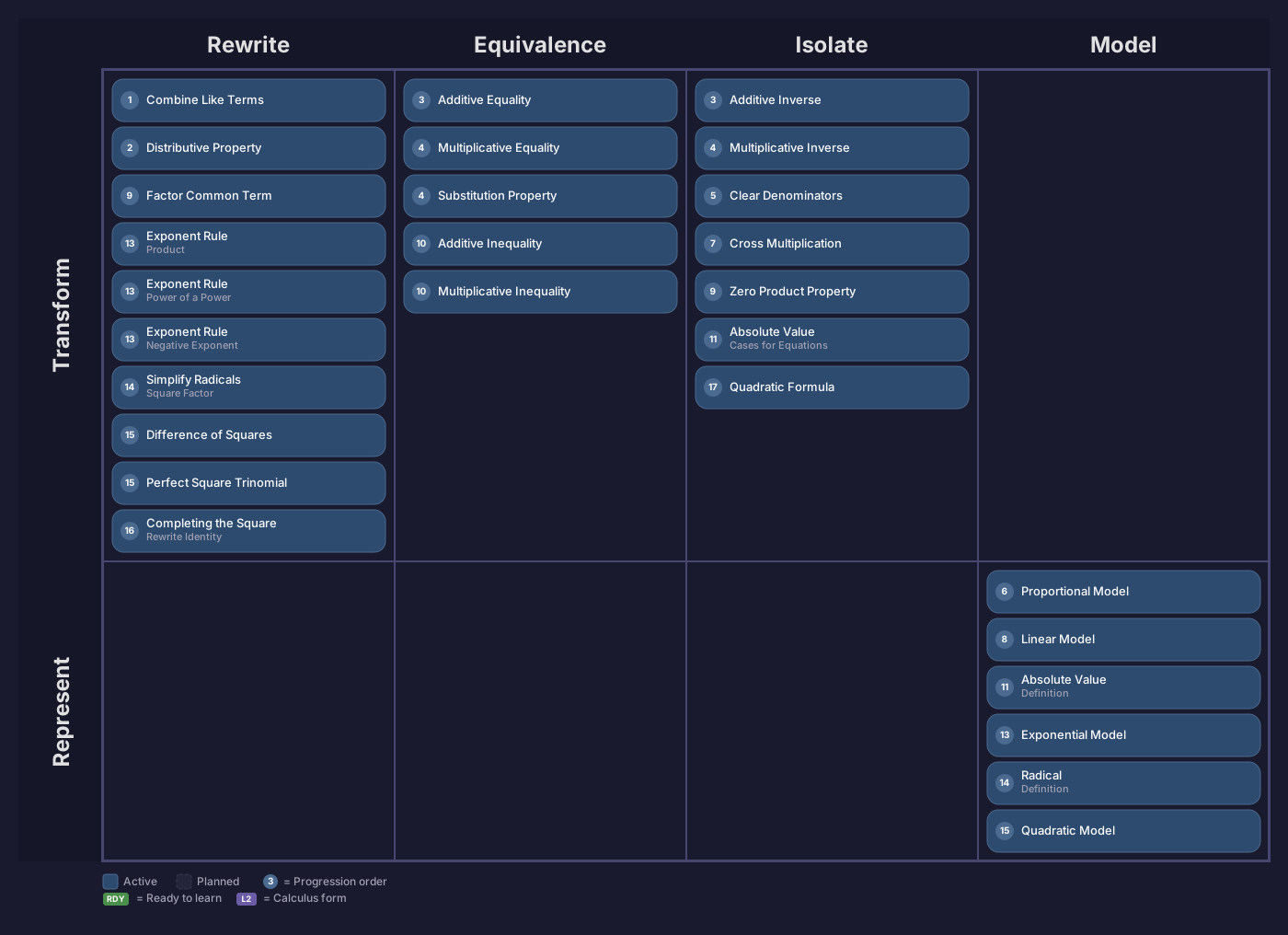
This reference map shows the algebra principles as one inspectable structure. Use it to see how rewrite moves, equivalence-preserving moves, isolation moves, and algebraic models sit across transformational and representational roles.

The Algebra principle map: a complete reference map of 30 algebra principles organized by purpose (rewrite, equivalence, isolate, model) and role (transformational or representational).
On this page
- Why Learn Algebra?
- Prerequisites
- The Principle Map
- Practice recalling the principles
- How to Use This Map
- Guide Paths Through Algebra
- Core Principles
- Extended Algebra Paths
- What’s Next?
- How This Fits in Unisium
Why Learn Algebra?
Algebra is the operating system for basically all STEM math: physics, statistics, programming, economics, you name it. The point isn’t “get ”; it’s learning to do valid local steps so your work is checkable, debuggable, and transferable.
Every time you simplify, isolate, or substitute, you’re implicitly invoking a principle. Making those principles explicit is what transforms algebra from “pattern matching formulas” into actual mathematical reasoning.
Prerequisites
Mathematics:
- Arithmetic fluency: negatives, fractions, ratios, percentages
- Order of operations and basic simplification
- Reading and writing simple equations
Prior Subdomains:
- None—Algebra is a foundation subdomain
The Principle Map
The principle map organizes Algebra along two axes:
Columns (What you’re trying to do):
- Rewrite/Simplify — change the form of an expression without changing its value
- Preserve Equivalence — keep both sides equal (or the inequality relation intact)
- Isolate/Solve — get the unknown alone on one side
- Model/Define — represent relationships or define concepts
Rows (Principle role):
- Transform (valid step) — rules that justify a rewrite or operation
- Represent (model/definition) — statements that define or model a relationship
Progression numbers (P1, P2, …) indicate learning order. Lower numbers come first. Principles with the same progression number are at the same conceptual level.
Solid nodes are active. Ghosted/dashed nodes are planned: they belong in the map already, but aren’t fully shipped in the learning path yet.
Practice recalling the principles
This flashcard tool helps make the main algebra principles stronger and easier to access from memory. You practice recalling each principle’s equation or form and its conditions before revealing the answer.
Use it if you often recognize algebra moves after seeing them, but struggle to remember which move or model to use, what it means, or when it applies. Start with the first part of the map, then add more purposes or principle roles when you want a broader review.
Why this works
This practice format is adapted from research on structured retrieval practice of physics principle structures. The direct studies were in introductory physics, but the learning move is the same here: retrieve the principle’s equation/form and conditions before relying on the completed map. The broader strategy is explained in the Retrieval Practice guide.
Research basis:
- Gjerde, Holst, & Kolstø (2020). Retrieval practice of a hierarchical principle structure in university introductory physics: Making stronger students. Physical Review Physics Education Research, 16(1), 013103.
- Gjerde, Havre Paulsen, Holst, & Kolstø (2022). Problem solving in basic physics: Effective self-explanations based on four elements with support from retrieval practice. Physical Review Physics Education Research, 18(1), 010136.
- Gjerde, Marisaldi, Oksavik, Olafsson, Spångberg, & Holst (2025). Mandatory retrieval test to incentivize retrieval practice of physics principles. Physical Review Physics Education Research, 21(1), 010119.
Equation/form
Conditions
No principles match those filters. Choose at least one purpose, principle role, and layer.
How to Use This Map
The map is a menu of legal moves.
In Unisium terms:
- Represent principles label what a statement is (model/definition).
- Transform principles label why a rewrite is valid.
A good rule: each new line should be defensible by a principle (sometimes more than one applies; Unisium will typically quiz you on one).
Micro-example (structured like Unisium)
Problem: Solve for :
Model (Represent):
- M1: — linear model
(This is a linear equation in - a special case of a linear model.)
Procedure (Transform):
-
P1: — apply the additive inverse move (undo +7)
(equivalently justified by additive equality: add to both sides) -
P2: — simplify (arithmetic; no new principle)
-
P3: — apply the multiplicative inverse move (undo x3)
(equivalently justified by multiplicative equality: multiply both sides by ) -
P4: — simplify (arithmetic)
When you’re stuck, use the map like this:
- Pick the column that matches your intent (rewrite / equivalence / isolate / model).
- Pick a principle node in that column that matches the structure you see.
- Write the resulting expression as the output of applying that principle.
When you make an error, the principle citation tells you exactly where your reasoning broke down.
Guide Paths Through Algebra
Use the map and the guide links together. Some pages below are the best first stop for a whole family; others are short repair guides that help when one local move keeps failing.
Foundation moves
- Start here: Additive Equality for both-sides balance in equations, and Combine Like Terms for expression cleanup that should feel automatic.
- Use next: Additive Inverse and Multiplicative Equality for equation solves, then Multiplicative Inverse and Clear Denominators when division and fractions start controlling the work.
- If stuck, review: Distributive Property before you try to collect or factor terms, and Substitution Property when the right move is replacement rather than rearrangement.
Ratios and models
- Start here: Proportional Model when the relationship passes through the origin, and Linear Model when there is a constant rate plus a starting value.
- Use next: Cross Multiplication when a proportion needs to become an explicit equation.
- If stuck, review: Multiplicative Equality or Clear Denominators before forcing a ratio solve that is still blocked by structure.
Inequalities and absolute value
- Start here: Additive Inequality for same-move-on-both-sides reasoning with inequalities, and Absolute Value Definition when the bars represent distance rather than decoration.
- Use next: Multiplicative Inequality when scaling enters the solve, then Absolute Value Cases Equations when the definition has to split into cases.
- If stuck, review: Additive Equality for the balance logic underneath inequality work, and Square Root Property when you are confusing absolute-value cases with plus-or-minus roots.
Exponents and radicals
- Start here: Exponential Model if the main question is growth or decay, Exponent Product Rule if the main problem is rewriting powers, and Radical Definition if roots themselves are still fuzzy.
- Use next: Exponent Power of a Power Rule and Negative Exponent Rule for exponent cleanup, then Simplify Radicals by Extracting a Square Factor and Square Root Property when radical expressions turn into equation-solving moves.
- If stuck, review: Radical Definition before using root rules mechanically, and Exponential Model before treating every power expression as just a rewrite exercise.
Factoring and quadratics
- Start here: Factor Common Term for structural cleanup, and Quadratic Model when the real question is what a curved relationship means.
- Use next: Zero Product after factoring exposes factors, then Difference of Squares, Perfect Square Trinomial, Quadratic Factoring, Completing the Square, and Quadratic Formula as the solving route becomes more specialized.
- If stuck, review: Distributive Property before factoring patterns, Linear Model before deciding a relationship is truly quadratic, and Square Root Property when quadratic solving turns into a root step.
Core Principles
Conditions tell you when an equation is valid.
They’re intentionally short here—think of them as the main assumptions. You’ll refine what they really mean through practice.
definition in the condition column means the equation is a definition (valid by stipulation).
Simplify Expressions (P1–P2)
| Principle | Equation | Condition |
|---|---|---|
| Combine Like Terms | Same variables and exponents | |
| Distributive Property | Always applies |
Preserve Equivalence (P3-P4)
| Principle | Equation | Condition |
|---|---|---|
| Additive Equality | Always applies | |
| Multiplicative Equality | ||
| Substitution Property | Always applies |
Isolate by Undoing (P3-P4)
| Principle | Equation | Condition |
|---|---|---|
| Additive Inverse | Always applies | |
| Multiplicative Inverse |
Clear Fractions (P5)
| Principle | Equation | Condition |
|---|---|---|
| Clear Denominators | All denominators |
Watch out: Clearing denominators changes the form fast, so always note which values make a denominator zero. Those values are excluded and must not appear in your final solution set.
Proportional Relationships (P6–P7)
| Principle | Equation | Condition |
|---|---|---|
| Proportional Model | ||
| Cross Multiplication |
Linear Relationships (P8)
| Principle | Equation | Condition |
|---|---|---|
| Linear Model | ; |
Factoring & Zeros (P9)
| Principle | Equation | Condition |
|---|---|---|
| Factor Common Term | Terms share a common factor | |
| Zero Product Property | Always applies |
Exponential Relationships (P13)
| Principle | Equation | Condition |
|---|---|---|
| Exponential Model | ; ; |
Extended Algebra Paths
These principles are already placed in the map and progression. Some guide pages may be available on the site while the app learning path or rollout is still catching up, so treat this section as the next layer beyond the core algebra route rather than as a promise that every item is fully active everywhere.
Inequalities (P10)
| Principle | Equation | Condition |
|---|---|---|
| Additive Inequality | Always applies | |
| Multiplicative Inequality | ; flip if |
Absolute Value (P11)
| Principle | Equation | Condition |
|---|---|---|
| Absolute Value - Definition | ||
| Absolute Value - Cases for Equations |
Systems of equations in Algebra v1 are solved via substitution. Row operations and elimination are covered in Linear Algebra.
Exponent Rewrite Rules (P13)
Exponential Model is part of the live guide path above. The rewrite-rule guides here are the neighboring algebra moves that support that family.
| Principle | Equation | Condition |
|---|---|---|
| Exponent Product Rule | Same base; defined where expressions are defined | |
| Exponent Power Rule | Defined where expressions are defined | |
| Negative Exponent Rule |
Radicals (P14)
| Principle | Equation | Condition |
|---|---|---|
| Radical - Definition | ||
| Simplify Radicals (Square Factor) | ||
| Square Root Property |
Quadratics (P15–P17)
| Principle | Equation | Condition |
|---|---|---|
| Quadratic Model | ||
| Difference of Squares | Defined where expressions are defined | |
| Perfect Square Trinomial | Defined where expressions are defined | |
| Quadratic Factoring | Factors exist over the working number system | |
| Completing the Square (Rewrite Identity) | ||
| Quadratic Formula |
What’s Next?
A sensible path after Algebra depends on what you’re trying to do. Inside algebra, the best move is usually to follow one of the family routes above until the local bottleneck is gone.
Functions & Graphs (planned): If you want transformations, composition, inverses, exponentials/logs as functions (objects you manipulate), rather than just equations you solve.
Linear Algebra (planned): If you want vectors, matrices, and system-solving as a main object—essential for data science, physics, and computer graphics.
Physics subdomains: If you want to apply algebra to modeling immediately. Classical Mechanics is a natural next step—every physics problem involves algebraic manipulation.
Suggested Learning Path (Core Algebra):
- Simplify (P1–P2) — get comfortable with expression manipulation
- Equivalence (P3) — understand what keeps equations balanced
- Isolation (P4) — the core of “solving for ”
- Fractions & Proportions (P5–P7) — handle rational expressions
- Linear Models (P8) — connect algebra to graphing
- Factoring & Zeros (P9) — complete the core toolkit
After core algebra, continue to inequalities, absolute value, exponents/radicals, and quadratics (P10–P17), then move outward into physics or later math subdomains with a stronger symbolic base.
How This Fits in Unisium
In the Unisium Study System, each step you take is tied to exactly one principle: either a transform (valid rewrite) or a representation (model/definition). That means your work stays locally checkable—and your weaknesses become obvious and fixable.
Unisium trains algebra in two complementary ways:
Principles in isolation (fast, targeted)
- Elaborative Encoding: answer short questions to build understanding
- Retrieval Practice: recall the equation + condition
Principles in context (real problem skill)
- Self-Explanation: step through worked solutions and justify each move
- Problem Solving: solve new problems and practice selecting the right principle under uncertainty
The principle map is your navigation layer: it shows what to learn next, and it explains why some problems feel harder (they combine more principles across columns).
Masterful Learning
The book behind these guides: a study system for physics, math, & programming built on retrieval, connection, explanation, and problem solving.
Ready to apply this strategy?
Unisium turns these evidence-based techniques into guided study sessions for math and physics. Places are limited during early access. Check current availability to start a trial; joining the mailing list is optional.
See plans and availability Read More GuidesAlready have access? Sign in