Derivative of a constant: Any constant differentiates to zero
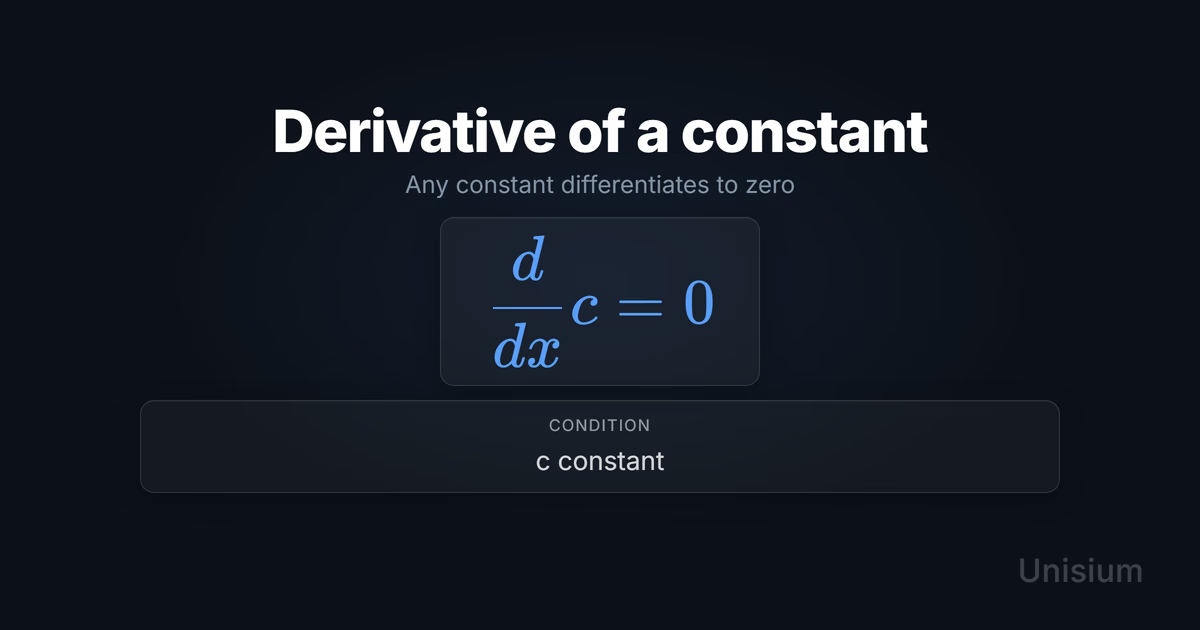
The derivative of a constant is always zero: for any constant . The rule applies whenever the expression being differentiated has no dependence on the variable of differentiation. The common near-miss is treating a term like as constant because is constant; the whole expression still depends on .
On this page: The Principle | Conditions | Failure Modes | EE Questions | Retrieval Practice | Practice Ground | Solve a Problem | FAQ
The Principle
The move: Replace the derivative of any constant expression with zero.
The invariant: This preserves the value of the derivative: replacing with on any constant term does not change the result.
Pattern:
| Legal ✓ | Illegal ✗ |
|---|---|
| — is constant, condition holds | — depends on the variable; condition fails (correct result: ) |
Left: is a fixed number — it does not change with , so the constant rule applies. Right: is the differentiation variable; it depends on and is not constant, so the rule does not apply. The move is blocked.
Conditions of Applicability
Condition: c constant
Before applying, check: confirm the entire expression being differentiated has no dependence on the variable of differentiation.
- Any specific number (, , , ) is constant — the rule applies.
- A parameter (such as or ) is constant with respect to if it does not depend on — when is independent of .
- Any expression involving the differentiation variable (, , ) is not constant — the rule does not apply.
- A common near-miss: cannot use the constant rule because as a whole is not constant, even though the coefficient is.
Want the complete framework behind this guide? Read Masterful Learning.
Common Failure Modes
Failure mode: apply the constant rule to an expression that contains the differentiation variable — for example, treating because “3 is a constant” → wrong derivative (the true result is ).
Debug: ask “does this entire expression change as the variable changes?” Check the full expression, not just a factor. If yes, the constant rule does not apply — use the constant multiple rule, power rule, or another rule for the full expression.
Elaborative Encoding
Use these questions to build deep understanding. (See Elaborative Encoding for the full method.)
Within the Principle
- What does the derivative measure, and why must it equal zero for an expression that never changes?
- Does it matter which letter the variable of differentiation is? Could give zero when is a constant?
For the Principle
- How do you decide that an expression qualifies as a “constant” before applying this rule?
- What role does the constant rule play in a longer differentiation chain, such as ?
Between Principles
- The derivative sum rule lets you split a sum before differentiating. How does the constant rule interact with that rule when one term of the sum is a constant?
Generate an Example
- Construct a differentiation expression where the constant rule seems applicable but the condition fails. Describe what goes wrong if you apply it anyway.
Retrieval Practice
Answer from memory, then click to reveal and check. (See Retrieval Practice for the full method.)
State the move in one sentence: _____The derivative of any constant is zero: replace d/dx c with 0 whenever c does not depend on the variable.
Write the canonical pattern: _____
State the canonical condition: _____c constant
Practice Ground
Use these exercises to build move-selection fluency. (See Self-Explanation for how to use worked examples effectively.)
Procedure Walkthrough
Starting from , reach the simplified derivative. One term survives; one does not.
| Step | Expression | Operation |
|---|---|---|
| 0 | — | |
| 1 | Sum rule — distribute the derivative over addition | |
| 2 | Constant multiple + power rule: | |
| 3 | Constant rule: is constant, condition holds ✓ | |
| 4 | Simplify |
Drills
Forward step (Format A)
Apply the constant rule once. State the condition check. Assume does not depend on .
Reveal
The variable of differentiation is . Since does not depend on , neither nor depends on — the entire expression is constant with respect to . Condition holds ✓.
The expression contains letters, but “constant” means no dependence on the differentiation variable — here .
Apply the constant rule once. State the condition check. Assume does not depend on .
Reveal
The variable of differentiation is , not . Since does not depend on , it is constant with respect to . Condition holds ✓.
“Constant” is always relative to the differentiation variable, not to whether the expression contains letters.
Apply the constant rule once. State the condition check. Assume is a constant with respect to .
Reveal
is a constant parameter — it does not depend on . Condition holds ✓.
This applies whether is a named constant like or an unspecified parameter; what qualifies it is that it does not change with .
Can the constant rule be applied here? State the condition check and explain your decision.
Reveal
No — the condition fails. is the variable of differentiation; it changes as changes and is not constant.
The constant rule does not apply. The correct result is (by the power rule: ).
Can the constant rule be applied here? State the condition check and explain your decision.
Reveal
No — this is a near-miss. Although is a constant, the expression as a whole is not constant: it changes with . The condition for the constant rule is that the entire expression being differentiated is constant.
The correct result is (by the constant multiple rule: ).
Can the constant rule be applied here? State the condition check. Assume and are both constant with respect to .
Reveal
Yes — the whole expression is constant with respect to . Although contains the letter , that does not depend on , so the entire expression is fixed as varies. Condition holds ✓.
The constant rule applies even when the expression contains letters, as long as none of them depend on the variable of differentiation.
Action label (Format B)
What was done between these two steps? Verify whether the move is valid. Assume does not depend on .
Reveal
Constant rule applied. does not depend on — it is constant with respect to the variable of differentiation. Condition holds ✓.
What was done at each arrow? Identify which rule was applied.
Reveal
Arrow (1): Sum rule — the derivative was distributed over addition.
Arrow (2): Power rule on giving ; constant rule on giving . The expression is constant, condition holds ✓.
What was done between these two steps? Is the move valid?
Reveal
Invalid — the condition fails. This attempted move treats as a constant and applies the constant rule, but depends on and is not constant.
The correct result is (by the constant multiple rule: ).
What was done in this step? Identify the rules and verify the condition for each.
Reveal
Two rules were applied simultaneously. The constant multiple rule and power rule gave . The constant rule gave : is constant, condition holds ✓.
Transition identification (Format C)
In the evaluation chain below, identify which step applies the constant rule. Verify the condition at that step.
Reveal
Step (3) applies the constant rule: . The expression is constant, condition holds ✓.
Step (1) applied the sum rule. Step (2) applied the constant multiple and power rules to and . Step (4) simplified .
Solve a Problem
Apply what you’ve learned with Problem Solving.
Problem: Differentiate , using the constant rule as a key step. Show the condition check before applying it.
Full solution
| Step | Expression | Move |
|---|---|---|
| 0 | — | |
| 1 | Sum rule — distribute over each term | |
| 2 | Constant multiple + power rule: | |
| 3 | Constant multiple + power rule: | |
| 4 | Constant rule: is constant, condition holds ✓ | |
| 5 | Simplify |
Related Principles
| Principle | Relationship |
|---|---|
| Derivative at a point | The limit definition that grounds the constant rule — a constant’s difference quotient is zero |
| Derivative constant multiple rule | Closest sibling: once a constant multiplies a nonconstant expression, the whole expression is no longer constant and this rule takes over |
| Power rule | The next differentiation move; together with the constant rule it handles all monomials |
| Derivative sum rule | Lets you isolate constant terms in a sum so the constant rule can be applied to each |
FAQ
What is the derivative of a constant?
The derivative of any constant is zero: for any constant . A constant function is flat — it has no slope — so its rate of change is zero everywhere.
Why does differentiating a constant give zero?
The derivative measures how a function changes as the variable changes. A constant does not change at all, so its rate of change is zero at every point. Using the limit definition: gives , so the difference quotient is for all , and its limit is .
Does the constant rule apply to expressions like ?
No. Although is a constant, the expression as a whole is not constant — it changes with . The rule applies to the entire differentiated expression, not to factors inside it. For , use the constant multiple rule: the result is , not .
How do I recognize that an expression qualifies as a constant?
Ask: “Does this expression change as the variable changes?” Any fixed number (, , , ) is constant. Any expression containing the differentiation variable (, , , ) is not constant and does not qualify. When differentiating with respect to , the variable is constant if and only if it is independent of .
What is the difference between a constant number and a constant coefficient?
A constant number like can be the entire differentiated expression — (constant rule). A constant coefficient like the in is a multiplicative factor, not the full expression — you use the constant multiple rule: .
How This Fits in Unisium
Within the calculus subdomain, derivative fluency is built by training move selection before execution — recognizing which rule applies before applying it. For the constant rule, that means asking “is the entire expression constant?” before writing . The near-miss drills above (expressions like or that share visual features with constant expressions) build the diagnostic precision that separates fluent differentiation from careless pattern-matching. Spaced retrieval practice then locks in the condition and pattern automatically.
Explore further:
- Calculus Subdomain Map — Return to the calculus hub to see where the constant rule sits in the first derivative-rule family
- Derivative at a point — The limit definition that proves why the constant rule holds
- Derivative constant multiple rule — The next rule to use when a constant factor multiplies an expression that still depends on
- Elaborative Encoding — Build deep understanding of why zero is always the correct result
- Retrieval Practice — Make the condition and pattern instantly accessible
Ready to master the constant rule? See Unisium’s 14-day free trial or explore the full learning framework in Masterful Learning.

Masterful Learning
The book behind these guides: a study system for physics, math, & programming built on retrieval, connection, explanation, and problem solving.
Ready to apply this strategy?
Unisium turns these evidence-based techniques into guided study sessions for math and physics. Places are limited during early access. Check current availability to start a trial; joining the mailing list is optional.
See plans and availability Read More GuidesAlready have access? Sign in