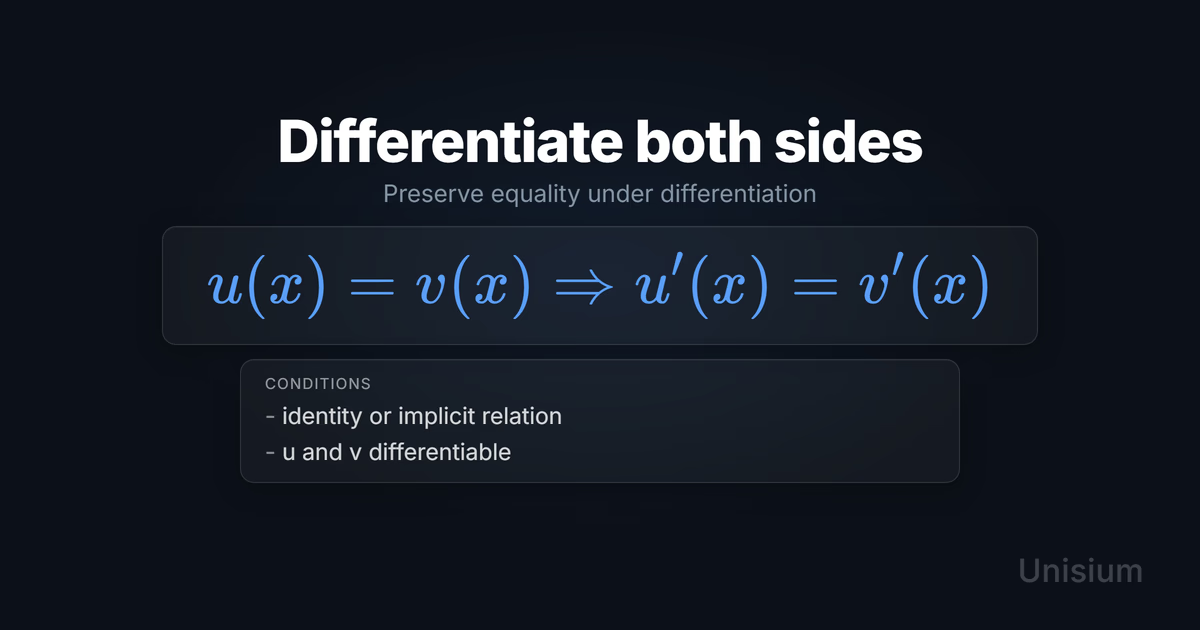
Differentiate both sides: Preserve equality under differentiation
Differentiate both sides is the move that applies to an identity or implicit relation and produces , preserving equality under differentiation. It applies when and are differentiable in the setting where the relation is being used, so move selection means checking both the relation itself and the derivative existence before you transform the equation. Building that check into every derivative chain is a core fluency skill practiced in the Unisium Study System.
On this page: The Principle | Conditions | Failure Modes | EE Questions | Retrieval Practice | Practice Ground | Solve a Problem | Related Principles | FAQ | How This Fits
The Principle
The move: Apply to both sides of an identity or implicit relation , producing a new equation between the derivatives.
The invariant: This preserves equality under differentiation, so the transformed equation remains true wherever the relation holds and both sides are differentiable.
Pattern:
| Legal ✓ | Illegal ✗ |
|---|---|
| ; the relation holds and both sides are differentiable with respect to | at ; the equation is true only at one point, not as an identity or implicit relation in a neighborhood where the move can act |
The tempting mistake is to treat any equation that happens to be true at one point as automatically eligible. It is not. The move acts on a differentiable relation, not on a one-point coincidence or a random equation-to-solve.
Conditions of Applicability
Condition: identity or implicit relation; u and v differentiable
Differentiability is not enough. The equation must function as an identity or implicit relation in the setting where you are differentiating, not merely be true at one point, and each side must define a differentiable function of the same variable in the part of the domain where you are working.
Before applying, check: confirm that the equation is being used as an identity or implicit relation, and that both sides have derivatives in the current setting.
- If the equation is only true at one isolated point, differentiating both sides can create a false new equation; the move is not valid there.
- If one side has a corner, cusp, vertical tangent, or domain break where you want to differentiate, the move is not valid there.
- In implicit-differentiation problems, treating as is part of the setup; then both sides must still be differentiable with respect to .
Want the complete framework behind this guide? Read Masterful Learning.
Common Failure Modes
Failure mode: differentiate a one-point coincidence or a non-differentiable equation as though it were a differentiable relation → the new derivative equation is not justified and can be false.
Debug: ask “does this relation hold in the setting I am differentiating, and do both sides have derivatives there?” before writing a new line.
Elaborative Encoding
Use these questions to build deep understanding. (See Elaborative Encoding for the full method.)
Within the Principle
- Why does the move preserve equality only for a relation you are legitimately differentiating, rather than for every equation that happens to be true at one point?
- In an implicit equation like , why does differentiating both sides create a term instead of treating like a constant?
For the Principle
- How do you decide whether the equation is an identity, an implicit relation, or only an equation-to-solve? Why does that distinction decide whether differentiate-both-sides is even available?
- What changes if a relation holds on an interval but one side fails to be differentiable at an isolated point inside that interval?
Between Principles
- How does differentiate-both-sides differ from the derivative chain rule? One authorizes acting on the whole equation; the other authorizes differentiating a composite expression on one side. Where do they appear together in an implicit-differentiation chain?
Generate an Example
- Construct an equation that is true at one point but not as a relation in a neighborhood, and explain why differentiating both sides there would create a false derivative equation.
Retrieval Practice
Answer from memory, then click to reveal and check. (See Retrieval Practice for the full method.)
State the move in one sentence: _____If u(x)=v(x) is the relation you are differentiating, apply d/dx to both sides to get u'(x)=v'(x).
Write the canonical pattern: _____
State the canonical condition: _____identity or implicit relation; u and v differentiable
Practice Ground
Use these exercises to build move-selection fluency. (See Self-Explanation for how to use worked examples effectively.)
Procedure Walkthrough
Starting from , differentiate both sides with respect to .
Assume is a differentiable function of .
| Step | Expression | Operation |
|---|---|---|
| 0 | — | |
| 1 | Differentiate both sides — valid because is the relation being studied and both sides are differentiable with respect to | |
| 2 | Derivative sum rule on the left; derivative of a constant on the right | |
| 3 | Power rule on and chain rule on |
Drills
Format A: Forward step
Apply the move, then simplify the derivative expressions enough to make the new equation readable.
Differentiate both sides of the identity
Reveal
This is legal because is an identity, and each side is differentiable for all real .
Assume is differentiable as a function of . Differentiate both sides of
Reveal
This is a legal implicit-differentiation step: the relation is being studied as a curve, and both sides are differentiable with respect to .
Assume is differentiable as a function of . Differentiate both sides of
Reveal
Differentiate the whole relation first, then use the product rule and chain rule inside the new derivative equation.
[Near-miss — negative] At , can you differentiate both sides of
Reveal
No. The displayed equation is true at , but it is not the relation you are differentiating in any neighborhood of .
If you tried the move anyway, you would get , and then at . This is the key near-miss: one-point truth is not enough. Differentiate-both-sides acts on a differentiable relation, not on an isolated coincidence.
Format B: Action label
Name the move being used, and say why it is or is not legal.
What move takes this equation to the next line? Why is it valid?
Reveal
Differentiate both sides. It is valid because is the relation being studied and both sides are differentiable with respect to .
What move is used first in the chain below?
Reveal
The first move is differentiate both sides. After that, the later simplification uses the derivative sum rule on and the chain rule on .
This distinction matters: the whole equation is transformed first; the term-by-term derivative rules come afterward.
[Negative] A student writes
Is the move legal? Explain the exact condition failure.
Reveal
Illegal. This is an equation-to-solve, not an identity or implicit relation being differentiated.
Even though both expressions are differentiable, the move has no relation to act on here. Differentiability alone is not enough; the equality must be the differentiable relation under study.
Format C: Transition identification and eligibility
Locate where the move appears, or decide whether the equation is eligible for it.
Which transition uses differentiate both sides?
| Transition | From | To |
|---|---|---|
| 0→1 | ||
| 1→2 | ||
| 2→3 |
Reveal
Transition 0→1 uses differentiate both sides.
Transition 1→2 uses the derivative sum rule and constant rule. Transition 2→3 uses the power rule and chain rule.
[Negative] Which of these are eligible for differentiate-both-sides in the stated setting? Give a one-line reason for each.
- for all
- at
- , with differentiable as a function of
- at
Reveal
- Eligible — it is an identity, and both sides are differentiable for all .
- Not eligible — it is true only at one isolated point, not as a relation in a neighborhood.
- Eligible — it is the implicit relation being studied, and the setup assumes is differentiable.
- Not eligible — although the equality is true, neither side is differentiable at .
This is the real eligibility check: are you differentiating a genuine relation, and do both sides have derivatives in that setting?
In the implicit-differentiation chain below, which step is the differentiate-both-sides step, and which step uses the derivative chain rule?
Reveal
- The differentiate-both-sides step is the first arrow: .
- The chain rule appears in the second arrow when becomes .
The whole-equation move and the within-expression move are different rules that appear back-to-back.
Solve a Problem
Apply what you’ve learned with Problem Solving.
Problem: Starting from , differentiate both sides with respect to . Assume is differentiable as a function of .
Full solution
| Step | Expression | Move |
|---|---|---|
| 0 | — | |
| 1 | Differentiate both sides | |
| 2 | Derivative sum rule and constant rule | |
| 3 | Product rule on and chain rule on | |
| 4 | Group the terms as a genuine algebraic state change |
Related Principles
| Principle | Relationship |
|---|---|
| Derivative at a point | Foundational meaning of a derivative; differentiate-both-sides assumes each side has a derivative to take |
| Derivative sum rule | Usually appears immediately after differentiating both sides when a side contains added terms |
| Derivative chain rule | Powers implicit differentiation: after differentiating both sides, composite terms such as and create the factor through the chain rule |
FAQ
What does “differentiate both sides” mean?
It means applying to the entire identity or implicit relation so that the next line is . The move acts on the equation first; only after that do you simplify each derivative using rules like the sum rule, product rule, or chain rule.
When is it legal to differentiate both sides?
It is legal when the displayed equality is the differentiable relation you are studying and both sides are differentiable in that setting. If you are differentiating an identity, the identity must hold on the interval you are using. If you are differentiating an implicit relation, the relation is treated locally and each side must still have a derivative there.
Why is the move common in implicit differentiation?
Implicit equations like do not isolate first. Differentiating both sides turns the whole relation into a derivative equation, and then the chain rule converts derivatives of -expressions into terms involving . That is why the move is often the first step in implicit differentiation.
What goes wrong when one side is not differentiable?
The transformed equation includes a derivative that does not exist, so the move has no theorem behind it. This is why near-miss examples like at matter: the equality is true, but the condition fails, so you cannot differentiate both sides there.
Why can’t I use this on any equation that happens to be true at one point?
Because the move differentiates a relation, not a coincidence. An equation like is true at , but it is not true as a relation in a neighborhood of . Differentiating both sides would create the false new equation , which immediately breaks at that same point.
Do I simplify the equation before or after differentiating both sides?
Either can be correct, but they answer different tactical questions. If simplifying first reveals an easier identity, that can be better. If the goal is implicit differentiation or preserving a relation between variables, differentiating both sides first is often the cleanest entry point. The key is that the condition must still hold wherever you choose to apply the move.
How This Fits in Unisium
Differentiate both sides is a move-selection principle about relation type as much as derivative mechanics. Unisium trains it as the entry step that converts an identity or implicit relation into a derivative equation, then layers follow-up rules such as the derivative sum rule and derivative chain rule to finish the chain. The goal is to make both guards automatic: do I have a real relation to differentiate, and do both sides have derivatives in this setting?
Explore further:
- Calculus Subdomain Map — Return to the calculus map to see where implicit differentiation begins inside the derivative application layer
- Derivative chain rule — the rule that creates terms after differentiate-both-sides in implicit equations
- Self-Explanation — use the drills above to explain not only what move is legal, but why tempting alternatives fail
- Retrieval Practice — make the equation and condition retrievable on demand
Ready to master differentiate both sides? See Unisium’s 14-day free trial or explore the full learning framework in Masterful Learning.
Masterful Learning
The book behind these guides: a study system for physics, math, & programming built on retrieval, connection, explanation, and problem solving.
Ready to apply this strategy?
Unisium turns these evidence-based techniques into guided study sessions for math and physics. Places are limited during early access. Check current availability to start a trial; joining the mailing list is optional.
See plans and availability Read More GuidesAlready have access? Sign in