Chain rule: Differentiating Composite Functions
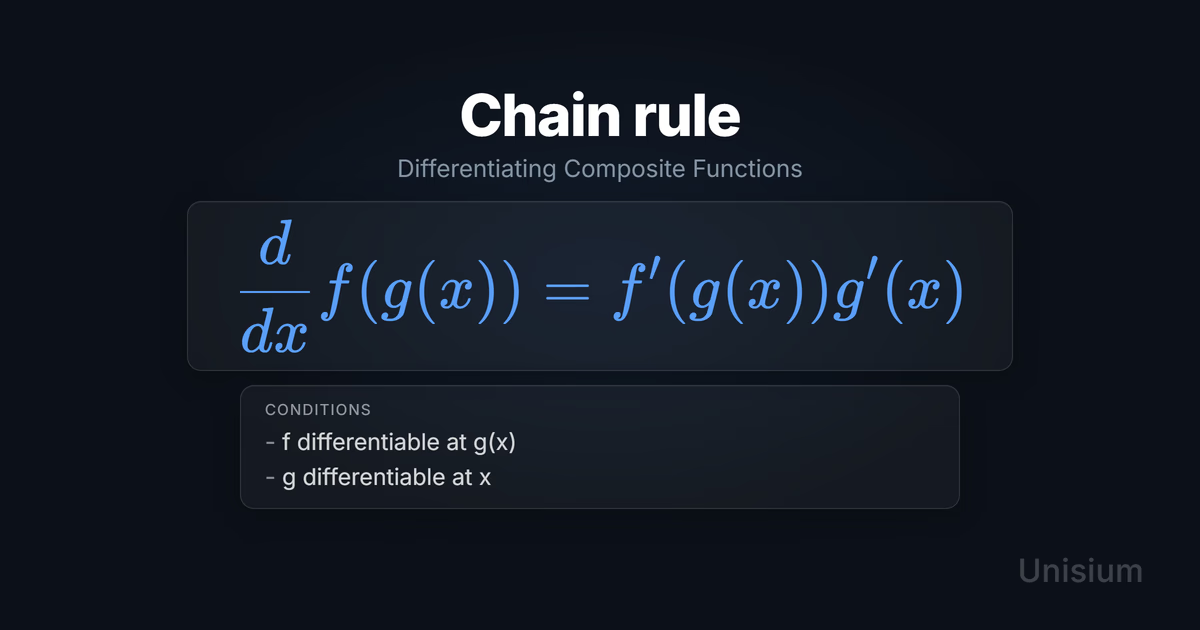
The chain rule lets you differentiate a composite function by multiplying the outer derivative by the inner derivative — provided both and are differentiable at the relevant points. Move selection means recognizing a genuine composition and checking both differentiability conditions before applying the rule. Building that recognition automatically is a core goal of the Unisium Study System.
On this page: The Principle | Conditions | Failure Modes | EE Questions | Retrieval Practice | Practice Ground | Solve a Problem | Related Principles | FAQ
The Principle
The move: Differentiate a composite function by evaluating the outer derivative at the inner function, then multiplying by the derivative of the inner function.
The invariant: This produces an expression equal to the derivative of — the outer-then-inner multiplication correctly captures how the composition’s rate of change depends on both layers.
Pattern:
| Legal ✓ | Illegal ✗ |
|---|---|
| — outer differentiable everywhere; condition holds | — this attempted chain-rule move differentiates at , where the outer derivative does not exist |
At , the inner value is , and the outer function is not differentiable at . The composition looks eligible, but the attempted move fails exactly at the condition check.
Conditions of Applicability
Condition: f differentiable at g(x); g differentiable at x
Both layers of the composition must be differentiable: the inner function must have a derivative at , and the outer function must have a derivative at — the output of the inner function at that point.
Before applying, check: identify the outer function and inner function ; confirm that is differentiable at and that is differentiable at the value produces.
If the condition is violated: the chain rule cannot be applied at that point — the expression may still have a derivative via another route, or it may be non-differentiable.
- When is not differentiable at (for example, at ), the chain rule cannot be applied from that layer outward.
- When is not differentiable at (for example, when ), the chain rule cannot be applied — even if the composite expression happens to have a limit elsewhere.
- For a positive constant base , the constant-base exponential derivative supplies the outer derivative before the chain rule adds the factor .
Want the complete framework behind this guide? Read Masterful Learning.
Common Failure Modes
Failure mode: differentiate the outer function at the inner value but omit the factor → the result is wrong by a missing multiplicative factor; for non-linear , the missing factor is never , so the error is always visible in the final answer.
Debug: after writing , ask “have I multiplied by the inner derivative?” If the inner function is anything other than the bare variable , a factor is present and must appear.
Elaborative Encoding
Use these questions to build deep understanding. (See Elaborative Encoding for the full method.)
Within the Principle
- Why does the chain rule multiply by rather than add it or apply instead?
- What does “differentiable at ” mean precisely — why does the outer function’s differentiability depend on the inner function’s output value rather than on directly?
For the Principle
- How do you recognize, when examining an expression, that it is a composition requiring the chain rule rather than a product or sum?
- What changes about the procedure when the inner function is itself a composite of a third function?
Between Principles
- How does the chain rule differ from the product rule, and how does the composition structure from function composition tell you that is an input-nesting relationship rather than a product ?
Generate an Example
- Describe a composite function where the outer function is continuous but not differentiable at the exact value that the inner function produces at some point . Explain why the chain rule fails there but the function itself is still defined.
Retrieval Practice
Answer from memory, then click to reveal and check. (See Retrieval Practice for the full method.)
State the chain rule in one sentence: _____Differentiate the outer function at the inner function, then multiply by the inner function's derivative: f'(g(x)) times g'(x).
Write the canonical chain rule pattern: _____
State the canonical condition: _____f differentiable at g(x); g differentiable at x
Practice Ground
Use these exercises to build move-selection fluency. (See Self-Explanation for how to use worked examples effectively.)
Procedure Walkthrough
Starting from , compute .
Outer: , differentiable everywhere. Inner: , differentiable everywhere. Both conditions hold.
| Step | Expression | Operation |
|---|---|---|
| 0 | — | |
| 1 | Chain rule: outer evaluated at inner; inner derivative written as a separate factor | |
| 2 | Sum rule on the inner derivative: differentiate each term of separately | |
| 3 | Power rule on and constant rule on | |
| 4 | Simplify the inner derivative and collect the product |
Drills
Format A: Forward step
Apply the chain rule to find the derivative.
Apply the chain rule to differentiate .
Reveal
Outer (differentiable everywhere), inner (differentiable everywhere). Both conditions hold.
Apply the chain rule to differentiate .
Reveal
Outer (differentiable everywhere), inner (differentiable everywhere).
Determine whether the chain rule can be applied to differentiate at . If it cannot, explain why.
Reveal
The chain rule cannot be applied at .
The outer function is NOT differentiable at . The inner value is . Condition fails: is not differentiable at .
The chain rule requires to be differentiable at — that requirement is violated here.
Apply the chain rule to differentiate for .
Reveal
Outer (differentiable for ), inner for . Both conditions hold.
Apply the chain rule to differentiate .
Reveal
Outer (differentiable everywhere), inner (differentiable everywhere).
Apply the chain rule to differentiate .
Reveal
Rewrite as . Outer (differentiable for ), inner everywhere.
Format B: Action label
Identify the rule applied, or spot the error in the proposed step.
What rule was applied — and why is it valid — in the step below?
Reveal
Chain rule. Outer (differentiable everywhere) differentiated at inner , giving . Multiplied by inner derivative . Both differentiability conditions hold everywhere.
Which of the following expressions require the chain rule to differentiate? Identify all that do.
(a) (b) (c) (d)
Reveal
(b) and (d) require the chain rule — both are composite functions with a non-trivial inner function.
- (a) is a product of two functions of : use the power rule and product rule.
- (b) : outer , inner — chain rule required.
- (c) is a sum of elementary functions: use the sum rule plus standard derivatives directly.
- (d) : outer , inner — chain rule required.
Identify the error in the proposed differentiation below.
Reveal
The inner derivative factor is missing. The chain rule requires multiplying the outer derivative by . The correct step is:
Label what happened in the transition below. State the outer function, the inner function, and the inner derivative used.
Reveal
Chain rule applied with:
- Outer , so , evaluated at : gives .
- Inner , so .
- Result: .
Format C: Transition identification
The computation below differentiates . Identify which steps use the chain rule and explain the outer/inner pair for each.
| Step | Expression |
|---|---|
| 0 | |
| 1 | |
| 2 | |
| 3 |
Reveal
Steps 1 and 2 both use the chain rule:
- Step 0 → 1: outer , inner . Chain rule: .
- Step 1 → 2: outer , inner . Chain rule: .
- Step 2 → 3: algebraic cancellation and simplification only — no differentiation rule applied.
Solve a Problem
Apply what you’ve learned with Problem Solving.
Problem: Compute where . Apply the chain rule twice: first to the outer exponential, then to the cubic inner layer.
Full solution
| Step | Expression | Move |
|---|---|---|
| 0 | — | |
| 1 | Chain rule: outer , inner | |
| 2 | Chain rule again: outer , inner | |
| 3 | Sum and power rules on the inner derivative: | |
| 4 | Multiply the constants and collect the factors |
Related Principles
| Principle | Relationship |
|---|---|
| Derivative at a Point | Foundation — every derivative rule stands on the limit definition, and the chain rule inherits that derivative object before it becomes a reusable move |
| Derivative Product Rule | Product rule handles two separate factors ; the chain rule handles one function nested inside another as |
| Derivative Power Rule | Power rule often supplies the outer derivative when the chain rule is applied to powers such as |
| Derivative of e^x | Common outer-rule case: chain rule turns the direct derivative into when the exponent is nontrivial |
| Derivative of ln(x) | Common outer-rule case: chain rule turns the direct derivative into for composite logarithms |
| Function Composition | The chain rule depends on recognizing the composition structure before choosing the move |
FAQ
What is the chain rule?
The chain rule states that the derivative of a composite function equals — the outer derivative evaluated at the inner function, multiplied by the inner derivative. It applies whenever both and are differentiable at the relevant points.
When does the chain rule apply?
It applies when you have a genuine composition with a non-trivial inner function, and when is differentiable at and is differentiable at . If either differentiability condition fails at the point of interest, the chain rule cannot be used there.
What happens if I forget the inner derivative?
Omitting gives the wrong derivative. For example, is incorrect; the correct answer is . The missing factor is never unless the inner function is itself, so the error always affects the final answer.
How is the chain rule different from the product rule?
The product rule handles a product — two functions multiplied together with the same variable. The chain rule handles a composition — one function applied inside another. The structural distinction is whether you are multiplying two functions or plugging one into the other.
Can the chain rule apply more than once in the same problem?
Yes. When the inner function is itself a composition, you apply the chain rule at each layer in succession — from outermost to innermost — multiplying the outer derivative by each successive inner derivative. This is sometimes called the “extended chain rule” or “chain of chains.”
How This Fits in Unisium
The chain rule is one of the highest-leverage moves in single-variable calculus — almost every non-trivial differentiation problem involves a composition, and fluent application requires both recognizing the composition structure and automatically checking the differentiability conditions. Unisium builds this fluency through targeted state-transition drills: you practice identifying outer and inner functions, naming the conditions, and executing the multiplication — until move selection is automatic rather than deliberate.
Explore further:
- Calculus Subdomain Map — Return to the calculus hub to see how the derivative-rule cluster is grouped around the definition and the structural rules
- Derivative Product Rule — The paired move for products rather than compositions; knowing both rules sharpens your ability to tell them apart
- Derivative of e^x — The direct exponential rule becomes a chain-rule example as soon as the exponent is instead of
- Derivative of ln(x) — The direct logarithm rule becomes a chain-rule example as soon as the input is instead of
- Function Composition — The structural concept underlying the chain rule; understanding makes outer/inner identification faster
- Power Rule — Frequently used as the outer or inner step when applying the chain rule to polynomial compositions
- Elaborative Encoding — Build deep understanding of why the inner derivative factor is mathematically necessary
- Retrieval Practice — Reinforce the condition and pattern until they are instantly accessible
Ready to master the chain rule? See Unisium’s 14-day free trial or explore the full learning framework in Masterful Learning.
Masterful Learning
The book behind these guides: a study system for physics, math, & programming built on retrieval, connection, explanation, and problem solving.
Ready to apply this strategy?
Unisium turns these evidence-based techniques into guided study sessions for math and physics. Places are limited during early access. Check current availability to start a trial; joining the mailing list is optional.
See plans and availability Read More GuidesAlready have access? Sign in