Integral constant multiple rule: Pull constants outside an integral
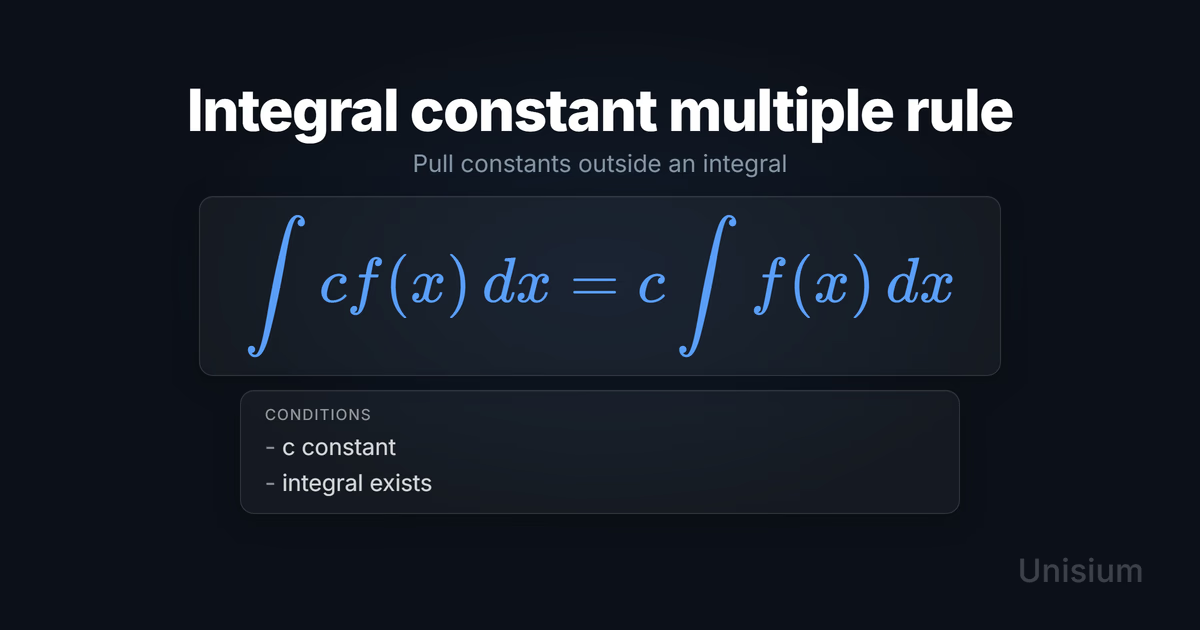
The integral constant multiple rule lets you rewrite as , pulling a true constant outside the integral without changing the antiderivative family. It applies when is constant with respect to the integration variable and the integral exists. The key boundary is that -dependent factors cannot be pulled outside just because they multiply the rest of the integrand.
On this page: The Principle | Conditions | Failure Modes | EE Questions | Retrieval Practice | Practice Ground | Solve a Problem | FAQ | How This Fits
The Principle
The move: Pull a factor that is constant with respect to the integration variable outside the integral sign.
The invariant: This preserves the antiderivative family: moving a true constant outside does not change which functions differentiate back to the original integrand.
Pattern:
| Applies ✓ | Does not apply ✗ |
|---|---|
The contrast is about applicability. In the first case, is independent of , so the rule applies. In the second, the factor depends on , so it is not the constant and the rewrite changes the integrand.
Conditions of Applicability
Condition: c constant; integral exists
The factor you pull out must be constant with respect to the integration variable, and the integral must exist. The main decision boundary in practice is whether the factor is truly constant or only looks easy to detach.
Before applying, check: ask whether the factor depends on the integration variable at all.
If the condition is violated: pulling out an -dependent factor changes the integrand instead of rewriting it equivalently, so the resulting antiderivative is wrong.
- Numbers such as , , , and are constants with respect to , so they can be pulled outside.
- Parameters such as can be treated as constants only when the integration is with respect to and the problem states or implies that is independent of .
- If the factor depends on , use a different structure such as splitting a linear combination first, substitution, or integration by parts rather than forcing this move.
- The rule rewrites one antiderivative problem into an equivalent one; it does not authorize detaching a factor just because the product looks simple.
Want the complete framework behind this guide? Read Masterful Learning.
Common Failure Modes
Failure mode: treat any multiplicative factor as though it were the constant in → you pull out an -dependent term and produce the antiderivative of a different integrand.
Debug: before moving a factor outside, point to the integration variable and ask “does this factor change when that variable changes?”
Elaborative Encoding
Use these questions to build deep understanding. (See Elaborative Encoding for the full method.)
Within the Principle
- Why does multiplying an integrand by a true constant scale every antiderivative by that same constant?
- What does the condition “c constant” protect here: algebraic neatness, antiderivative correctness, or both?
For the Principle
- What is the fastest check you can run to decide whether a factor is constant with respect to the variable of integration?
- If a factor depends on , which neighboring integration decisions become more plausible than the constant multiple rule?
Between Principles
- How does the integral constant multiple rule interact with the decision to split a linear combination such as into separate integrals before integrating term by term?
Generate an Example
- Write one integral where the constant multiple rule is valid and one near-miss where the factor looks easy to pull out but depends on the integration variable.
Retrieval Practice
Answer from memory, then click to reveal and check. (See Retrieval Practice for the full method.)
State the move in one sentence: _____Pull a constant factor outside an integral: replace the integral of c times f(x) with c times the integral of f(x).
Write the canonical equation: _____
State the canonical condition: _____c constant; integral exists
Practice Ground
Use these exercises to build move-selection fluency. (See Self-Explanation for how to use worked examples effectively.)
Procedure Walkthrough
Starting from , find an antiderivative. Assume is constant with respect to .
The selection point is the whole lesson: and can move because they are constant with respect to , but an -dependent factor would not be eligible.
| Step | Expression | Operation |
|---|---|---|
| 0 | — | |
| 1 | Integral sum rule: split the linear combination into two integrals | |
| 2 | Integral constant multiple rule on both terms: and are constant with respect to | |
| 3 | Use standard antiderivatives on the simplified integrals | |
| 4 | Simplify |
Drills
Forward step (Format A)
Apply the rule once, then finish the antiderivative or reject the move if the condition fails.
Integrate:
Reveal
Pull out the constant first:
Integrate:
Reveal
Use the constant multiple rule and the sum rule to integrate:
Reveal
Assume is constant. Integrate:
Reveal
Choose the valid first step. Which integral can begin with the constant multiple rule?
Reveal
- 1: yes. The rule applies, so the first step is because is constant with respect to .
- 2: no. The factor depends on , so it is not the constant and the rule does not apply.
This is the core discrimination the rule is meant to train.
Can the constant multiple rule be the first move here? Explain.
Reveal
No. The factor depends on , so it is not the constant . Pulling it outside would change the integrand rather than rewrite it equivalently.
Action label (Format B)
Name the move used, or explain why the attempted move is not a valid application of the rule.
What rule was used between these two lines?
Reveal
Integral constant multiple rule. The factor is independent of , so it can be pulled outside the integral sign without changing the antiderivative family.
What combination of rules was used in the step below?
Reveal
First the integral sum rule splits the difference, then the integral constant multiple rule pulls out the constants and from the two resulting integrals.
[Eligibility check — negative] Which of the following factors can be pulled outside the integral with respect to ? Assume is constant.
Reveal
- 1: yes, pull out
- 2: yes, pull out because it is constant with respect to
- 3: no, because depends on
- 4: yes, pull out
The rule is about dependence on the integration variable, not about whether a factor is numeric-looking.
Transition identification (Format C)
Locate where the rule appears, or identify the invalid transition.
Which transition uses the integral constant multiple rule?
| Transition | From | To |
|---|---|---|
| 0→1 | ||
| 1→2 | ||
| 2→3 |
Reveal
Transition 1→2 uses the integral constant multiple rule. The constants and are pulled outside their respective integrals.
Transition 0→1 uses the integral sum rule. Transition 2→3 uses standard antiderivatives.
[Negative] In the chain below, which transition is invalid, and why?
Reveal
Transition (1) is where the rule does not apply. The factor depends on the integration variable, so it is not the constant .
This integral needs a different method, typically integration by parts, not the integral constant multiple rule.
Goal micro-chain (Format D)
Reach the target form in the fewest justified moves.
Starting from
reach an antiderivative with the constant factors already pulled outside.
Reveal
One minimal chain is
If you continue from there,
Solve a Problem
Apply what you’ve learned with Problem Solving.
Problem: Find an antiderivative of .
Full solution
| Step | Expression | Move |
|---|---|---|
| 0 | — | |
| 1 | Integral sum rule | |
| 2 | Integral constant multiple rule | |
| 3 | Standard antiderivatives | |
| 4 | Simplify |
FAQ
What is the integral constant multiple rule?
It is the rule
which says a factor constant with respect to the integration variable can be moved outside the integral sign.
When can I pull a factor outside an integral?
You can do it when that factor is constant with respect to the variable of integration and the integral itself exists in the current setting.
Why can’t I pull out from ?
Because changes with the integration variable. Pulling it outside would replace the original integrand with a different problem, so the move is not an equivalent rewrite.
Does the rule work with parameters like or ?
Yes, as long as those symbols are constant with respect to the integration variable. For example, with respect to , you may write when does not depend on .
Do I use this rule before or after the integral sum rule?
Often both appear together. A common pattern is to split a sum first, then pull constants out of each smaller integral. In simple cases, you may combine those moves mentally, but the applicability checks are still separate.
Is this rule different from the derivative constant multiple rule?
The structure is parallel, but the goal differs. The derivative rule scales a derivative, while the integral rule scales an antiderivative family. In both cases the deciding question is the same: is the factor truly constant with respect to the active variable?
How This Fits in Unisium
In Unisium, the integral constant multiple rule is one of the first move-selection checks in integration: split linear combinations cleanly, pull out only the factors that are truly constant, and leave variable-dependent structure for other tools. It connects directly to the indefinite integral as antiderivative, parallels the derivative constant multiple rule across a neighboring operation, and becomes more reliable when reinforced with retrieval practice and self-explanation.
Explore further:
- Indefinite integral as antiderivative — the model that explains what an integral answer means
- Integral sum rule — the paired linearity move that often comes right before or after pulling constants outside
- Derivative constant multiple rule — compare the same constant-factor idea in differentiation
- Principle Structures — see where this rule sits in the calculus integration map
Ready to practice constant-factor integration? See Unisium’s 14-day free trial or explore the full framework in Masterful Learning.

Masterful Learning
The book behind these guides: a study system for physics, math, & programming built on retrieval, connection, explanation, and problem solving.
Ready to apply this strategy?
Unisium turns these evidence-based techniques into guided study sessions for math and physics. Places are limited during early access. Check current availability to start a trial; joining the mailing list is optional.
See plans and availability Read More GuidesAlready have access? Sign in