Derivative of e^x: The Function Equal to Its Own Derivative
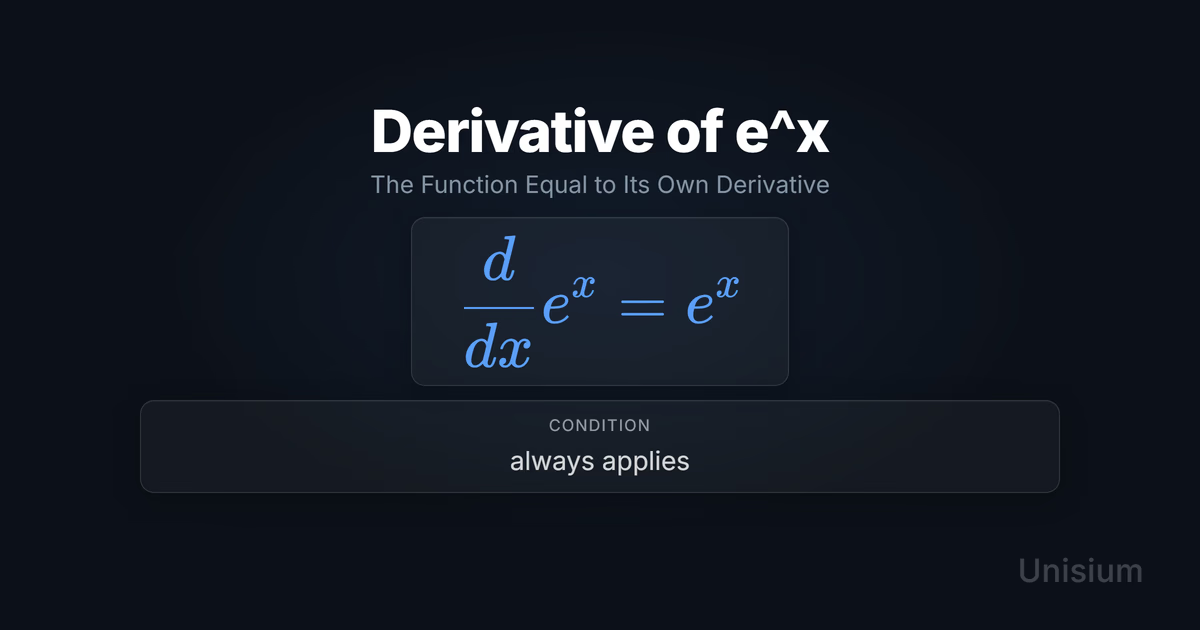
Derivative of e^x gives the exact derivative of the natural exponential in one step: . Its canonical condition is “always applies,” but the real decision is local structure: use this rule for the exact pattern, and use chain rule when the exponent is another function such as or .
On this page: The Principle | Conditions | Failure Modes | EE Questions | Retrieval Practice | Practice Ground | Solve a Problem | FAQ | How This Fits
The Principle
The move: Differentiate with respect to in one step: its derivative is again.
The invariant: Differentiating leaves the functional form unchanged: the exact derivative is again.
Pattern:
| Legal ✓ | Illegal ✗ |
|---|---|
The illegal move treats as though it were the direct pattern. The correct derivative is found by chain rule:
The mistake is not a failure of the canonical condition. It is a wrong rule choice for the local structure.
Conditions of Applicability
Condition: always applies
Before applying, check: are you taking the derivative of the exact local pattern as a direct step? If yes, apply derivativeExpRule directly. If the exponent is another expression, chain rule governs the step. If the term sits inside a sum, product, or constant multiple, that larger rule governs the whole derivative while derivativeExpRule is used locally on the term.
- The canonical condition is still “always applies.” The real decision point here is structural recognition: are you looking at the direct pattern, or at a larger structure that calls another rule first?
- If the exponent is a differentiable function rather than the bare variable , chain rule supplies the extra factor: .
- If the base is not but a general constant , use the general derivative rule for instead: .
Want the complete framework behind this guide? Read Masterful Learning.
Common Failure Modes
Failure mode: treat every exponential with base as the direct pattern and write — dropping the chain factor and misidentifying which rule governs the step.
Debug: inspect the local structure before writing the derivative. If the step is exactly , use derivativeExpRule directly. If the exponent is anything other than the bare variable, write the chain-rule factor explicitly: .
Elaborative Encoding
Use these questions to build deep understanding. (See Elaborative Encoding for the full method.)
Within the Principle
- What is special about the number that makes its own derivative — and would any other base share this property?
- Why does the derivative of equal exactly, rather than a constant multiple of ?
For the Principle
- How do you decide whether derivativeExpRule applies directly to the current local step, or whether chain rule (or product rule) governs the larger expression first?
- What changes in the derivative computation when the exponent is instead of ?
Between Principles
- How does derivativeExpRule relate to the chain rule when the exponent is a differentiable function — what extra factor appears, and where does it come from?
Generate an Example
- Describe a step in a derivative computation where applying derivativeExpRule without first inspecting the exponent would produce a wrong answer.
Retrieval Practice
Answer from memory, then click to reveal and check. (See Retrieval Practice for the full method.)
State the derivative of e^x in one sentence: _____The derivative of e^x with respect to x is e^x — the natural exponential is its own derivative.
Write the canonical equation: _____
State the canonical condition: _____always applies
Practice Ground
Use these exercises to build move-selection fluency. (See Self-Explanation for how to use worked examples effectively.)
Procedure Walkthrough
Starting from , differentiate and track which term uses derivativeExpRule directly versus which term requires chain rule.
| Step | Expression | Operation |
|---|---|---|
| 0 | — | |
| 1 | Sum rule: distribute the derivative over addition | |
| 2 | derivativeExpRule applies directly to the first term because it is exactly | |
| 3 | Chain rule on the second term: outer , inner | |
| 4 | Differentiate the inner function | |
| 5 | Simplify |
Drills
Forward step — differentiate using derivativeExpRule
Apply the rule to differentiate this expression.
Reveal
This is exactly the direct pattern, so derivativeExpRule applies directly:
Apply the rule (with constant multiple rule) to differentiate this expression.
Reveal
Constant multiple rule first; inside that step, this is exactly the direct pattern:
Evaluate: is the following derivation correct?
Reveal
No. This is not the direct pattern, so chain rule governs the step:
Does derivativeExpRule apply directly to the whole step below? If not, name the governing rule and complete the derivative.
Reveal
No. The whole expression is a product, so product rule governs the derivative, with derivativeExpRule used on the factor inside that computation:
Differentiate .
Reveal
Differentiate .
Reveal
Action label — identify which rule was applied
What was done between these two steps?
Reveal
Sum rule split the derivative across the two terms; then derivativeExpRule was used on and the power rule was used on .
What was done between these two steps?
Reveal
Constant multiple rule preserved the factor , and derivativeExpRule differentiated the term: .
A student writes: . What error was made?
Reveal
derivativeExpRule applies only to base , not to a general base . For the correct rule introduces a logarithmic factor:
In the computation below, name the rule applied to each term:
Reveal
- term: derivativeExpRule — .
- term: derivative constant rule — .
Rule attribution — locate derivativeExpRule in a larger computation
In computing , which term uses derivativeExpRule and which uses a different rule?
Reveal
- term: derivativeExpRule — .
- term: derivative of ln(x) rule — .
So .
For each expression below, state whether derivativeExpRule applies directly or another rule must be invoked first:
(a) — (b) — (c)
Reveal
(a) Direct — this is exactly the local pattern , so derivativeExpRule applies immediately.
(b) Chain rule first — the exponent is , so the derivative is .
(c) Product rule first — this is a product of and . derivativeExpRule is used on the factor within the product-rule computation, but the governing rule for the whole step is product rule: .
Solve a Problem
Apply what you’ve learned with Problem Solving.
Problem: Find the derivative of .
Full solution
| Step | Expression | Move |
|---|---|---|
| 0 | — | |
| 1 | Sum/difference rule: distribute derivative over each term | |
| 2 | Constant multiple rule: pull coefficients out | |
| 3 | derivativeExpRule on ; constant rule on gives | |
| 4 | Power rule: | |
| 5 | Arithmetic: |
FAQ
What is the derivative of ?
The derivative of with respect to is . The natural exponential is its own derivative.
What is the canonical condition for derivativeExpRule?
The canonical condition is always applies. The real challenge is move selection: recognizing when the local step is exactly and when a neighboring rule governs the whole derivative.
Does the derivative of change if there is a coefficient in front, like ?
No. Apply the constant multiple rule first: . The coefficient carries through unchanged.
What if the exponent is not just — for example or ?
Then the direct one-step pattern is no longer the whole story, and chain rule governs the derivative: . For example, and .
How is different from ?
For general base , the derivative is . The rule is the special case where , so the logarithmic factor disappears.
Can I use derivativeExpRule on ?
No — is a power function (constant exponent , variable base), not an exponential function. Apply the power rule instead: .
How This Fits in Unisium
Within the calculus subdomain, derivativeExpRule is one of the first exponential derivative rules you encounter. The main challenge is not memorizing a hidden applicability guard; it is recognizing local structure correctly. The drills above train you to separate the direct step from neighboring cases such as , , and products containing , so that you choose the governing rule correctly before differentiating.
Explore further:
- Calculus Subdomain Map — Return to the calculus hub to see where the natural exponential rule sits in the derivative family
- Chain Rule — The direct rule becomes a chain-rule problem as soon as the exponent is any nontrivial function
- Derivative of ln(x) — The paired natural logarithm rule sits next to because the two functions are inverse partners on their real domains
- Principle Structures — Where derivativeExpRule fits in the calculus derivative taxonomy
- Elaborative Encoding — Build deep understanding of why is uniquely self-replicating under differentiation
- Retrieval Practice — Make the pattern and condition instantly accessible from memory
Ready to master the derivative of ? See Unisium’s 14-day free trial or explore the full learning framework in Masterful Learning.
Masterful Learning
The book behind these guides: a study system for physics, math, & programming built on retrieval, connection, explanation, and problem solving.
Ready to apply this strategy?
Unisium turns these evidence-based techniques into guided study sessions for math and physics. Places are limited during early access. Check current availability to start a trial; joining the mailing list is optional.
See plans and availability Read More GuidesAlready have access? Sign in