Integration by parts: Reassign derivative and antiderivative roles in a product
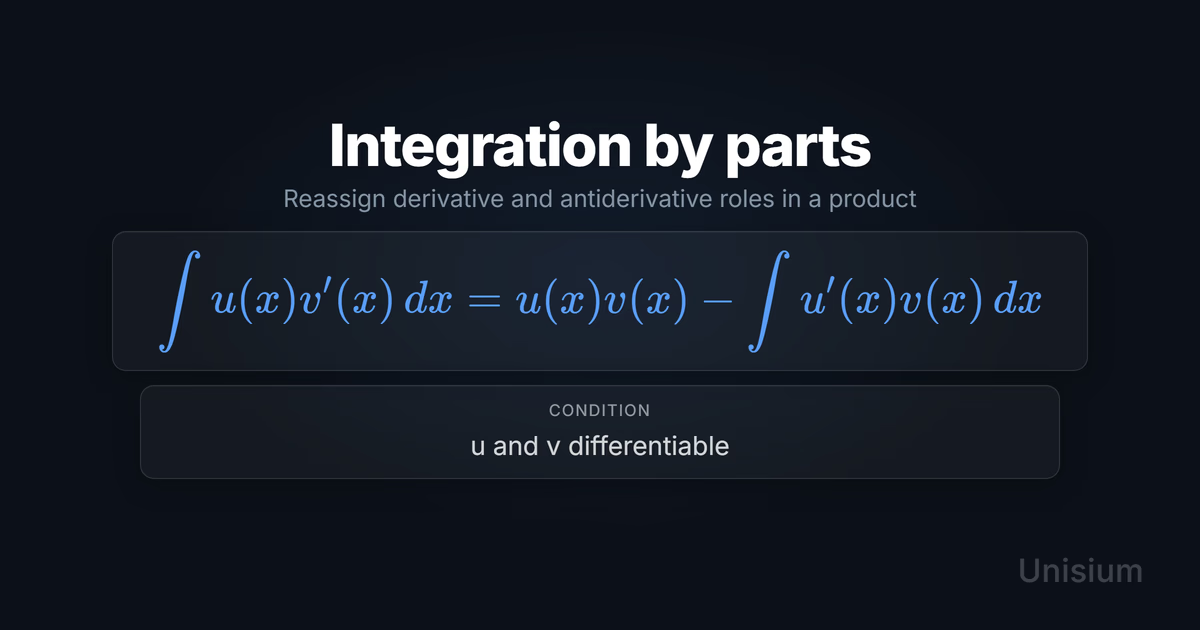
Integration by parts rewrites an integral of a product into a boundary term minus a new integral, preserving the same antiderivative family on the interval: . It applies when and are differentiable, so the core move-selection habit is checking that the chosen parts make the rewrite valid before worrying about whether they make the remaining integral easier. After the differentiability check, the useful choice is the one that makes the remaining integral simpler, not merely one that fits the product shape.
On this page: The Principle | Conditions | Failure Modes | EE Questions | Retrieval Practice | Practice Ground | Solve a Problem | Related Principles | FAQ | How This Fits
The Principle
The move: Rewrite an integral of a product as boundary term minus a new integral after choosing one part to differentiate and the other to antidifferentiate.
The invariant: This preserves the antiderivative family of the original integrand; the rewritten expression differentiates back to the same product on the same interval.
Pattern:
| Valid ✓ | Not valid ✗ |
|---|---|
Left: choose and , so both and are differentiable and the rewritten integral is valid. Right: the product shape is visible, but is not differentiable at , so the condition fails and the move is not valid on an interval containing that point.
Conditions of Applicability
Condition: u and v differentiable
Integration by parts starts from a deliberate choice of and , then uses a differentiable and a differentiable antiderivative to rewrite the integral. The rule is about a valid derivative-antiderivative swap, not about any visible product automatically qualifying.
Before applying, check: can you choose a differentiable and a differentiable such that is the other factor on the working interval?
- Product shape alone is not enough; your chosen split must produce a differentiable and a differentiable on the interval you are using.
- Strategy note: once the rewrite is valid, prefer a choice that makes the remaining integral simpler or more manageable.
- The move comes from reversing the derivative product rule, so if your split does not correspond to a product whose differentiated form you can trust, choose again.
- Keep the antiderivative target in view: after the rewrite, you are still producing an answer in the sense of indefinite integral as antiderivative, and you may combine the new integral with rules like the integral sum rule if needed.
Want the complete framework behind this guide? Read Masterful Learning.
Common Failure Modes
Failure mode: choose parts only by surface pattern, then run integration by parts where your selected or is not differentiable on the working interval → the rewrite looks formal but is not a valid application of the rule.
Debug: name your exact and before writing the formula; if either one fails differentiability on the interval, the move is not available with that choice.
Elaborative Encoding
Use these questions to build deep understanding. (See Elaborative Encoding for the full method.)
Within the Principle
- Why does the rewrite produce a minus sign, and how does that sign trace back to the product rule rather than to a memorized pattern alone?
- In , why is it useful to think of one factor as the part that becomes simpler when differentiated and the other as the part that stays manageable when antidifferentiated?
For the Principle
- When two different choices of and are both valid, what makes one choice better for finishing the problem efficiently?
- Why is differentiability part of the condition even though many classroom examples use polynomials, exponentials, or trig functions where it is automatic?
Between Principles
- How does integration by parts reverse the derivative product rule, and how is that different from the substitution logic behind the chain rule?
Generate an Example
- Create one product integral where integration by parts is a good first move and one near-miss where a chosen split fails because one selected part is not differentiable on the interval.
Retrieval Practice
Answer from memory, then click to reveal and check. (See Retrieval Practice for the full method.)
State the move in one sentence: _____Rewrite an integral of a product as uv minus the integral of u prime times v after choosing one factor to differentiate and the other to antidifferentiate.
Write the canonical equation: _____
State the canonical condition: _____u and v differentiable
Practice Ground
Use these exercises to build move-selection fluency. (See Self-Explanation for how to use worked examples effectively.)
Procedure Walkthrough
Starting from , reach a finished antiderivative. Choose and , so and .
| Step | Expression | Operation |
|---|---|---|
| 0 | - | |
| 1 | Integration by parts with and | |
| 2 | Simplify the remaining integrand | |
| 3 | Evaluate the remaining integral | |
| 4 | Factor the common exponential |
Drills
Format A: Forward step
Apply integration by parts and simplify.
Reveal
Choose and , so and .
Apply integration by parts and simplify.
Reveal
Choose and , so and .
[Negative] On an interval containing , should you apply integration by parts directly after choosing and for
Reveal
No. The split is not valid on an interval containing because the chosen is not differentiable at . The product looks suitable, but the condition fails for that choice of parts. You would need a different interval or a different method.
Apply integration by parts to compute the definite integral.
Reveal
Using the walkthrough antiderivative,
Format B: Action label
What rule was used in the step below, and what were the chosen parts?
Reveal
Integration by parts. The choice was and , so and . On , both chosen parts are differentiable, so the rewrite is valid.
What choice of parts is visible in this completed step?
Reveal
The visible choice is and . Then and , which gives
[Negative] Explain why the proposed step is not a valid direct use of integration by parts on an interval containing .
Reveal
The chosen split is and , but is not differentiable at . Since integration by parts requires the chosen and to be differentiable on the working interval, the step is not valid on any interval containing .
Format C: Transition identification
Which transition uses integration by parts directly?
Reveal
Transition (1) uses integration by parts directly. It chooses and , so and .
- (2) simplifies the minus signs.
- (3) evaluates the remaining integral.
Which proposed transitions are valid applications of integration by parts on the stated interval?
- On :
- On :
- On :
Reveal
Valid transitions: 1 and 3.
- 1 is valid on because the chosen and are differentiable there.
- 2 is invalid on because the chosen is not differentiable at .
- 3 is valid on all real numbers because and are differentiable everywhere.
Format D: Goal micro-chain
Starting from , reach a finished antiderivative in the minimum number of moves.
Reveal
One efficient chain is:
The move is repeated because the first application leaves another product that is still simpler after a second pass.
Solve a Problem
Apply what you’ve learned with Problem Solving.
Problem: Compute
and simplify the result.
Full solution
| Step | Expression | Move |
|---|---|---|
| 0 | - | |
| 1 | Integration by parts with and | |
| 2 | Simplify the remaining integrand | |
| 3 | Pull out the constant multiple | |
| 4 | Evaluate the remaining integral and simplify |
Check: differentiating gives , so the antiderivative is consistent.
Related Principles
| Principle | Relationship |
|---|---|
| Derivative product rule | Integration by parts comes from rearranging the product rule after integration |
| Indefinite integral as antiderivative | Clarifies what is preserved when the original integral is rewritten into a new antiderivative chain |
| Integral sum rule | Often helps finish the remaining integral after one or more integration-by-parts rewrites |
FAQ
What is integration by parts?
It is the rewrite
which trades one derivative for one antiderivative inside a product. The goal is not to use the formula mechanically, but to choose parts so the new integral is easier than the original one.
When is integration by parts valid?
It is valid when the chosen and are differentiable on the working interval, with matching the other factor in the product. Product shape by itself is not enough; the chosen split has to satisfy the condition.
How should I choose a function as ?
Choose so that differentiating it makes it simpler or at least no harder. A standard classroom pattern is to differentiate algebraic or logarithmic factors and antidifferentiate exponentials, trig functions, or when that makes the new integral cleaner.
Can I use integration by parts on definite integrals?
Yes. The same rewrite works, and then you evaluate the resulting antiderivative expression at the bounds. The condition still matters: your chosen and must be differentiable on the interval you are using.
Why is there a minus sign in the formula?
Because the rule comes from the product rule:
Solving that equation for and then integrating moves the term to the other side, creating the minus sign.
What if integration by parts makes the integral worse?
Then the chosen split was valid but unhelpful. The rule is still valid, but move selection failed. Try a different choice of and , or use another method instead.
How This Fits in Unisium
In Unisium, integration by parts is trained as a move-selection principle: you look at a product integral, test whether your chosen parts meet the condition, and judge whether the rewrite is likely to simplify the task. That connects directly to retrieval practice, self-explanation, and the broader logic of Masterful Learning, where the point is not memorizing a slogan but recognizing when the move is both valid and useful. To keep building this fluency across calculus, practice directly in the Unisium app once you can spot a good integration-by-parts setup on sight.
Explore further:
- Derivative product rule - Revisit the derivative identity that integration by parts algebraically reverses
- Principle Structures - See where integration by parts sits in the broader calculus map
- Elaborative Encoding - Use deeper questions to make the rule easier to recognize and justify
- Retrieval Practice - Make the condition and rewrite easier to recall under time pressure

Masterful Learning
The book behind these guides: a study system for physics, math, & programming built on retrieval, connection, explanation, and problem solving.
Ready to apply this strategy?
Unisium turns these evidence-based techniques into guided study sessions for math and physics. Places are limited during early access. Check current availability to start a trial; joining the mailing list is optional.
See plans and availability Read More GuidesAlready have access? Sign in