Continuity at a Point: Definition and the Three-Part Test
Continuity at a point means function has no break at input : is defined, exists, and both agree. This definition gives the exact condition for a function to be unbroken at a single input and is foundational to differentiability, limit composition, and most of what follows in calculus.
On this page: The Principle | Conditions | Misconceptions | EE Questions | Retrieval Practice | Worked Example | Solve a Problem | FAQ
The Principle
Statement
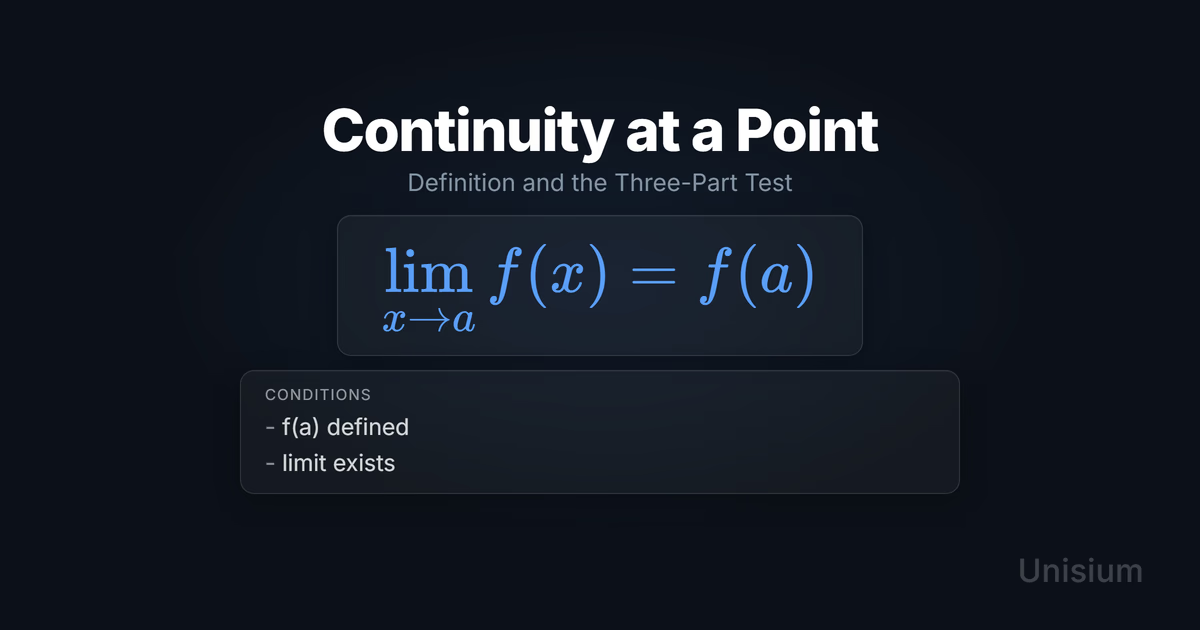
A function is continuous at a point if and only if three conditions hold simultaneously: is defined, the two-sided limit exists, and the limit equals the function value. There is no break, jump, or hole in the graph at —the function value is exactly what the function approaches from both sides.
Mathematical Form
Where:
- = a real-valued function
- = the point at which continuity is tested
- = the two-sided limit as approaches
- = the function value at
The Three-Part Test
The canonical equality is the final checkpoint inside the full continuity definition. To verify continuity at , apply these three checkpoints in order:
- is defined
- exists (both one-sided limits agree and are finite)
All three must hold. Failure at any checkpoint—even if the other two hold—means is not continuous at .
Conditions of Applicability
Condition: f(a) defined; limit exists
Practical modeling notes
- Unpack the definition into three explicit steps: check that is defined, check that the two-sided limit exists (left- and right-hand limits agree), then compare the two.
- For piecewise functions, evaluate the limit and the function value separately at each boundary point.
- For polynomials and rational functions at points in their domain, continuity holds by standard algebraic limit rules. The three-part test is still the governing definition; these families satisfy it automatically wherever they are defined.
When It Doesn’t Apply
Continuity at fails in three distinct ways:
- undefined: If is not defined, continuity at fails immediately, regardless of limit behavior. Example: at .
- Limit does not exist: The left- and right-hand limits disagree at , so no two-sided limit can match . Example: the floor function at any integer .
- Limit and value disagree: is defined and the limit exists, but . This is a removable discontinuity with the wrong fill. Example: for and .
Want the complete framework behind this guide? Read Masterful Learning.
Common Misconceptions
Misconception 1: “The limit existing is enough for continuity”
The truth: The limit must exist and equal , which must itself be defined. All three conditions are necessary—missing any one produces a discontinuity.
Why this matters: Students who skip checking will incorrectly declare continuity at holes (removable discontinuities where the formula is undefined at ).
Misconception 2: “Drawing without lifting your pencil means continuous at every point”
The truth: The informal pencil-lifting test describes continuity on an interval, not at a specific point. It also breaks down at endpoints and for functions where the graph oscillates or becomes dense.
Why this matters: The formal definition at a point is a quantitative claim. Informal reasoning is a useful starting point but not a substitute when you need to verify or prove continuity rigorously.
Misconception 3: “Undefined at and limit-does-not-exist at are the same failure”
The truth: These are distinct failure modes. The function value and the limit are computed by different procedures. Either can fail while the other holds—the three parts of the test are logically independent.
Why this matters: Treating these as identical leads to misdiagnosing the type of discontinuity and choosing the wrong repair strategy.
Elaborative Encoding
Use these questions to build deep understanding. (See Elaborative Encoding for the full method.)
Within the Principle
- What does it mean for to “exist”? What must the left- and right-hand limits satisfy for this to be true?
- If and , does that guarantee continuity at ? What additional condition are you implicitly relying on?
For the Principle
- How would you decide which of the three conditions to check first when given a piecewise-defined function?
- What happens to the continuity conclusion if you change while leaving the limit unchanged?
Between Principles
- The limit statement is the prerequisite for this principle. How is continuity a stricter claim than simply saying a limit exists at ?
Generate an Example
- Construct a function that fails continuity at because the limit exists but does not equal . How would you modify the function value to repair the discontinuity?
Retrieval Practice
Answer from memory, then click to reveal and check. (See Retrieval Practice for the full method.)
State the principle in words: _____A function is continuous at a point a if f(a) is defined, the limit as x approaches a exists, and the limit equals f(a).
Write the canonical equation: _____
State the canonical condition: _____f(a) defined; limit exists
Worked Example
Use this worked example to practice Self-Explanation.
Problem
Let for , and . Determine whether is continuous at .
Step 1: Verbal Decoding
Target: whether is continuous at
Given: ,
Constraints: is directly specified; limit must be evaluated via the formula for
Step 2: Visual Decoding
Draw an -axis and mark . Sketch the line near and note that the defined value places the point exactly where the removable hole would be.
Step 3: Mathematical Modeling
Step 4: Mathematical Procedures
Step 5: Reflection
- Verification: The computed limit equals and , so the equality check holds and the other two continuity conditions are satisfied.
- Graphical meaning: Filling the hole at with closes the gap, making the graph of connected at .
- Domain check: For , reduces to the polynomial , which is continuous everywhere on its domain.
Before moving on: self-explain the model
Try explaining Step 3 out loud (or in writing): why the continuity equality check applies here, what the factoring step tells you about the limit, and why the defined value is the key piece.
Mathematical model with explanation
Principle: Continuity at a Point — is continuous at if and only if .
Conditions: is defined (given). exists: after cancelling the removable factor , both one-sided limits approach .
Relevance: This is a removable-discontinuity scenario. The formula produces a form at , but the defined value exactly fills the hole in the graph.
Description: Factoring and cancelling is valid because the limit process ignores the value at itself. The limit evaluates to . Since , the equality holds.
Goal: Verify that the explicitly defined value matches what the function is approaching as .
Solve a Problem
Apply what you’ve learned with Problem Solving.
Problem
Let be defined by for and . Determine whether is continuous at .
Hint (if needed): Evaluate using the formula for , then compare to .
Show Solution
Step 1: Verbal Decoding
Target: whether is continuous at
Given: ,
Constraints: is defined; limit uses the formula valid for
Step 2: Visual Decoding
Draw a coordinate plane and sketch the parabola near . Mark an open circle at for the formula value and a solid dot at for the defined value . (The dot sits above the parabola, making the gap explicit.)
Step 3: Mathematical Modeling
Step 4: Mathematical Procedures
Step 5: Reflection
- Verification: Both the limit () and the function value () are well-defined, but they disagree—the third condition of the three-part test fails.
- Limiting case: If had been defined as instead of , all three conditions would hold and would be continuous at .
- Connection to concept: This is a point discontinuity: the limit exists and is defined, but the values do not match.
Related Principles
| Principle | Relationship to Continuity at a Point |
|---|---|
| Limit statement | Prerequisite — the definition requires the two-sided limit to exist and be finite |
| Left-hand limit statement | Boundary check component — piecewise continuity tests often start by comparing the left-side approach value to the right-side approach value |
| Right-hand limit statement | Boundary check component — piecewise continuity tests often start by comparing the right-side approach value to the left-side approach value |
| Limit of a Continuous Composition | Successor rule: once continuity at the inner limit value is known, composite limits can often be evaluated by pushing the limit through the outer function |
| Derivative at a Point | Differentiability at implies continuity at , but continuity does not imply differentiability |
| Piecewise Definition | Structural prerequisite from functions: continuity at a boundary only becomes a real question once the function is defined by different regional rules |
See Principle Structures for how these relationships fit hierarchically.
FAQ
What is continuity at a point?
A function is continuous at a point when is defined, exists, and the two are equal. The intuition is that the function has no break, hole, or jump at .
What are the three conditions for continuity at a point?
(1) must be defined. (2) The two-sided limit must exist—meaning both one-sided limits agree. (3) The limit must equal .
Is every differentiable function continuous?
Yes—differentiability at a point implies continuity at that point. The converse is false: is continuous at but not differentiable there.
What is a removable discontinuity?
A removable discontinuity at means the limit exists but either is undefined or does not match the limit. Redefining to equal the limit repairs the discontinuity.
How do I check continuity of a piecewise function?
Evaluate the limit from each side as approaches the boundary point using the appropriate piece. Verify both one-sided limits agree. Then compare the resulting limit to the function value at the boundary.
What is the difference between continuity at a point and continuity on an interval?
Continuity at a point is a local condition about a single input . Continuity on an interval means the function is continuous at every point in that interval—the pointwise condition must hold everywhere in the interval simultaneously.
Related Guides
- Calculus Subdomain Map — Return to the calculus hub to see how continuity sits between the limits cluster and the derivative definition
- Piecewise Definition — The functions-side structure most often checked with one-sided limits before deciding whether a boundary is continuous
- Principle Structures — Organize continuity in a hierarchical framework with limits and derivatives
- Self-Explanation — Practice explaining each step of the three-part test as you work through problems
- Retrieval Practice — Strengthen recall of the continuity equality check and the three-part test before it appears on an exam
- Problem Solving — Apply continuity systematically using the Five-Step Strategy
How This Fits in Unisium
Within the calculus subdomain, Unisium structures continuity at a point as a representational principle: the equality is the final criterion you check inside the three-part continuity definition, and the three-part check is the procedure. The platform surfaces this principle in elaborative encoding exercises, retrieval prompts, and problem sets so you build the precise habit of verifying all three conditions, not just checking whether the formula evaluates at . As a prerequisite to the derivative definition and to the limit of a continuous composition, this principle appears in virtually every calculus topic that follows.
Ready to master continuity at a point? See Unisium’s 14-day free trial or explore the full framework in Masterful Learning.
Masterful Learning
The book behind these guides: a study system for physics, math, & programming built on retrieval, connection, explanation, and problem solving.
Ready to apply this strategy?
Unisium turns these evidence-based techniques into guided study sessions for math and physics. Places are limited during early access. Check current availability to start a trial; joining the mailing list is optional.
See plans and availability Read More GuidesAlready have access? Sign in