Integral of 1/x: Recognize the Logarithmic Antiderivative Away From Zero
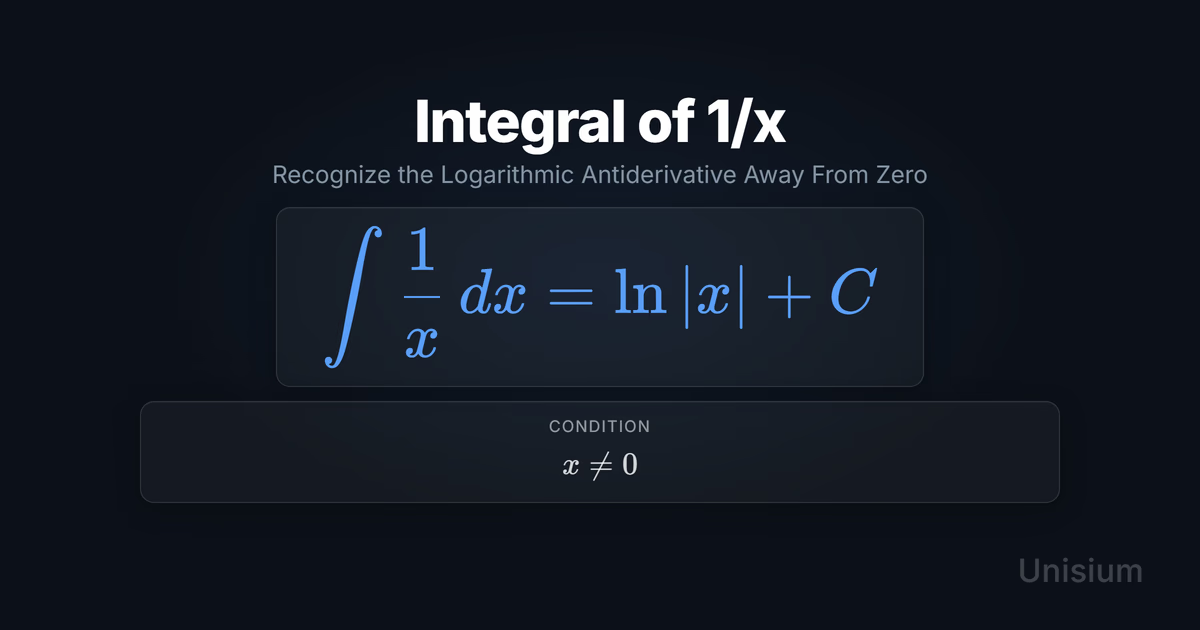
Integral of 1/x replaces with , preserving the antiderivative family on intervals that stay away from zero. It applies where ; in practice, that means you should not present one real antiderivative statement as covering a domain that passes through the undefined point. The common near-miss is treating the pattern as valid on an interval like : the shape is right, but the domain crosses , so the rule is not available as one real antiderivative statement.
On this page: The Principle | Conditions | Failure Modes | EE Questions | Retrieval Practice | Practice Ground | Solve a Problem | Related Principles | FAQ | How This Fits
The Principle
The move: Replace with .
The invariant: This preserves the antiderivative family on any interval where the original integrand stays defined.
Pattern:
| Legal ✓ | Illegal ✗ |
|---|---|
| On , $\int 1/x,dx \to \ln | x |
The left-hand move is legal because the interval stays away from , so has a real antiderivative there. The right-hand move is an applicability failure, not a syntax failure: the pattern looks right, but an interval crossing breaks the condition because the integrand is undefined at that point.
Conditions of Applicability
Condition:
Before applying, check: are you working on an interval that stays entirely on one side of , so the integrand really is throughout the step?
If the condition is violated: there is no single real antiderivative across that interval, so writing as though nothing happened hides a domain break.
- The condition is a domain guard. It tells you the reciprocal function is defined at the points where you are claiming an antiderivative.
- The absolute value in matters because the valid antiderivative family must cover both positive and negative intervals separately.
- If the domain you are using passes through , do not present the result as one real antiderivative statement across that whole domain. The pattern alone does not license the move.
See indefinite integral as antiderivative for the object this rule preserves, compare the nearby power rule for integration to see why is the exceptional exponent, and connect the output to the inverse-direction derivative of ln(x).
Want the complete framework behind this guide? Read Masterful Learning.
Common Failure Modes
Failure mode: treat as though it came from the usual power rule family or ignore the interval crossing → you either miss the logarithm or claim one antiderivative across a domain break.
Debug: ask two questions before integrating: “Is the exponent really ?” and “Am I staying on an interval where the whole time?”
Elaborative Encoding
Use these questions to build deep understanding. (See Elaborative Encoding for the full method.)
Within the Principle
- Why is usually another power, but the exponent produces a logarithm instead?
- What does the condition protect here: the algebraic pattern match, the existence of the integrand, or both?
For the Principle
- When you see inside a longer integrand, what quick check tells you whether the logarithmic antiderivative is available immediately?
- Why does keep the antiderivative valid on both positive and negative intervals, even though alone does not?
Between Principles
- How does this rule differ from the power rule for integration, and why is the one place where the usual power antiderivative fails?
Generate an Example
- Build a reciprocal-looking integral where the shape suggests this rule, but the stated interval makes the move invalid. What part of the condition failed?
Retrieval Practice
Answer from memory, then click to reveal and check. (See Retrieval Practice for the full method.)
State the move in one sentence: _____Replace the integral of 1/x with ln|x| + C on intervals where x is not 0.
Write the canonical equation: _____
State the canonical condition: _____
Practice Ground
Use these exercises to build move-selection fluency. (See Self-Explanation for how to use worked examples effectively.)
Procedure Walkthrough
Starting from , find an antiderivative on .
| Step | Expression | Operation |
|---|---|---|
| 0 | — | |
| 1 | Integral sum rule on the interval , where both component integrals exist | |
| 2 | $\ln | x |
| 3 | $\ln | x |
| 4 | $\ln | x |
Drills
Forward step (Format A)
Apply the principle once. Assume you are working on .
Reveal
The condition holds on because never reaches there.
Apply the principle once inside the larger integral. Assume you are working on an interval where .
Reveal
Split or identify the reciprocal term, then apply the rule to that term:
The condition still holds because the interval stays away from even on the negative side.
Apply the principle after rewriting the integrand in reciprocal form. Assume you are working on a domain where .
Reveal
Since , this is the same canonical pattern:
[Negative] On the interval , should you apply the rule directly to this indefinite integral?
Reveal
No. The interval crosses , so the condition fails somewhere in the claimed domain. This is the central near-miss for the rule: the local shape is correct, but the interval makes the move unavailable as one real antiderivative statement.
Integrate this expression on .
Reveal
The reciprocal term uses the logarithmic antiderivative, and the polynomial term uses the power rule.
Action label (Format B)
What was done between these two states? Assume you are working on a domain where .
Reveal
The integral of rule was applied: the reciprocal integrand was replaced by its logarithmic antiderivative.
What was done between these two states on ?
Reveal
The reciprocal term was integrated using the integral of rule, while the remaining term was left for a later step.
[Negative] A student writes the following step. What is the correct action label for what went wrong?
Reveal
The student misapplied the integral power rule at the exceptional exponent . The correct move is to switch to the logarithmic antiderivative:
The tempting move is invalid because the power-rule denominator would be .
Transition identification (Format C)
Which transitions use the integral of rule on the interval ?
| Transition | From | To |
|---|---|---|
| 0→1 | ||
| 1→2 | $\ln | |
| 2→3 | $\ln\left | x\right |
Reveal
Only transition 1→2 uses the integral of rule.
- 0→1 is the integral sum rule.
- 1→2 is the logarithmic antiderivative step for .
- 2→3 evaluates the remaining power integral.
Which of these proposed applications are eligible?
- On :
- On :
- On :
Reveal
Eligible applications: 1 and 2.
- 1 is valid because the interval stays positive and never hits .
- 2 is valid because the interval stays negative and never hits .
- 3 is invalid because the interval crosses , so the condition fails on the stated domain.
Goal micro-chain (Format D)
Starting from , reach a finished antiderivative on in the minimum number of moves.
Reveal
One efficient chain is:
The first move is the integral sum rule, the second uses both the integral of rule and the constant multiple rule, and the last evaluates the power integral.
Solve a Problem
Apply what you’ve learned with Problem Solving.
Problem: Starting from , find an antiderivative on .
Full solution
| Step | Expression | Move |
|---|---|---|
| 0 | — | |
| 1 | Integral sum rule, valid on because all three component integrals exist there | |
| 2 | $\ln\left | x\right |
| 3 | $\ln | x |
| 4 | $\ln | x |
Related Principles
| Principle | Relationship |
|---|---|
| Indefinite integral as antiderivative | Explains what it means for $\ln\left |
| Power rule for integration | Shows the neighboring rule that works for except at the exceptional exponent |
| Derivative of ln(x) | Runs the inverse direction: differentiating the logarithm returns the reciprocal on its real domain |
FAQ
What is the integral of ?
The antiderivative is . The absolute value matters because the reciprocal function has separate positive and negative intervals, and the logarithm has to match both of them.
Why is the answer not just ?
only works on the positive side of the real line. The antiderivative for uses so the same formula differentiates back to on any interval where .
When is the rule valid?
It is valid where . In practice, that means you should not use one real antiderivative statement across a domain that passes through .
Why can’t I use the usual power rule on ?
Because the power-rule denominator would become . That is exactly why is the exceptional exponent that switches to a logarithm instead of another power.
What is the most common near-miss?
Treating the pattern as valid on an interval such as just because the integrand looks like . The shape is right, but the domain crosses , so the rule is not available there as one real antiderivative statement.
How This Fits in Unisium
In Unisium, the integral of rule sits at a useful boundary: it looks like a simple reciprocal pattern, but it forces you to slow down and check the interval before executing. That makes it a strong test of move selection rather than raw execution. The guide pairs naturally with retrieval practice, self-explanation, and the broader principle structures view so the logarithmic exception becomes easy to recognize under pressure.
Explore further:
- Indefinite integral as antiderivative — Revisit what an indefinite integral answer means
- Power rule for integration — Compare the usual power-family move with the exception
- Derivative of ln(x) — See the reciprocal-log connection in the reverse direction
Ready to make this exception automatic? See Unisium’s 14-day free trial or explore the full learning framework in Masterful Learning.

Masterful Learning
The book behind these guides: a study system for physics, math, & programming built on retrieval, connection, explanation, and problem solving.
Ready to apply this strategy?
Unisium turns these evidence-based techniques into guided study sessions for math and physics. Places are limited during early access. Check current availability to start a trial; joining the mailing list is optional.
See plans and availability Read More GuidesAlready have access? Sign in