Second derivative test (local maximum): Classify a critical point from concavity
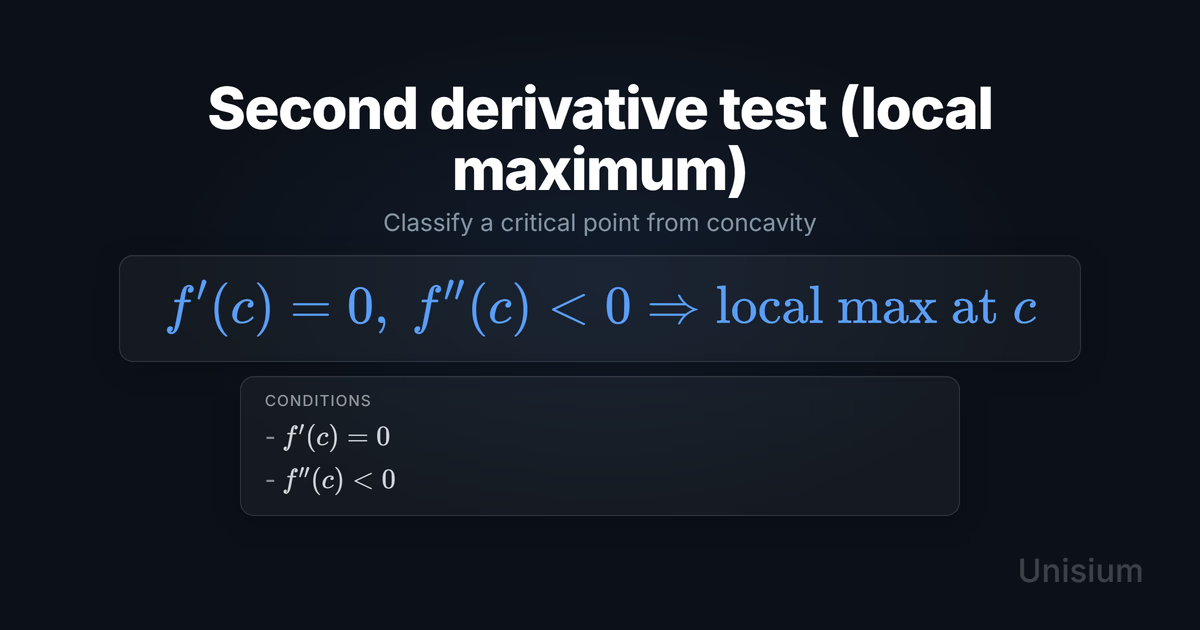
Second derivative test (local maximum) classifies a critical point from second-derivative evidence: when and , the graph is concave down at a flat point, so the theorem supports a local maximum conclusion. It applies only when both parts of that condition hold: negative curvature alone is not enough unless the same point also satisfies .
On this page: The Principle | Conditions | Failure Modes | EE Questions | Retrieval Practice | Practice Ground | Solve a Problem | Related Principles | FAQ | How This Fits
The Principle
The move: Infer that has a local maximum at when is a critical point and the second derivative is negative there.
The invariant: This rule classifies a critical point from second-derivative evidence: at a flat point, negative curvature supports the local-maximum conclusion.
Pattern:
| Applies ✓ | Does not apply ✗ |
|---|---|
| and has a local maximum at | and has a local maximum at |
Left: the point is critical and concave down, so the theorem applies. Right: the setup looks close, but does not satisfy the condition, so this test gives no local-maximum conclusion.
Conditions of Applicability
Condition: ;
This theorem is a shortcut for classifying a critical point. It does not replace the need to verify that the candidate point is critical first.
Before applying, check: verify the candidate point is critical, then check that the second derivative there is negative; only then is the theorem available.
If the condition is violated: this test does not prove a local maximum; the point could be a local minimum, neither, or require a first-derivative sign chart instead.
- If , the point is not even a critical point, so the theorem is unavailable immediately.
- If , the same structure supports a local minimum instead; compare with the second derivative test (local minimum).
- If , the second derivative test is inconclusive, so you need another argument such as the first derivative test (local maximum) or a direct sign analysis.
- The derivative values come from earlier differentiation work, so rules such as the power rule and derivative sum rule often matter before this classification step begins.
Want the complete framework behind this guide? Read Masterful Learning.
Common Failure Modes
Failure mode: treat any point with as a local maximum without checking → you classify a point that may still be increasing or decreasing, so the theorem was never applicable.
Debug: ask for the pair, not the curvature alone: first verify , then check the sign of .
Elaborative Encoding
Use these questions to build deep understanding. (See Elaborative Encoding for the full method.)
Within the Principle
- Why does describe concave-down behavior, and why does that support a peak only when the tangent is flat at ?
- Why is the pair and more informative than the single fact by itself?
For the Principle
- When you already have a critical point, why can the second derivative test be faster than building a full sign chart for ?
- If the test gives , what should you do next, and why is that not a contradiction of the theorem?
Between Principles
- How does this theorem differ from the first derivative test (local maximum), which uses sign changes of instead of the value of at one point?
Generate an Example
- Create one critical point where the second derivative test proves a local maximum and one near-miss critical point where so the theorem cannot decide.
Retrieval Practice
Answer from memory, then click to reveal and check. (See Retrieval Practice for the full method.)
State the move in one sentence: _____Infer that f has a local maximum at c when f'(c)=0 and f''(c)<0.
Write the canonical equation: _____
State the canonical condition: _____
Practice Ground
Use these exercises to build move-selection fluency. (See Self-Explanation for how to use worked examples effectively.)
Procedure Walkthrough
Starting from and the candidate point , determine whether the theorem is available and what conclusion it supports.
| Step | Expression | Operation |
|---|---|---|
| 0 | Start with the proposed candidate point | |
| 1 | Differentiate to get the critical-point test quantity | |
| 2 | Confirm that the theorem is still available at the candidate point | |
| 3 | Differentiate again to get the curvature test quantity | |
| 4 | Check the sign that decides whether the theorem applies | |
| 5 | has a local maximum at | Use the satisfied condition to classify the point |
Drills
Action label
What principle justifies the conclusion below, and is the move valid?
Reveal
The principle is the second derivative test for a local maximum, and the move is valid. The point is critical and the second derivative is negative there.
What principle is being attempted below, and why is the move invalid?
Reveal
The attempted move is the second derivative test for a local maximum, but it is invalid because the condition fails. The theorem needs ; when , this test is inconclusive.
What principle is being attempted below, and why is the move invalid?
Reveal
The attempted move is again the second derivative test for a local maximum, but it is invalid because the point is not critical. The theorem requires before the sign of matters.
Which proposed conclusion step is eligible for the second derivative test for a local maximum?
- and has a local maximum at
- and has a local maximum at
- and has a local maximum at
- and has a local maximum at
Reveal
Only 1 is eligible.
- 1 matches the canonical condition exactly.
- 2 supports a local minimum instead.
- 3 is inconclusive.
- 4 fails the critical-point requirement.
Transition identification
Which transition uses the second derivative test directly?
Reveal
Transition (3) uses the second derivative test directly.
- (1) checks the critical-point condition.
- (2) computes the second derivative value.
- (3) turns those verified facts into the local-maximum conclusion.
Which transition is not justified by the second derivative test?
Reveal
Transition (3) is not justified. The theorem requires , but here the second derivative equals , so the test cannot classify the point.
In which conclusion steps is the second derivative test for a local maximum being used correctly?
- has a local maximum at
- has a local maximum at
- is concave down at
- has a local maximum at
Reveal
Only 1 uses the theorem correctly.
- 1 has the full condition.
- 2 gives the wrong extremum type.
- 3 is a concavity statement, not a local-maximum conclusion from the theorem.
- 4 skips the critical-point condition.
Which chain reaches a justified local-maximum conclusion?
- has a local maximum at
- has a local maximum at
- has a local maximum at
Reveal
Only 1 reaches a justified conclusion. In 2, the test is inconclusive. In 3, the point is not critical.
Forward step
Apply the theorem once at .
Reveal
The condition matches and , so has a local maximum at .
Should you conclude a local maximum at from the data below? Explain your decision.
Reveal
No. The point is critical, but the second derivative is positive, not negative. This data supports a local minimum, not a local maximum.
Should you conclude a local maximum at from the data below? Explain your decision.
Reveal
No. This is the classic near-miss case. The point is critical, but , so the second derivative test is inconclusive and gives no extremum classification.
Solve a Problem
Apply what you’ve learned with Problem Solving.
Problem: For , determine what the second derivative test says about and .
Full solution
| Step | Expression | Move |
|---|---|---|
| 0 | — | |
| 1 | Differentiate and factor to expose the critical points | |
| 2 | and | Identify the candidate points for the theorem |
| 3 | Differentiate again to get the curvature test quantity | |
| 4 | and | Check the second derivative at each critical point |
| 5 | has a local maximum at and not at | Apply the local-maximum test point by point |
At , the full condition is satisfied, so the theorem gives a local maximum. At , the second derivative is positive, so this local-maximum theorem does not apply there.
Related Principles
| Principle | Relationship |
|---|---|
| Second derivative test (local minimum) | Uses the same critical-point setup, but instead of |
| First derivative test (local maximum) | Reaches the same type of conclusion through a sign chart for rather than one second-derivative value |
| Derivative at a point | Supplies the derivative values you evaluate before applying the theorem |
FAQ
What does the second derivative test for a local maximum say?
It says that if and , then has a local maximum at . The first condition gives a critical point, and the second says the graph is concave down there.
Is enough by itself?
No. Concavity alone is not enough for this theorem. You must also verify that , or else the point is not a valid candidate for the second derivative test.
What if ?
Then this test is inconclusive. The point could still be a local maximum, a local minimum, or neither, so you need another method such as a first-derivative sign chart.
Is this faster than the first derivative test?
Often, yes. If computing is easy after you have a critical point, the second derivative test can classify the point without building a full sign chart. But it is not stronger, because it can fail to decide when .
Can the test classify more than one critical point in the same problem?
Yes. Once you find all critical points, you can evaluate at each one separately. Some points may satisfy the local-maximum condition, while others may not.
How This Fits in Unisium
In Unisium, the second derivative test is trained as a move-selection theorem: after you find a critical point, you decide whether curvature gives an immediate extremum classification or whether you need a different tool. That fits directly with retrieval practice, self-explanation, and the broader logic of Masterful Learning, where fluency comes from choosing the right theorem under the right condition. To keep building that fluency across calculus, practice directly in the Unisium app once you can classify critical points without defaulting to a sign chart every time.
Explore further:
- Second derivative test (local minimum) - Contrast the local-maximum curvature condition with the matching local-minimum theorem
- First derivative test (local maximum) - Use a sign chart when the second derivative test is unavailable or inconclusive
- Derivative at a point - Rebuild what and mean before using them as classification evidence
- Problem Solving - Practice choosing between classification tools in longer calculus workflows

Masterful Learning
The book behind these guides: a study system for physics, math, & programming built on retrieval, connection, explanation, and problem solving.
Ready to apply this strategy?
Unisium turns these evidence-based techniques into guided study sessions for math and physics. Places are limited during early access. Check current availability to start a trial; joining the mailing list is optional.
See plans and availability Read More GuidesAlready have access? Sign in