Recall and connect
Retrieve principles from memory. Explain what the quantities mean, when a principle applies, and how it connects to other ideas.
Calculus with Unisium
Understand change, accumulation, and approximation. Practise explaining the principles and using them in unfamiliar problems.
See plans and the 14-day free trialThe upper graph shows f. As a tangent slides along it, the lower graph plots f′(x), the tangent’s slope at the same x. Which graph will appear?
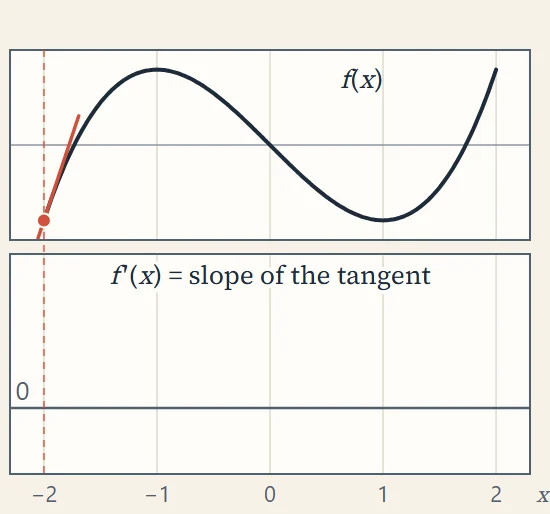
Watch the tangent slide from left to right while its slope is plotted below at the same x.
Watch the animation, or go straight to the result.
The animation could not play here. Open the animation, or read the result below.
The tangent’s slope traces Graph C.
Why is f′ below zero between the peak and the low point of f? Explain how the tangent’s slope gives the lower graph, then compare.
Graph A copies the shape of f. The derivative records its slope instead: the tangent is horizontal at both turning points, and its slope is negative throughout the falling section.
Graph B keeps every slope at or above zero. But slope has a sign: when f falls as x increases, the change in f is negative, so f′ must be below zero.
The derivative f′(x) is the tangent’s signed slope at x. It measures the change in f for a tiny step to the right, divided by that step.
Where f rises, the change in f is positive, so f′ is above zero. At the peak and the low point, the tangent is horizontal, so f′ is zero. Between them, f falls: a step to the right gives a negative change in f, so f′ is below zero.
The steepest fall is between the turning points, where Graph C reaches its lowest value. Graph A copies the height of f; Graph B keeps the steepness but loses the negative sign.
Read about the derivative as a tangent’s slope
In the animation: The tangent slides along f while a dot traces its slope below. The dot reaches zero at each horizontal tangent, dips below zero while f falls, then rises above zero as f rises again.
Choose your prediction, then watch what happens.
Choosing a graph is a start; explaining its shape tests your understanding. In Unisium, you write explanations of calculus principles and receive AI feedback on your reasoning, then practise recalling and applying those principles in problems.
Created by Vegard Gjerde, drawing on ten years researching university students’ learning strategies and exam preparation.
Try Unisium free for 14 daysStart with calculus. Your subscription also includes the other currently available subjects.
A payment method is required. Billing begins after the trial unless you cancel. See pricing for plans and current availability.
From familiar formulas to usable knowledge
Retrieve principles from memory. Explain what the quantities mean, when a principle applies, and how it connects to other ideas.
Study a worked problem, then explain why its principles and mathematical steps make sense. Use feedback to revisit gaps in your reasoning.
Choose the principles and steps, work through a problem, and check your result. Return to practice as Unisium brings material back for review.
Unisium organizes the activities and review. You do the thinking. A session can be a few cards or a longer stretch of work; it does not have to include every activity.
Build university-level calculus skills
Learn single-variable calculus through questions, worked solutions, and problem solving. The current material includes Level 4 practice, designed to match university exam difficulty. We plan to extend the material to higher levels of difficulty.
Reason about what happens as an input approaches a value.
Understand rates of change and apply differentiation rules.
Use slopes and derivative tests to study a function.
Connect accumulation, antiderivatives, and definite integrals.
Choose and apply methods such as substitution.
Use tangent lines and Taylor polynomials as local models.
Be comfortable with algebra, functions, graphs, and basic trigonometry. Use the other included subjects to revisit foundations as you need them.
Use the free principle guides to learn the ideas, then build your skills with elaborative encoding questions, retrieval practice, worked solutions, and problems in Unisium. The resources and study activities work together so you can learn independently.
If you are taking a course, match your practice to its syllabus and use what you learn in your assignments and exams.
Your first practice