Product Rule: Differentiating Products of Functions
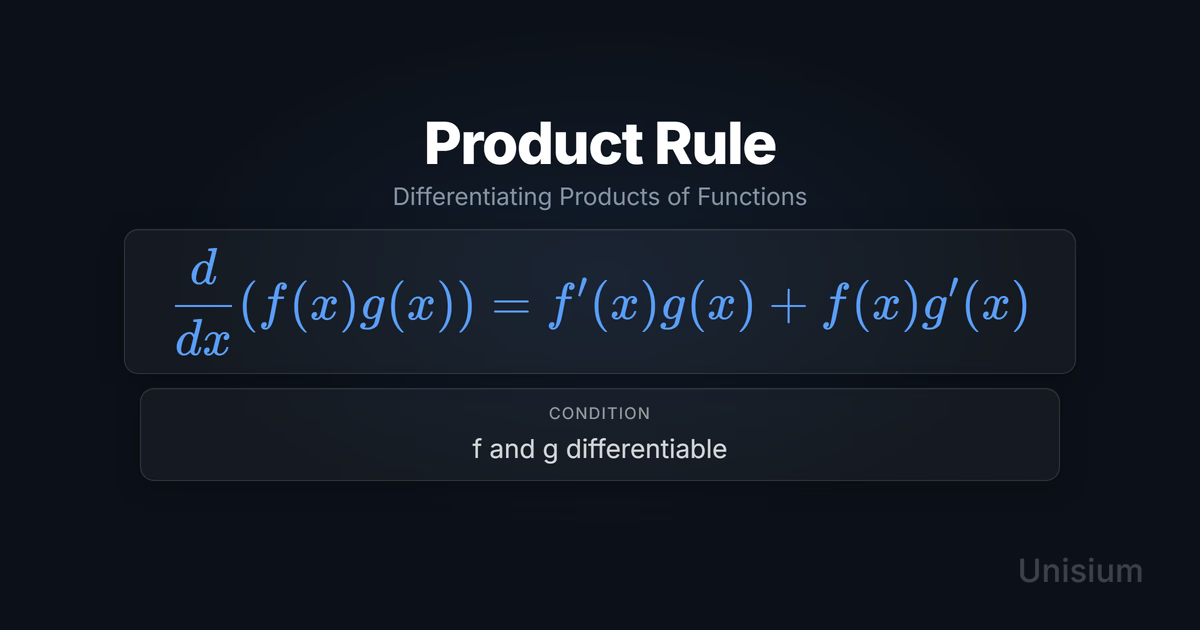
The product rule lets you differentiate a product of two functions by combining each factor with the derivative of the other: . It applies whenever both factors are differentiable at the point of interest. Recognizing which expressions are products (not compositions), checking that both factors are differentiable, and applying the formula without dropping a term are the core fluency skills practiced in the Unisium Study System.
On this page: The Principle | Conditions | Failure Modes | EE Questions | Retrieval Practice | Practice Ground | Solve a Problem | Related Principles | FAQ | How This Fits
The Principle
The move: Compute the derivative of a product of two functions by differentiating each factor in turn and weighting it by the other undifferentiated factor.
The invariant: This formula produces the exact value of the derivative of at every point where both and are differentiable.
Pattern:
The rule produces two terms — one for each factor differentiated. Forgetting either term is the single most common error.
| Legal ✓ | Condition fails — blocked ✗ |
|---|---|
| — both factors differentiable everywhere; two-term result is valid | : applying the formula requires at , which does not exist — the formula is blocked; the derivative at this point cannot be established via the product rule |
Conditions of Applicability
Condition: f and g differentiable
Before applying, check: Are both factors differentiable at the point (or on the interval) where you need the derivative?
- If either factor fails to be differentiable at a point, the product rule formula cannot be invoked at that point.
- A function can be continuous but not differentiable (e.g., at ); continuity alone is insufficient.
Want the complete framework behind this guide? Read Masterful Learning.
Common Failure Modes
Failure mode: Compute only one term — e.g., write , dropping the term → the derivative is wrong and the error compounds in every subsequent step.
Debug: After applying the rule, count the terms in the result: there must be exactly two. If you have one term, you lost a factor.
Elaborative Encoding
Use these questions to build deep understanding. (See Elaborative Encoding for the full method.)
Within the Principle
- Why does the product rule produce two terms rather than the single term ? What does each term represent geometrically or analytically?
- What does it mean for a function to be differentiable at a point, and how does that differ from merely being continuous?
For the Principle
- How do you recognize that an expression is a product of two factors (and not a composition) before choosing the product rule?
- What happens to the product rule formula when one of the factors is a constant? How does it reduce to a simpler rule?
Between Principles
- How does the product rule differ from the chain rule, and what structural feature of the expression tells you which to reach for?
Generate an Example
- Construct a function where applying the product rule but forgetting the second term would yield a nonzero (but incorrect) result — and show the error numerically at a specific point.
Retrieval Practice
Answer from memory, then click to reveal and check. (See Retrieval Practice for the full method.)
State the product rule in one sentence: _____Differentiate the first factor and multiply by the second, then add the first factor times the derivative of the second.
Write the product rule formula: _____
State the canonical condition: _____f and g differentiable
Practice Ground
Use these exercises to build move-selection fluency. (See Self-Explanation for how to use worked examples effectively.)
Procedure Walkthrough
Starting from , find .
| Step | Expression | Operation |
|---|---|---|
| 0 | — | |
| 1 | Product rule: and are both differentiable everywhere | |
| 2 | Differentiate each factor: , | |
| 3 | Distribute the negative sign |
Drills
Forward step
Apply the product rule once.
Reveal
Both and are differentiable everywhere. Product rule:
Apply the product rule once.
Reveal
Both and are differentiable everywhere. Product rule:
Apply the product rule once. (Assume .)
Reveal
For , both and are differentiable. Product rule:
Apply the product rule once.
Reveal
Both factors differentiable everywhere. Product rule:
Is the product rule the right tool here? If not, identify the correct rule and apply it.
Reveal
The natural rule here is the chain rule, not the product rule. is a composition: evaluated at . You could force a product decomposition — e.g., and — and the product rule arithmetic would give the same answer, but that approach obscures the composition structure this guide is training you to spot.
Chain rule:
The structural signal: the expression is a single function raised to a power, not two independent functions multiplied. That form calls for the chain rule first.
Classify each expression: direct product-rule case, chain-rule case, or requires a condition check? Explain each.
(i) \quad (ii) \quad (iii) \quad (iv) \quad (v) at
Reveal
(i) Direct product-rule case. and are distinct functions multiplied together, both differentiable everywhere. ✓
(ii) Chain-rule case. is a composition — applied to . The structural cue is a single expression raised to a power, not two separate factors.
(iii) Direct product-rule case. and are distinct differentiable functions. ✓
(iv) Chain-rule case. is a composition — applied to . The structural cue: is the input to , not a separate factor multiplied alongside it.
(v) Condition check required — blocked at . Both and are separate factors (product structure ✓), but is not differentiable at . The product rule formula requires both factors to be differentiable at the point; the condition fails here.
Apply the product rule once.
Reveal
Both and are differentiable everywhere. Product rule:
You can verify: expanding first gives ; differentiating gives . ✓
Action label
What rule was applied between these two steps?
Reveal
Product rule with and , both differentiable everywhere.
- First term :
- Second term :
What rule was applied between these two steps?
Reveal
Product rule with and , both differentiable everywhere.
- First term :
- Second term :
A student differentiates and writes . Identify the rule they used incorrectly and give the correct derivative.
Reveal
The student computed only the first term of the product rule — they applied and dropped the term entirely. This is a partial product rule error, sometimes described as “differentiating only the first factor.”
Correct application — product rule with , :
At : student’s answer gives ; correct answer gives . The error is not self-signaling — it produces a plausible-looking nonzero result.
What rule was applied between these two steps?
Reveal
Product rule with and , both differentiable everywhere.
Note: this equals by the double-angle identity, which you could verify by differentiating directly.
Transition identification
Below is a three-step worked chain for . For each numbered step, name the rule used.
| Step | Expression |
|---|---|
| 0 | |
| 1 | |
| 2 | |
| 3 |
Reveal
- Step 1: Product rule — is a product of and , both differentiable.
- Step 2: Power rule for ; exponential rule for .
- Step 3: Algebraic factoring — .
A student claims: . What went wrong, and what is the correct derivative?
Reveal
The student tried to apply the product rule to , treating it as . But is a composition — applied to — not a product of two separate functions.
The correct rule is the chain rule:
The student’s answer is wrong in two places: the outer function is evaluated at instead of , and the formula itself is chain-rule syntax misread as product syntax.
Solve a Problem
Apply what you’ve learned with Problem Solving.
Problem: Starting from (for ), find using the product rule and simplify completely.
Full solution
| Step | Expression | Move |
|---|---|---|
| 0 | — | |
| 1 | Product rule: , , both differentiable for | |
| 2 | Power rule: ; log rule: | |
| 3 | Simplify: | |
| 4 | Factor out |
Related Principles
| Principle | Relationship |
|---|---|
| Derivative constant multiple rule | Special case of the product rule where one factor is constant; the term vanishes, leaving |
| Derivative sum rule | Often combined with the product rule: differentiate a sum of products by applying the product rule to each |
| Power rule | Typically the rule applied to each factor after the product rule expands the expression into two terms |
| Derivative chain rule | Structural contrast — the product rule handles multiplied factors, while the chain rule handles nested factors; longer derivatives often require both |
FAQ
What is the product rule?
The product rule states that the derivative of a product of two functions equals the first function times the derivative of the second, plus the second function times the derivative of the first: . It applies whenever both factors are differentiable.
When does the product rule apply?
The only condition is that both factors and are differentiable at the point (or on the interval) where you need the derivative. Any two differentiable functions multiplied together can be differentiated this way, regardless of how complex the factors are.
What is the most common product rule mistake?
Dropping one of the two terms. Students write (or ) and forget the other half. After applying the rule, always count: the result must contain exactly two additive terms from the product rule (before any simplification).
How is the product rule different from the chain rule?
The product rule applies when a function is written as a product of two factors: . The chain rule applies when a function is a composition: . The structural signal is: if you see with and as separate differentiable pieces, use the product rule. If is the input to , use the chain rule.
Does the product rule extend to three or more factors?
Yes. For three factors: . Each term differentiates exactly one factor and leaves the others undifferentiated. In practice, apply the rule in two steps: treat the product as and apply the rule twice.
Does the product rule apply when one factor is a constant?
Yes, and it reduces to a simpler rule. If (a constant), then , so . This is the constant multiple rule — a special case of the product rule.
How This Fits in Unisium
The product rule is one of the structural pillars of differential calculus. In Unisium, the goal is not just to memorize the formula but to build automatic condition-checking: before applying any differentiation rule, identify the expression’s structure (product, composition, sum) and verify that the relevant conditions hold. The product rule guide trains that move-selection skill through contrasts — valid applications alongside cases where the condition fails or a different rule applies.
Explore further:
- Calculus Subdomain Map — Return to the calculus hub to see how product, quotient, and chain split the derivative cluster by expression structure
- Principle Structures — See where the product rule sits in the calculus derivative hierarchy
- Elaborative Encoding — Build lasting understanding of why the product rule has two terms
- Retrieval Practice — Make the formula and condition instantly accessible under exam pressure
- Self-Explanation — Use the worked examples and drills above to deepen fluency
Ready to master the product rule? See Unisium’s 14-day free trial or explore the full learning framework in Masterful Learning.

Masterful Learning
The book behind these guides: a study system for physics, math, & programming built on retrieval, connection, explanation, and problem solving.
Ready to apply this strategy?
Unisium turns these evidence-based techniques into guided study sessions for math and physics. Places are limited during early access. Check current availability to start a trial; joining the mailing list is optional.
See plans and availability Read More GuidesAlready have access? Sign in