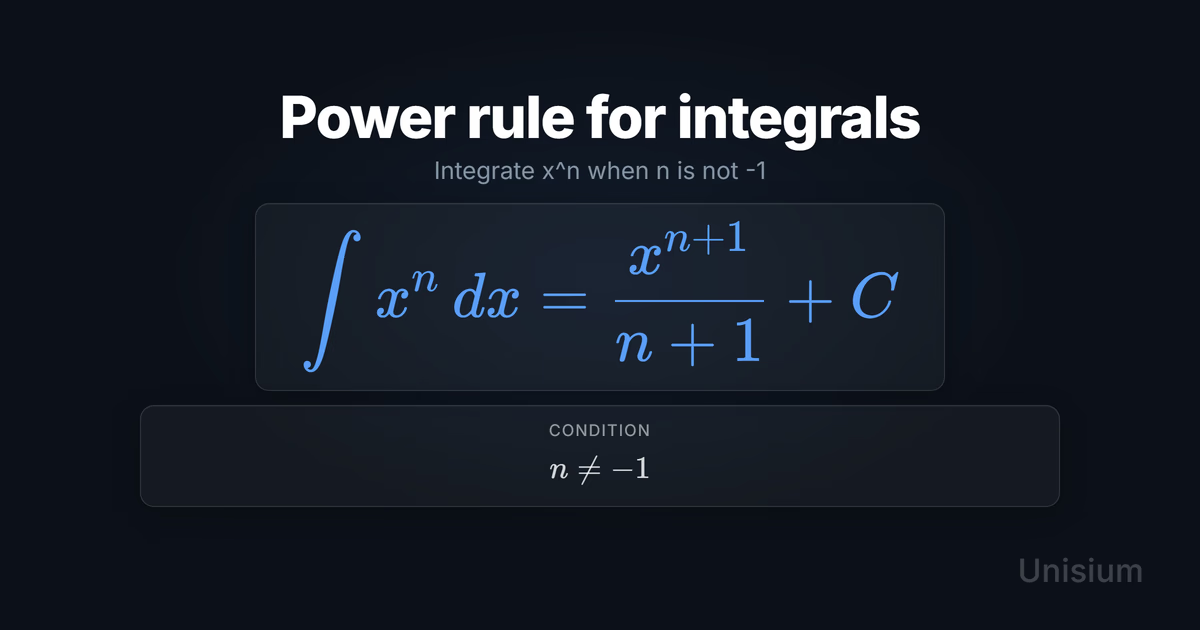
Power rule for integrals: Integrate x^n when n is not -1
The power rule for integration tells you how to integrate : add to the exponent and divide by , giving . It applies when , because the denominator must not be zero. If , use the logarithmic antiderivative instead: .
This guide is for you if you know the formula but still hesitate on exam-style problems, especially when the exponent is negative or when appears. The goal is to make the rule usable: when it applies, when it fails, and how to check your answer.
On this page: Power Rule for Integration | Conditions | Failure Modes | EE Questions | Retrieval Practice | Practice Ground | Solve a Problem | FAQ
Power Rule for Integration
Use this rule when you need to integrate a power of , such as , , or .
To integrate , add to the exponent, then divide by that new exponent:
This works when . If , the denominator would become zero, so you switch to the logarithm rule:
Rule selector for powers of x
If n = -1
Use ln|x| + C
The power-rule denominator would be zero.
If n is not -1
Use x^(n+1)/(n+1) + C
Add 1 to the exponent, then divide by n+1.
You can check every answer by differentiating it. If the derivative gives you the original , the antiderivative is correct. For a textbook reference, compare OpenStax Calculus Volume 1, section 4.10 on antiderivatives.
| Legal ✓ | Illegal ✗ |
|---|---|
Left: , so and the rule applies. Right: , so the denominator becomes ; the expression looks eligible, but the condition fails and the move is not available.
Conditions of Applicability
Condition:
Before applying, check: confirm the integrand is exactly of the form with a constant exponent, then verify that adding to the exponent does not produce in the denominator.
If the condition is violated: the formula creates division by zero, so it does not produce a valid antiderivative. The case must use instead.
- The rule covers positive exponents, zero, and negative exponents other than .
- The near-miss is : it has the right surface form, but the condition fails exactly where the denominator would become zero.
- If the integrand is not a pure power of , pause and identify the actual local pattern before moving. The exception belongs to a logarithm antiderivative, not to this power-rule family.
Want the complete framework behind this guide? Read Masterful Learning.
Common Failure Modes
Failure mode: apply the power rule mechanically to and write -> produces a meaningless denominator and hides that this is the special logarithm case.
Debug: before integrating, compute the new exponent denominator . If it equals , stop and switch to the logarithm antiderivative for .
Elaborative Encoding
Use these questions to build deep understanding. (See Elaborative Encoding for the full method.)
Within the Principle
- Why does adding to the exponent and then dividing by that same new exponent undo differentiation of ?
- Why is the condition attached to the denominator rather than the original exponent alone?
For the Principle
- What quick check can you run before applying the rule to decide whether the exception is present?
- How does the result change when is negative but not , such as ?
Between Principles
- The derivative power rule and the power rule for integrals reverse each other. What does each rule do to the exponent, and where does the exception appear only on the integral side?
Generate an Example
- Build one integral where the power rule works and one near-miss where it fails, then explain which condition check separates them.
Retrieval Practice
Answer from memory, then click to reveal and check. (See Retrieval Practice for the full method.)
State the move in one sentence: _____Add 1 to the exponent, divide by the new exponent, and add C to integrate x^n when n is not -1.
Write the canonical equation: _____
State the canonical condition: _____
Practice Ground
Use these exercises to build move-selection fluency. (See Self-Explanation for how to use worked examples effectively.)
Procedure Walkthrough
Starting from , reach a simplified antiderivative.
| Step | Expression | Operation |
|---|---|---|
| 0 | - | |
| 1 | Power rule - , so | |
| 2 | Arithmetic on the exponent and denominator | |
| 3 | Simplify the coefficient | |
| 4 | Rewrite the negative exponent as a fraction |
Drills
Forward step (Format A)
Apply the power rule once.
Reveal
, so .
Apply the power rule once.
Reveal
, so .
Can the power rule be applied? Explain the condition check before doing anything else.
Reveal
No. Here , so . That breaks the denominator in the rule, so the power rule is not applicable.
This is the required near-miss: the integrand has the form , but the condition fails exactly at the exception. Use the integral of instead:
Which integrands can be handled directly by the power rule for integrals?
(i) \quad (ii) \quad (iii) \quad (iv)
Reveal
(i) and (iii) only.
- : , so -> valid
- : , so -> invalid
- : , so -> valid
- : not of the form -> use the exponential integral rule instead
Action label (Format B)
What was done between these two steps, and was it valid?
Reveal
Power rule for integrals applied. The exponent was increased from to , then divided by the new exponent. This is valid because .
What was done between these two steps? Was the move valid?
Reveal
An invalid use of the power rule was attempted. The move is not valid because , so the new denominator becomes .
The correct action is to reject the move and switch to:
What was done between these two steps, and why is the move legal?
Reveal
Power rule for integrals applied, then simplified. Since , the new exponent is and the new denominator is , which is nonzero:
Transition identification (Format C)
Which transition uses the power rule for integrals?
Reveal
Transition (1) uses the power rule for integrals. Transition (2) is only algebraic rewriting of the coefficient.
Which transition is invalid, and why?
Reveal
Transition (1) is invalid. The power-rule pattern was attempted where , so the denominator becomes immediately.
The fix is not to simplify further. The fix is to reject the move and replace the chain with:
Goal micro-chain (Format D)
Starting from , reach a correct final antiderivative by using the power rule only where it is legal.
Reveal
First use the integral sum rule to split the sum:
Apply the power rule to the first term only:
Use the integral of on the exception term:
Combine constants:
Solve a Problem
Apply what you’ve learned with Problem Solving.
Problem: Integrate and simplify the final antiderivative.
Full solution
| Step | Expression | Move |
|---|---|---|
| 0 | - | |
| 1 | Power rule - , so | |
| 2 | Arithmetic on the exponent and denominator | |
| 3 | Simplify the coefficient | |
| 4 | Rewrite the negative exponent as a fraction |
Check: differentiating returns .
Related Principles
| Principle | Relationship |
|---|---|
| Indefinite integral as antiderivative | Explains what an antiderivative family means and why every result ends with |
| Derivative power rule | The inverse move: differentiating gives the integrand that the integral rule reverses |
| Derivative of ln(x) | Shows why the exceptional antiderivative family is logarithmic rather than another power |
FAQ
What is the power rule for integrals?
The power rule for integrals states that when . You add to the exponent, divide by the new exponent, and append the constant of integration.
Why does the rule exclude n = -1?
If , then the denominator becomes , so the formula breaks immediately. That case is not a minor algebra issue; it marks a different antiderivative family: .
Does the rule work for negative exponents?
Yes, as long as the exponent is not . For example, is valid because the new denominator is , not .
Why do I still add +C after using the formula?
Indefinite integrals describe a family of antiderivatives, not one single function. The keeps every vertical shift of the antiderivative in the answer, which is required for the full family.
How do I know whether to use the power rule or the integral of 1/x?
Check the exponent first. If the integrand is with , use the power rule. If the exponent is exactly , rewrite the integrand as and use the integral of instead.
How This Fits in Unisium
In Unisium, integration fluency is trained as move selection plus guard checking, not as blind formula recall. For the power rule, the critical habit is to test the exponent before you act: most powers of take the standard antiderivative, but the single near-miss changes the rule family completely. The drills above train that branch point directly, while retrieval practice, self-explanation, and elaborative encoding make the condition and exception stable enough to use under time pressure.
Explore further:
- Indefinite integral as antiderivative - See why every correct result ends with
- Integral of 1/x - Compare the standard power-family move with the single reciprocal exception at
- Derivative of ln(x) - See why the exception produces a logarithm rather than another power
- Derivative power rule - Connect the integration rule to its inverse derivative move
Ready to master the power rule for integrals? See Unisium’s 14-day free trial or explore the full learning framework in Masterful Learning.

Masterful Learning
The book behind these guides: a study system for physics, math, & programming built on retrieval, connection, explanation, and problem solving.
Ready to apply this strategy?
Unisium turns these evidence-based techniques into guided study sessions for math and physics. Places are limited during early access. Check current availability to start a trial; joining the mailing list is optional.
See plans and availability Read More GuidesAlready have access? Sign in