Derivative of a^x: Why the Log Factor Appears
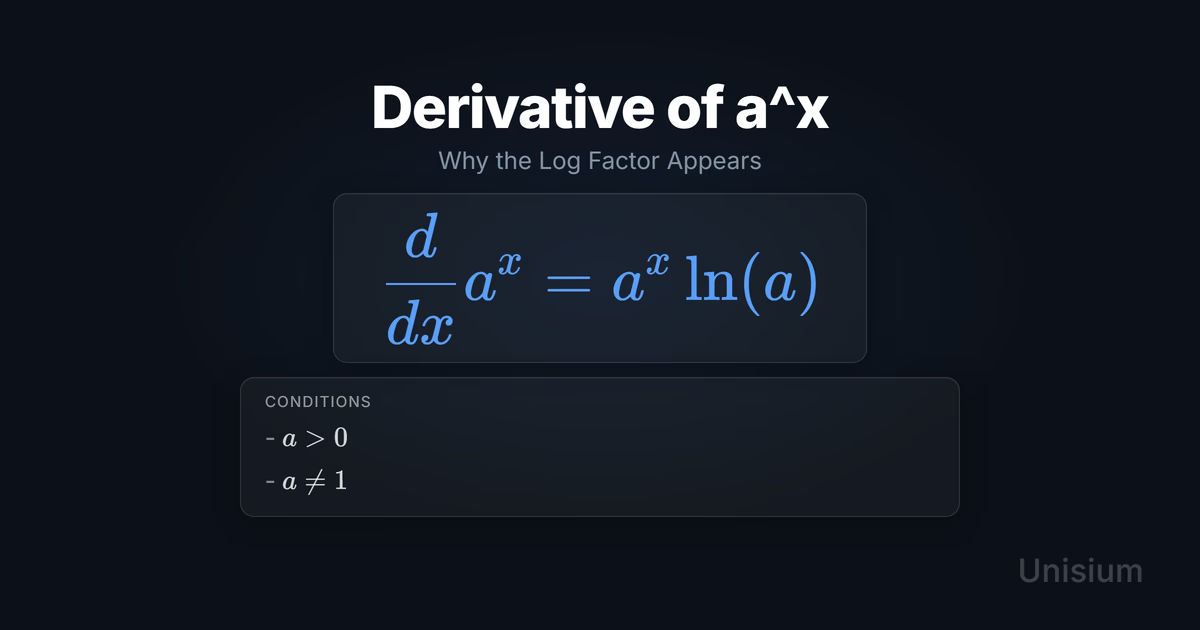
Derivative of a^x gives the derivative of an exponential with constant base : . The rule applies when and , so the base defines a real exponential and the logarithmic factor is meaningful. Fluency means separating from near-misses: uses the power rule, needs chain rule, and is the special case where .
On this page: The Principle | Conditions | Failure Modes | EE Questions | Retrieval Practice | Practice Ground | Solve a Problem | FAQ | How This Fits
The Principle
The move: Differentiate a constant-base exponential in one step by keeping and multiplying by .
The invariant: This rewrites the derivative into an equivalent derivative expression with the same value wherever the condition holds.
Pattern:
| Legal ✓ | Illegal ✗ |
|---|---|
| — base is positive and not | — the base is negative, so the real exponential is not defined for all real and the condition fails |
The contrast is about applicability, not symbol shape: both expressions look like “constant base to the variable,” but only the positive non-unit base belongs to this rule in real calculus.
The special case still fits this general rule with , giving . There is a separate guide for because that simplification is important enough to recognize instantly.
Conditions of Applicability
Condition: ;
Before applying, check: is the base a fixed positive constant different from , and is the local derivative step exactly a constant-base exponential? If the exponent is a nontrivial function , the derivative of still appears, but chain rule governs the whole step.
If the condition is violated: the usual real-calculus exponential model breaks. Either the function is not a real exponential for all real () or it collapses to the constant function (), so this is not the right rule to invoke.
- If , then is not defined as a real-valued function for all real , and is not a real number. The formula is not available in ordinary real-variable calculus.
- If , then for every , so the function is constant and its derivative is . That case belongs to the derivative constant rule, not to the general constant-base exponential family.
- If the base is the variable and the exponent is constant, as in , use the power rule instead.
- If the base is , the general rule still applies with , but Derivative of e^x is the cleaner special-case guide because .
Want the complete framework behind this guide? Read Masterful Learning.
Common Failure Modes
Failure mode: treat every expression that mixes a constant and an exponent as the same pattern → use the power rule on , or use the rule on , and write a derivative from the wrong family.
Debug: ask two structure questions before differentiating: “Is the base constant?” and “Is the exponent exactly the variable?” If the answers are yes and the base also satisfies , , then derivativeExponentialRule applies.
Elaborative Encoding
Use these questions to build deep understanding. (See Elaborative Encoding for the full method.)
Within the Principle
- Why does the derivative of keep the original exponential factor but multiply by the constant ? What does that say about the growth rate of the exponential family as the base changes?
- Why does the rule exclude even though is easy to differentiate by another method?
For the Principle
- When you inspect an expression such as , , , or , what structural cue tells you which derivative rule governs the next step?
- If the exponent becomes a function instead of the bare variable , how does chain rule change the computation while still using the derivative of locally?
Between Principles
- How does derivativeExponentialRule differ from Derivative of e^x and the power rule? One is a special base, one is a variable base, and only one introduces the factor .
Generate an Example
- Describe a derivative step that looks close to but is not eligible for this rule as written. Explain whether the problem is a failed condition ( or ) or the need for a different structural rule.
Retrieval Practice
Answer from memory, then click to reveal and check. (See Retrieval Practice for the full method.)
State the derivative of a^x in one sentence: _____For a positive constant base a not equal to 1, the derivative of a^x with respect to x is a^x times ln(a).
Write the canonical equation: _____
State the canonical condition: _____
Practice Ground
Use these exercises to build move-selection fluency. (See Self-Explanation for how to use worked examples effectively.)
Procedure Walkthrough
Starting from , differentiate each term and track why the two terms use different rules.
| Step | Expression | Operation |
|---|---|---|
| 0 | — | |
| 1 | Sum rule: distribute the derivative across the two terms | |
| 2 | derivativeExponentialRule on : constant positive base, variable exponent | |
| 3 | Power rule on : variable base, constant exponent |
The key decision is structural: is a constant-base exponential, while is a power function.
Drills
Format A: Forward step
Apply the derivative move or decide why it cannot be applied as written.
Differentiate .
Reveal
The base is a positive constant and not , so derivativeExponentialRule applies directly:
Differentiate .
Reveal
Apply the sum rule, then choose the correct local derivative for each term:
Near miss: can you apply derivativeExponentialRule directly to ? If not, what derivative rule gives the answer?
Reveal
No. The condition fails, so this rule does not apply as written.
Since for every , the function is constant. Use the derivative constant rule:
This is the near-miss case: the surface shape resembles , but the base value collapses the family to a constant.
Applicability check: can derivativeExponentialRule be used in real calculus for ? Explain.
Reveal
No. The condition fails.
For a negative base, is not a real-valued function for all real , and is not real. The formula
belongs to the real exponential family with positive base only.
Differentiate .
Reveal
Each term uses the matching exponential rule for its base:
The first term uses derivativeExponentialRule; the second uses Derivative of e^x.
Format B: Action label
Name the rule choice or diagnose the incorrect move.
What rule was used in the step below?
Reveal
derivativeExponentialRule. The base is the positive constant , not the variable , so the derivative is the original exponential times .
A student writes . What structural mistake was made?
Reveal
The student treated a power function as though it were a constant-base exponential.
has variable base and constant exponent, so the power rule governs the step:
Which derivative rule matches each term in ?
Reveal
- : derivativeExponentialRule, giving
- : Derivative of e^x, giving
- : power rule, giving
Format C: Transition identification
Locate where this principle is eligible or used inside a longer chain.
Which expressions below satisfy the condition and match derivativeExponentialRule as written?
Reveal
1. and 2. match the rule as written.
- : yes — positive constant base, not , exponent is exactly
- : yes — it fits the general pattern with , giving ; there is still a dedicated Derivative of e^x guide because the special case is important enough to recognize instantly
- : no — variable base, constant exponent, so use the power rule
- : not as written — derivativeExponentialRule appears locally, but chain rule governs the whole step because the exponent is
- : no — the condition fails
In the chain below, which transition uses derivativeExponentialRule?
| Step | Expression |
|---|---|
| 0 | |
| 1 | |
| 2 | |
| 3 |
Reveal
The transition Step 1 → Step 2 uses derivativeExponentialRule on .
The transition Step 2 → Step 3 uses the special rule and the power rule on the remaining terms.
Solve a Problem
Apply what you’ve learned with Problem Solving.
Problem: Compute the derivative of .
Full solution
| Step | Expression | Move |
|---|---|---|
| 0 | — | |
| 1 | Sum and difference rules | |
| 2 | derivativeExponentialRule on | |
| 3 | derivativeExponentialRule on | |
| 4 | Power rule on |
FAQ
What is the derivative of ?
For a positive constant base with , the derivative is
The original exponential stays in place, and the logarithm of the base appears as a constant factor.
Why does the formula require and ?
The real exponential family is defined cleanly for all real only when the base is positive, and the logarithm factor is then real. The case is excluded because is a constant function, so the usual exponential-family reasoning collapses.
How is this different from the derivative of ?
is the special case where , so the logarithm factor becomes . That is why
while a general base keeps the extra factor .
Why can’t I use the power rule on ?
The power rule applies to variable-base expressions such as with constant exponent. In , the base is constant and the exponent is the variable, so it belongs to the exponential family instead.
What if the exponent is not just , for example or ?
Then the derivative of still appears locally, but chain rule governs the whole step:
The extra factor comes from differentiating the exponent.
How This Fits in Unisium
In Unisium, derivativeExponentialRule sits beside Derivative of e^x, the power rule, and chain rule as one of the core move-selection tests in early calculus. The point is not to memorize a loose slogan like “bring down the exponent,” but to inspect structure: fixed base or variable base, exact exponent or composite exponent, condition satisfied or not. Those distinctions are what make the correct rule automatic under time pressure.
Explore further:
- Calculus Subdomain Map — Return to the calculus map to see where constant-base exponentials sit in the derivative family
- Derivative of e^x — Compare the general constant-base rule with the special base , where the logarithmic factor simplifies to
- Principle Structures — see where derivativeExponentialRule fits in the calculus derivative map
- Elaborative Encoding — build a durable explanation for why the logarithmic factor appears
- Retrieval Practice — make the equation, condition, and special case instantly retrievable
Ready to practice constant-base exponentials? See Unisium’s 14-day free trial or explore the full learning framework in Masterful Learning.

Masterful Learning
The book behind these guides: a study system for physics, math, & programming built on retrieval, connection, explanation, and problem solving.
Ready to apply this strategy?
Unisium turns these evidence-based techniques into guided study sessions for math and physics. Places are limited during early access. Check current availability to start a trial; joining the mailing list is optional.
See plans and availability Read More GuidesAlready have access? Sign in