Quotient Rule: Differentiating Ratios of Functions
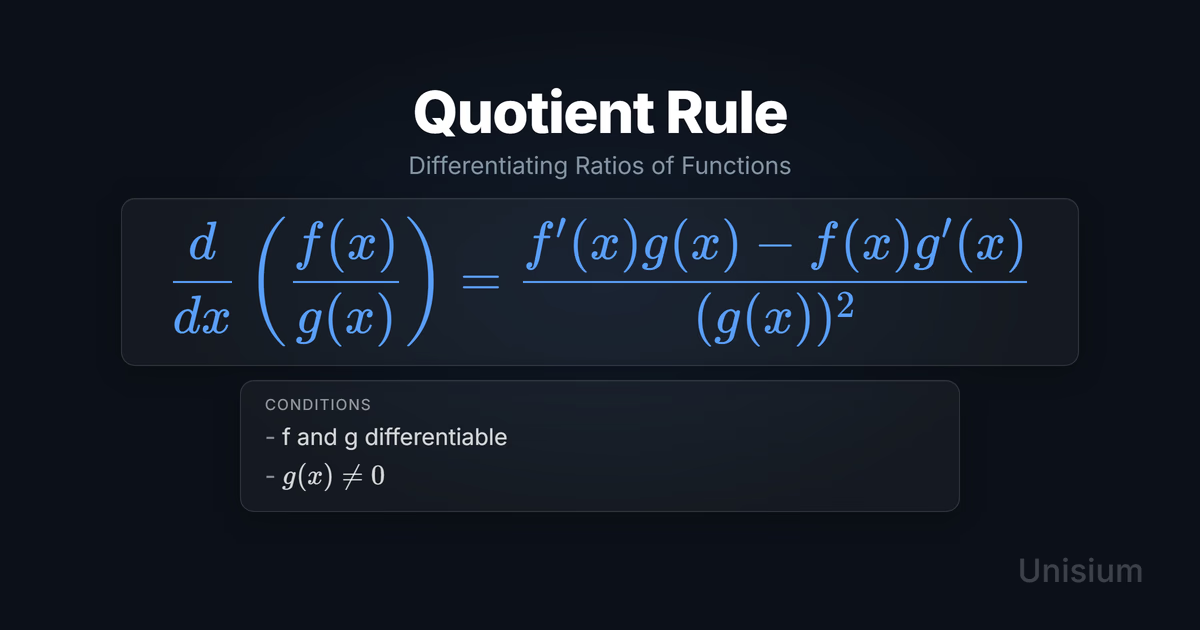
The quotient rule differentiates a ratio by rewriting as . It applies when and are differentiable and , so the quotient is defined. Checking first prevents the denominator-zero failure where the quotient is undefined.
On this page: The Principle | Conditions | Failure Modes | EE Questions | Retrieval Practice | Practice Ground | Solve a Problem | FAQ | How This Fits
The Principle
The move: Differentiate a ratio by applying the formula .
The invariant: The result is the exact derivative of the quotient — it produces an expression equal to for every where both functions are differentiable and .
Pattern:
| Legal ✓ | Illegal ✗ |
|---|---|
The right column is blocked because at the denominator factor is , so the quotient is undefined there and the quotient-rule move is not available.
Conditions of Applicability
Condition: f and g differentiable;
Before applying, check: Confirm on the domain (or at the point) where you are differentiating — if , the quotient is not even defined at , and no derivative exists there.
- When at a point: The quotient rule cannot be applied at that point. The denominator factor in the formula would be zero, and the underlying function is undefined.
- When is not differentiable at a point: Even if there, the quotient rule requires to be differentiable so that can be computed.
Want the complete framework behind this guide? Read Masterful Learning.
Common Failure Modes
Failure mode: writing — distributing the derivative operator to numerator and denominator separately → this produces the wrong formula; the denominator is lost, and the cross term is dropped entirely.
Debug: ask “do I have in the numerator and in the denominator?” If either part is missing, the formula is wrong.
Elaborative Encoding
Use these questions to build deep understanding. (See Elaborative Encoding for the full method.)
Within the Principle
- What role does each term in the numerator play — why does the formula need both and ?
- Why does the denominator involve rather than just ?
For the Principle
- How do you decide whether holds on the domain before applying the rule?
- What step would you add if you were unsure whether the denominator could be zero?
Between Principles
- How does the quotient rule relate to the product rule — can you derive the quotient rule by writing and applying the product rule?
Generate an Example
- Describe a problem where the quotient rule appears necessary but you could avoid it by simplifying the fraction first. What does that tell you about when to reach for the quotient rule?
Retrieval Practice
Answer from memory, then click to reveal and check. (See Retrieval Practice for the full method.)
State the quotient rule move in one sentence: _____Differentiate f(x)/g(x) by computing [f-prime times g minus f times g-prime] all divided by g squared.
Write the canonical quotient rule formula: _____
State the canonical condition: _____
Practice Ground
Use these exercises to build move-selection fluency. (See Self-Explanation for how to use worked examples effectively.)
Procedure Walkthrough
Compute .
Identify: , . Note only when , so the rule applies for all .
| Step | Expression | Operation |
|---|---|---|
| 0 | — | |
| 1 | Apply quotient rule after checking so | |
| 2 | Expand the numerator | |
| 3 | Collect like terms |
Drills
Format A — Forward step (apply the quotient rule)
Apply the quotient rule once and simplify the numerator.
Reveal
, ; , . Note for all , so the condition holds everywhere.
Apply the quotient rule once. State which values of must be excluded.
Reveal
, ; , . Excluding (where ):
Apply the quotient rule. State the excluded value before computing.
Reveal
, ; , . Excluded: (where ).
[Near-miss: applicability check] Is the quotient rule applicable to at , , and ?
Reveal
.
- At : — the function is not defined at . The quotient rule does not apply.
- At : — same situation. Not applicable.
- At : — the condition holds; the quotient rule applies here.
The expression looks like a well-formed quotient, but the condition fails at two points. Note: for , , so the derivative at eligible points simplifies to .
Use the quotient rule to verify that . Assume .
Reveal
, ; , . Condition: .
Format B — Action label (identify the rule and its setup)
State which differentiation rule was used and identify and .
Reveal
Quotient rule, with and . The form over is recognizable: numerator is , denominator is .
Below is a student’s computation. What rule was applied, and was it applied correctly? Identify the error if any.
Reveal
Invalid move. The student differentiated the numerator and denominator separately and divided — this is not a valid rule. The quotient rule requires , not .
Correct result: , ; , .
Identify which differentiation rule was applied at each labeled arrow.
(Arrow produces the ratio above. Arrow produces the derivative of the numerator.)
Reveal
Arrow : Product rule — differentiating gives .
Arrow : Not the quotient rule — dividing by is a Pythagorean identity simplification, not a differentiation step. No differentiation rule is applied at .
(This illustrates that an expression that looks like a quotient is not automatically the result of the quotient rule.)
Format C — Transition identification (multi-step chain)
A student differentiates in two ways. Which version uses the quotient rule, and at which step?
Version A: Expand numerator first: , so . Then differentiate each term.
Version B: Apply the quotient rule directly to with , .
Reveal
Version A uses the quotient rule on the sub-expression (one term after splitting). The quotient rule appears in the middle of the computation, not as the first move.
Version B uses the quotient rule as the first and only transformation step, after which the result is expanded.
Both routes are valid since for all .
In version B: , ; , .
In the derivation below, identify every step that uses the quotient rule (there may be more than one, or none at a given step).
| Step | Move |
|---|---|
| Identify as quotient | |
| Cancel from numerator (algebraic, ) | |
| Differentiate after simplification |
Reveal
No step uses the quotient rule. Step 1 is algebraic: for . Step 2 differentiates a polynomial — power rule and sum rule only.
If instead you applied the quotient rule before simplifying, with and :
Same result, but only valid for .
Solve a Problem
Apply what you’ve learned with Problem Solving.
Problem: Compute where . Confirm the quotient rule condition holds before starting.
Full solution
Condition check: . Discriminant: and , so for all real . The condition holds everywhere — no values need to be excluded.
| Step | Expression | Move |
|---|---|---|
| 0 | Start after confirming for all real | |
| 1 | Apply quotient rule: over | |
| 2 | Expand; | |
| 3 | Collect like terms |
Related Principles
| Principle | Relationship |
|---|---|
| Derivative Product Rule | Closest sibling — the quotient rule can be derived by rewriting as and then using product-style structure with a derivative on the reciprocal |
| Derivative Chain Rule | Needed whenever the numerator or denominator has an inner function, because the quotient rule does not replace the chain rule inside those factors |
| Derivative Power Rule | Shows up in the reciprocal-derivative derivation and in many quotient examples where polynomial pieces inside the numerator or denominator still need differentiation |
| Derivative Sum Rule | Often used to differentiate or simplify expanded numerator pieces after the quotient-rule structure is chosen |
FAQ
What is the quotient rule?
The quotient rule is a differentiation formula for a ratio of two functions. If , then , valid wherever and are differentiable and .
When is the quotient rule valid?
The condition has two parts: both and must be differentiable at the point, and there. If , the function is undefined at , so no derivative exists and the rule cannot be applied.
What goes wrong if I forget the condition?
If , the quotient is undefined at , so the quotient rule cannot be applied there. The formula also becomes undefined because its denominator is . A more common authoring mistake is to compute a formally correct derivative expression but forget to exclude the zeros of from the domain statement.
How is the quotient rule different from the product rule?
The product rule handles and gives — both terms are additive. The quotient rule handles and gives — the numerator is a difference, and the denominator appears. You can derive the quotient rule from the product rule by writing and applying the chain rule to .
Can I always simplify the fraction before differentiating?
Yes — simplifying first is often cleaner and valid as long as you track any points where cancellation changes the domain. If for , differentiating after simplification gives and is correct, but the derivative is still undefined at even though the simplified form looks continuous there.
Does a mnemonic help with the quotient rule formula?
The phrase “low d-high minus high d-low over low squared” (where “low” = and “high” = ) encodes the formula. Use it as a check after writing the formula, but always confirm the condition before applying it.
How This Fits in Unisium
Within the calculus subdomain, the quotient rule is one of the core derivative-building moves in single-variable calculus, alongside the product rule and chain rule. In Unisium, it is trained as a conditional move: learners are repeatedly pushed to check whether before applying the formula, so condition checking becomes part of the routine rather than an afterthought. The drill yard above mirrors how Unisium surfaces the move through forward-step exercises, action-label exercises, and transition-identification exercises — building both execution fluency and the ability to recognize where the rule applies in longer chains.
Explore further:
- Calculus Subdomain Map — Return to the calculus hub to see where quotient work sits relative to the other derivative-structure rules
- Principle Structures — See how the quotient rule sits alongside the product rule and chain rule in the calculus principle hierarchy
- Elaborative Encoding — Build deep understanding of why the condition is structural, not optional
- Retrieval Practice — Make the formula and condition instantly accessible under exam pressure
Ready to practice the quotient rule? See Unisium’s 14-day free trial or explore the full learning framework in Masterful Learning.

Masterful Learning
The book behind these guides: a study system for physics, math, & programming built on retrieval, connection, explanation, and problem solving.
Ready to apply this strategy?
Unisium turns these evidence-based techniques into guided study sessions for math and physics. Places are limited during early access. Check current availability to start a trial; joining the mailing list is optional.
See plans and availability Read More GuidesAlready have access? Sign in