Antiderivative definition: Recognizing the Reverse Derivative
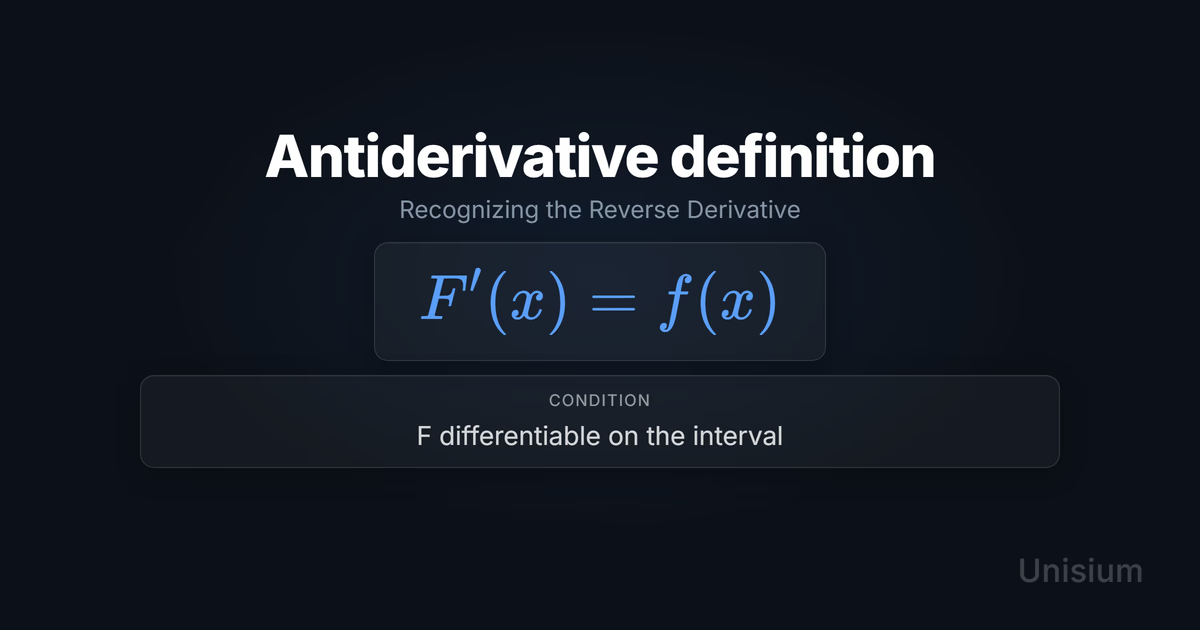
The antiderivative definition states that a differentiable function is an antiderivative of on an interval if at every point on that interval—identifying antiderivatives as reverse differentiation up to an additive constant. The definition provides the logical foundation for the indefinite integral, the Fundamental Theorem, and every integration technique in calculus. Mastering it requires elaborative encoding, retrieval practice, and problem solving—core strategies in the Unisium Study System.
On this page: The Principle | Conditions | Misconceptions | EE Questions | Retrieval Practice | Worked Example | Solve a Problem | FAQ
The Principle
Statement
A function is called an antiderivative of on an interval if is differentiable on and for every in . The definition captures differentiation run in reverse: instead of asking “what is the rate of change of ?”, it asks “which function, when differentiated, produces ?”. Because any constant differentiates to zero, antiderivatives are never unique—if works, so does for any constant .
Mathematical Form
Where:
- = the antiderivative function, differentiable on the interval of interest
- = the given function (the integrand whose antiderivative is sought)
- = the derivative of
- = the input variable
Alternative Forms
In a different notational context the same relationship appears as:
- Leibniz notation:
Conditions of Applicability
Condition: F differentiable on the interval
Practical modeling notes
- “F differentiable on the interval” means has a well-defined derivative at every point in the interval under consideration—the limit of the difference quotient for must exist and be finite at each such point.
- The interval should be stated or understood from context. A function can be an antiderivative of on one interval but not on another; the equality must hold throughout the interval being claimed.
- For continuous on an interval, the First Part of the Fundamental Theorem of Calculus guarantees that an antiderivative exists—but existence of an antiderivative and existence of an elementary antiderivative are different questions.
When It Doesn’t Apply
The antiderivative definition fails when the defining derivative relationship breaks on the claimed interval:
- is not differentiable on the interval: If has a corner, cusp, vertical tangent with undefined derivative, or discontinuity inside the interval, then is not defined at every point there, so cannot be an antiderivative of on that interval.
- does not equal throughout the interval: A differentiable function is not an antiderivative of unless its derivative matches pointwise on the interval. For example, is not an antiderivative of because , not .
Want the complete framework behind this guide? Read Masterful Learning.
Common Misconceptions
Misconception 1: “The antiderivative of is unique”
The truth: If is one antiderivative of , then is also an antiderivative for any constant , because . On a connected interval, the family of all antiderivatives of consists of every function of the form .
Why this matters: Forgetting the constant in indefinite integration is the direct consequence of this misconception. Omitting converts a family into a single function and loses valid solutions when solving differential equations or initial-value problems.
Misconception 2: “Antiderivative and indefinite integral mean exactly the same thing”
The truth: A single antiderivative satisfies . The indefinite integral denotes the entire family —it packages all antiderivatives into one expression. The antiderivative definition provides the test; the integral notation provides the representation of the family.
Why this matters: Conflating the two obscures where the constant comes from and why it appears in every indefinite integral answer.
Misconception 3: “The antiderivative of is ”
The truth: Products of antiderivatives are generally not antiderivatives of the product. Differentiating gives by the product rule—not in general.
Why this matters: Students who apply this false rule arrive at incorrect integrals. Integrating products typically requires integration by parts or substitution, not a factor-by-factor antiderivative product.
Elaborative Encoding
Use these questions to build deep understanding. (See Elaborative Encoding for the full method.)
Within the Principle
- In , what does each letter represent? Which function is the “input” to the antiderivative relationship, and which is the “output”?
- Why does checking whether is an antiderivative of always reduce to a single derivative test? Why does adding a constant to not change whether is an antiderivative of ?
For the Principle
- Given a function , what is the decision procedure for checking whether a proposed is an antiderivative of ? What one operation do you perform, and what equality do you check?
- What happens when is not differentiable at but is continuous there? Can still be an antiderivative of on an interval that includes ?
Between Principles
- The derivative at a point requires the limit of the difference quotient to exist. The antiderivative definition uses . How does the antiderivative definition depend on the derivative definition, and which concept is more fundamental?
Generate an Example
- Pick any smooth function you know (polynomial, trig, exponential). Compute and identify the resulting . You have just produced an antiderivative pair —what does this tell you about how the definition is always satisfiable in one direction?
Retrieval Practice
Answer from memory, then click to reveal and check. (See Retrieval Practice for the full method.)
State the principle in words: _____A differentiable function F is an antiderivative of f on an interval if F'(x) = f(x) at every point on that interval.
Write the canonical equation: _____
State the canonical condition: _____F differentiable on the interval
Worked Example
Use this worked example to practice Self-Explanation.
Problem
Show that is an antiderivative of .
Step 1: Verbal Decoding
Target: confirm
Given: ,
Constraints: polynomial functions; differentiability of holds everywhere for polynomials
Step 2: Visual Decoding
Draw both graphs on the same axes. Label the cubic and the parabola . Mark a shared -value and indicate the tangent slope on and the corresponding function value on at that point. (Key visual: slope of versus value of .)
Step 3: Mathematical Modeling
Step 4: Mathematical Procedures
Step 5: Reflection
- Verification: matches exactly, confirming the definition is satisfied.
- Connection to concept: The derivative power rule reverses here; the power rule for integration names that antiderivative move directly: raise the exponent by one and divide by the new exponent.
- Domain check: Polynomials are differentiable everywhere, so satisfies the differentiability condition on all of .
Before moving on: self-explain the model
Try explaining Step 3 out loud (or in writing): why the instantiated form is the right model for this verification, what it means for a function to pass this test, and why the differentiability condition is automatically satisfied for polynomial .
Mathematical model with explanation
Principle: Antiderivative definition — is an antiderivative of iff is differentiable and .
Conditions: is a polynomial, hence differentiable everywhere; the condition is satisfied on all of .
Relevance: The problem calls for a direct application of the definition. No integral notation is required—only differentiate and compare.
Description: Differentiating via the derivative power rule gives . The same relationship is why the power rule for integration sends to . Comparing with confirms the equality, closing the verification.
Goal: Establish that satisfies the defining relationship , confirming it qualifies as an antiderivative of .
Solve a Problem
Apply what you’ve learned with Problem Solving.
Problem
Show that is an antiderivative of .
Hint (if needed): Differentiate and compare the result to .
Show Solution
Step 1: Verbal Decoding
Target: confirm
Given: ,
Constraints: trigonometric functions; must be differentiable on the interval
Step 2: Visual Decoding
Draw both graphs on the same axes over . Label and . Mark a shared -value and indicate the tangent slope on and the corresponding function value on at that point. (Key visual: slope of versus value of .)
Step 3: Mathematical Modeling
Step 4: Mathematical Procedures
Step 5: Reflection
- Verification: matches ; the definition is satisfied.
- Graphical meaning: The slope of at every equals the height of —a geometric confirmation of the antiderivative relationship.
- Connection to concept: The same derivative test applies as in the worked example: differentiate the proposed antiderivative and check equality with the target function.
Related Principles
| Principle | Relationship to Antiderivative Definition |
|---|---|
| Derivative at a point (definition) () | Prerequisite — in the definition uses exactly this limit concept; the antiderivative definition makes no sense without it |
| Indefinite integral as antiderivative () | Direct successor — extends this definition to represent the full family of antiderivatives via the constant |
| Fundamental Theorem of Calculus (Part 2) () | Uses as its condition; connects the antiderivative definition to the evaluation of definite integrals |
See Principle Structures for how these relationships fit hierarchically in calculus.
FAQ
What is the antiderivative definition?
A function is an antiderivative of on an interval if is differentiable on that interval and for every in the interval. The definition characterizes antiderivatives by a single derivative test.
What is the condition for the antiderivative definition?
must be differentiable on the interval. Differentiability ensures is well-defined at every point so the equation can be checked throughout the interval.
Are antiderivatives unique?
No. If is one antiderivative of , then is also an antiderivative for any constant , because . On a connected interval, antiderivatives of the same function differ by exactly a constant.
What is the difference between an antiderivative and the indefinite integral?
A single antiderivative satisfies . The indefinite integral denotes the entire family —all antiderivatives at once. The in integral notation reflects the non-uniqueness guaranteed by the definition.
What are the most common mistakes when working with the antiderivative definition?
Forgetting the constant (treating the antiderivative as unique), assuming the antiderivative of a product equals the product of antiderivatives, and confusing the existence of an antiderivative with the existence of an elementary antiderivative.
When does an antiderivative exist?
If is continuous on an interval, then has an antiderivative on that interval—guaranteed by the First Part of the Fundamental Theorem of Calculus. Whether that antiderivative can be expressed in terms of elementary functions is a separate question: some continuous functions, like , have no elementary antiderivative.
Related Guides
- Calculus Subdomain Map — Return to the full calculus map to see where antiderivatives sit relative to definite integrals, FTC, and the main integration techniques
- Principle Structures — See how the antiderivative definition anchors the hierarchy of integration principles in calculus
- Derivative at a Point — The prerequisite definition that gives its precise meaning via the difference quotient
- Self-Explanation — Practice articulating every step of an antiderivative verification out loud
- Retrieval Practice — Build instant recall of the definition and condition before exams
How This Fits in Unisium
Unisium structures the antiderivative definition as a representational principle: the equation is the model you check, and differentiating to verify equality with is the procedure. The platform surfaces this principle in elaborative encoding exercises, retrieval prompts, and verification problems so you build the habit of applying the derivative test precisely—rather than treating antiderivatives as a mechanical symbol-manipulation step. Because the Fundamental Theorem, indefinite integrals, and every integration technique in calculus depend on this definition, mastering it first makes every subsequent integration principle easier.
Ready to master the antiderivative definition? See Unisium’s 14-day free trial or explore the full learning framework in Masterful Learning.

Masterful Learning
The book behind these guides: a study system for physics, math, & programming built on retrieval, connection, explanation, and problem solving.
Ready to apply this strategy?
Unisium turns these evidence-based techniques into guided study sessions for math and physics. Places are limited during early access. Check current availability to start a trial; joining the mailing list is optional.
See plans and availability Read More GuidesAlready have access? Sign in