Fundamental Theorem of Calculus (Part 2): Evaluate a definite integral from an antiderivative
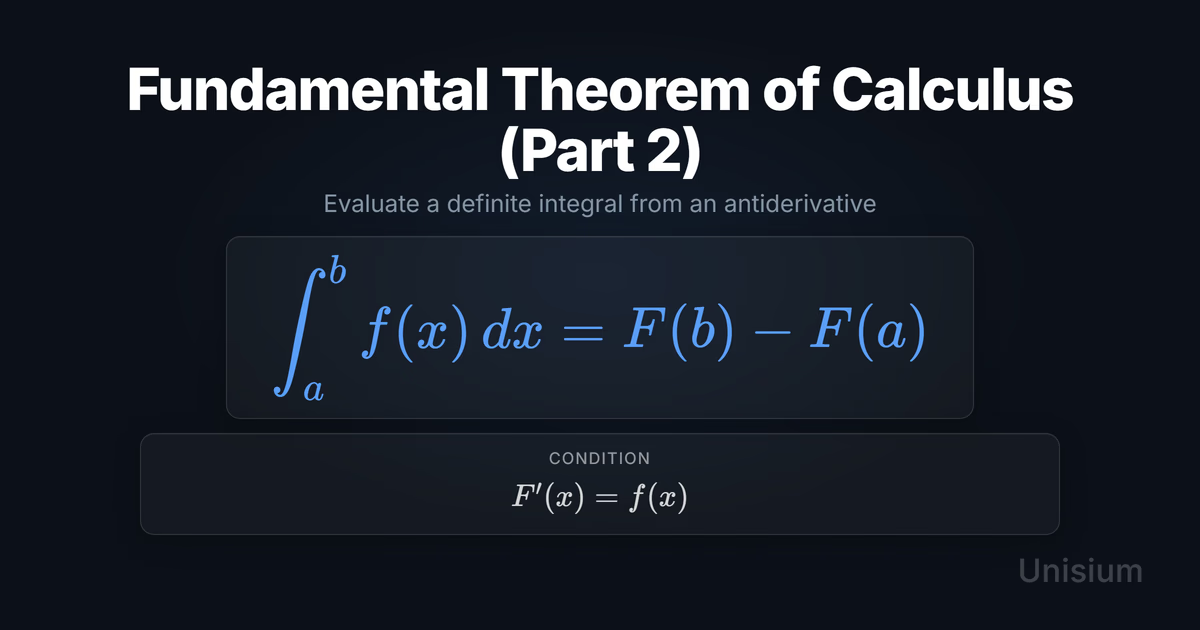
Fundamental Theorem of Calculus (Part 2) lets you replace a definite integral with an endpoint difference of any antiderivative: . It applies when , so the key move-selection check is not whether you know the bounds but whether your chosen really differentiates back to the integrand. That verification habit is central in the Unisium Study System.
On this page: The Principle | Conditions | Failure Modes | EE Questions | Retrieval Practice | Practice Ground | Solve a Problem | Related Principles | FAQ | How This Fits
The Principle
The move: Replace a definite integral with the upper-endpoint value minus the lower-endpoint value of an antiderivative.
The invariant: This preserves the numerical value of the definite integral because the endpoint difference measures the same net accumulation as the original integral.
Pattern:
| Applies ✓ | Does not apply ✗ |
|---|---|
Left: is an applicable choice because . Right: looks close, but , so the condition fails and FTC Part 2 does not apply with that candidate.
Conditions of Applicability
Condition:
The rule is about choosing a correct antiderivative first, then evaluating that antiderivative at the bounds. The bounds alone do not justify the move; the antiderivative relationship does.
Before applying, check: if you differentiate your chosen , do you recover the integrand exactly?
If the condition is violated: the endpoint subtraction computes the change in the wrong function, so the result is not the value of the integral.
- Re-differentiate the candidate antiderivative before substituting bounds, especially when several nearby formulas look similar.
- Keep the endpoint order as after the antiderivative check passes; reversing the order changes the sign.
See antiderivative definition for the object this rule requires, connect it to definite integral as Riemann sum for the quantity being evaluated, and compare it with indefinite integral as antiderivative to separate definite-value questions from antiderivative-family questions.
Want the complete framework behind this guide? Read Masterful Learning.
Common Failure Modes
Failure mode: plug the bounds into a function that merely resembles an antiderivative of → you compute an endpoint difference, but not the integral’s value.
Debug: differentiate the candidate function first; if the derivative is not exactly the integrand, stop before substituting and .
Elaborative Encoding
Use these questions to build deep understanding. (See Elaborative Encoding for the full method.)
Within the Principle
- Why does the theorem use endpoint values of an antiderivative instead of asking you to approximate area directly from rectangles each time?
- What is the difference between the statement "" and the evaluation step ""?
For the Principle
- When two candidate functions look close, such as and , why is differentiating the faster applicability check than substituting the bounds immediately?
- Why does changing the order of the bounds change the sign of the answer even when the same antiderivative is used?
Between Principles
- How does this theorem connect indefinite integral as antiderivative to definite integral as Riemann sum?
Generate an Example
- Create one definite integral and give two possible endpoint functions, one that satisfies and one that does not. What quick derivative check separates them?
Retrieval Practice
Answer from memory, then click to reveal and check. (See Retrieval Practice for the full method.)
State the move in one sentence: _____Replace a definite integral with the upper-endpoint minus lower-endpoint values of an antiderivative.
Write the canonical equation: _____
State the canonical condition: _____
Practice Ground
Use these exercises to build move-selection fluency. (See Self-Explanation for how to use worked examples effectively.)
Procedure Walkthrough
Starting from , reach the exact value.
| Step | Expression | Operation |
|---|---|---|
| 0 | - | |
| 1 | Choose because , then apply FTC Part 2 | |
| 2 | Substitute the upper and lower bounds in the correct order | |
| 3 | Simplify |
Drills
Forward step: Apply the theorem
Use FTC Part 2 to evaluate the integral.
Reveal
Choose because .
Use FTC Part 2 to evaluate the integral.
Reveal
Choose because .
[Negative] A student proposes for . Is FTC Part 2 ready to apply with that ? Explain first.
Reveal
No. FTC Part 2 is not ready to apply with that choice because
The condition fails, so substituting bounds into would give the change in the wrong function.
Use FTC Part 2 to evaluate the integral.
Reveal
Choose on because there.
Action label: Identify what was done
What was done between these two states?
Reveal
An antiderivative was chosen and FTC Part 2 was applied. Since
the definite integral can be rewritten as an endpoint difference.
What tempting application was attempted here, and why does FTC Part 2 not apply?
Reveal
The attempted move was to apply FTC Part 2 directly to the integrand instead of to an antiderivative.
FTC Part 2 does not apply because
so the condition is not satisfied.
What evaluation move was used between these two states?
Reveal
Upper-endpoint minus lower-endpoint substitution. After FTC Part 2 gives , you plug in the upper bound first and then subtract the lower-bound value.
Transition identification: Find where the theorem appears
Which transition uses FTC Part 2 directly?
Reveal
Transition (1) uses FTC Part 2 directly.
- (1) chooses an antiderivative and rewrites the definite integral as an endpoint difference.
- (2) substitutes the bounds.
- (3) simplifies the arithmetic.
Which proposed transitions are applicable applications of FTC Part 2?
Reveal
Applicable transitions: 1 and 3.
- 1 is valid because .
- 2 does not apply because , so the condition fails.
- 3 is valid because on , which contains .
Goal micro-chain: Reach the value efficiently
Starting from , reach the final value in the minimum number of moves.
Reveal
One efficient chain is:
The first move is FTC Part 2 after checking that .
[Negative] Starting from , a student writes . Should that chain continue, or should it stop?
Reveal
It should stop and be corrected first. The proposed endpoint function does not satisfy the condition because
This is a near-miss: the form looks antiderivative-like, but the derivative check blocks FTC Part 2.
Solve a Problem
Apply what you’ve learned with Problem Solving.
Problem: Evaluate using FTC Part 2.
Full solution
| Step | Expression | Move |
|---|---|---|
| 0 | - | |
| 1 | Choose an antiderivative and apply FTC Part 2 | |
| 2 | Substitute the upper and lower bounds | |
| 3 | Simplify each endpoint value | |
| 4 | Finish the arithmetic |
Related Principles
| Principle | Relationship |
|---|---|
| Antiderivative definition | Supplies the condition you must verify before applying FTC Part 2 |
| Definite integral as Riemann sum | Gives the accumulation quantity that FTC Part 2 converts into endpoint evaluation |
| Indefinite integral as antiderivative | Separates finding a family of antiderivatives from evaluating one definite integral value |
FAQ
What does Fundamental Theorem of Calculus (Part 2) say?
It says that if , then
So a definite integral can be evaluated by finding any antiderivative of the integrand and subtracting endpoint values.
What condition do I have to check before using it?
You must check that your chosen function really is an antiderivative of the integrand: . If that derivative check fails, the endpoint subtraction does not represent the integral.
What is the most common mistake?
Using the integrand itself, or a nearby-looking function, as though it were the antiderivative. For example, for , writing is wrong because the derivative of is , not .
Why is the order instead of ?
The theorem measures net change from the lower bound to the upper bound. Reversing the order reverses the sign, which corresponds to integrating over the interval in the opposite direction.
Can I use any antiderivative?
Yes. Any two antiderivatives of differ by a constant, and that constant cancels in . The only non-negotiable part is that the derivative of your chosen function must be exactly .
How is this different from an indefinite integral?
An indefinite integral as antiderivative asks for a family of functions plus . FTC Part 2 uses one antiderivative to compute a single number for a definite integral.
How This Fits in Unisium
Unisium uses FTC Part 2 as the bridge between antiderivative knowledge and exact accumulation. The skill is not only remembering the formula but selecting a correct antiderivative under pressure, then evaluating the endpoints in the correct order. That is why this guide emphasizes applicability checks, negative near-misses, and short endpoint-evaluation chains instead of one long narrative example.
Explore further:
- Principle Structures - See where FTC Part 2 sits in the broader calculus map
- Antiderivative definition - Recheck the meaning of before you substitute bounds
- Fundamental Theorem of Calculus (Part 1) - Pair endpoint evaluation with the theorem that differentiates accumulation in the other direction
- Self-Explanation - Narrate why a candidate antiderivative is valid before evaluating
- Retrieval Practice - Make the condition and pattern easier to recall under time pressure
Ready to make endpoint evaluation automatic? See Unisium’s 14-day free trial or go deeper with Masterful Learning.

Masterful Learning
The book behind these guides: a study system for physics, math, & programming built on retrieval, connection, explanation, and problem solving.
Ready to apply this strategy?
Unisium turns these evidence-based techniques into guided study sessions for math and physics. Places are limited during early access. Check current availability to start a trial; joining the mailing list is optional.
See plans and availability Read More GuidesAlready have access? Sign in