Taylor Polynomial Definition: Approximating Functions with Polynomials
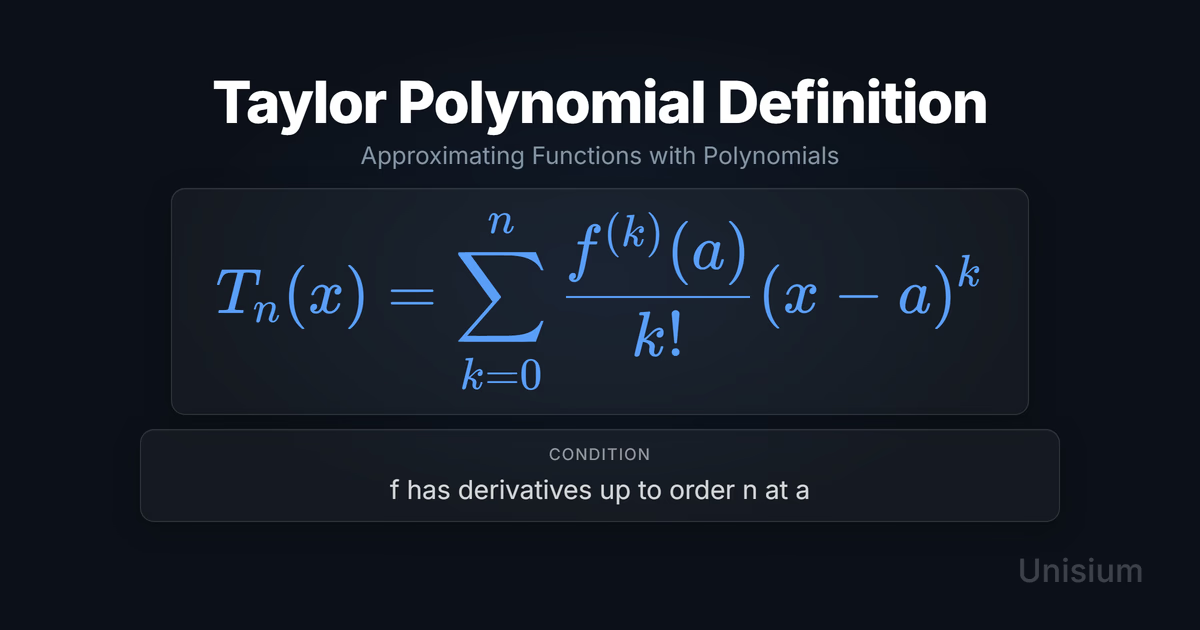
The Taylor polynomial definition states that the nth Taylor polynomial of at is , the unique polynomial of degree at most that matches and its first derivatives at . It applies when has derivatives up to order at . This guide helps you recognize that structure and use it cleanly in local approximation problems.
On this page: The Principle | Conditions | Misconceptions | EE Questions | Retrieval Practice | Worked Example | Solve a Problem | FAQ
The Principle
Statement
The Taylor polynomial definition says that for a function with derivatives up to order at , the nth Taylor polynomial at is the polynomial , where by convention. is the unique polynomial of degree at most satisfying for every .
Mathematical Form
Where:
- = the degree of the polynomial (a non-negative integer)
- = the input variable
- = the center (the point at which the polynomial is built)
- = the th derivative of evaluated at (with )
- = factorial, with
Alternative Forms
In different contexts, this appears as:
- Explicit terms (degree 3, center ):
- Maclaurin polynomial ():
Conditions of Applicability
Condition: f has derivatives up to order n at a
Practical modeling notes
- “Has derivatives up to order at ” means all exist as finite real numbers. For elementary functions (, , , polynomials), all derivatives exist everywhere, so the condition holds for any and any .
- The factor is not optional—it is the exact correction that makes . Omitting it produces a polynomial whose derivatives at do not match ‘s.
- Choose at a value where evaluation is easy: (the Maclaurin case) often gives the simplest arithmetic for , , and .
- is the definition of the polynomial and says nothing about how accurate the approximation is away from . How quickly the error grows with is determined by the Taylor remainder theorem, which is a separate result.
When It Doesn’t Apply
- Insufficient differentiability: If does not have an th derivative at , the th Taylor polynomial at is not defined. For example, is not differentiable at , so at does not exist for .
Want the complete framework behind this guide? Read Masterful Learning.
Common Misconceptions
Misconception 1: equals on its entire domain
The truth: agrees with and all its derivatives up to order at , but in general. The degree-1 polynomial agrees with and its first derivative at , but their values diverge for any .
Why this matters: Treating as equal to leads to errors when computing far from or when identifying when an approximation loses reliability.
Misconception 2: The in the denominator is just a scaling convention
The truth: , so dividing by is exactly what makes the th derivative of at equal . The factorial is not cosmetic—it is the mechanism behind the defining matching property.
Why this matters: Students who drop or misplace the produce polynomials whose derivatives at do not match ‘s, violating the definition and giving incorrect coefficients.
Elaborative Encoding
Use these questions to build deep understanding. (See Elaborative Encoding for the full method.)
Within the Principle
- In , what does each factor in the th term (, , and ) contribute? Why must all three factors be present?
- What is the value of ? What is ? What does this reveal about what “matching at ” means geometrically and analytically?
For the Principle
- Given a function and a target degree , how do you identify the center that makes the derivatives easiest to evaluate?
- Suppose is three-times differentiable at but not four-times differentiable. For which values of can you build there, and for which does the definition fail?
Between Principles
- The tangent line equation at is . How does compare to it? What does for capture that the tangent line cannot?
Generate an Example
- Describe a function and a center where the Taylor polynomial is exactly equal to for all . What does this say about functions that are themselves polynomials of low degree?
Retrieval Practice
Answer from memory, then click to reveal and check. (See Retrieval Practice for the full method.)
State the principle in words: _____The nth Taylor polynomial of f at a is the unique polynomial of degree at most n matching f and its first n derivatives at a, given by the sum from k=0 to n of f^(k)(a) over k! times (x-a)^k.
Write the canonical equation: _____
State the canonical condition: _____f has derivatives up to order n at a
Worked Example
Use this worked example to practice Self-Explanation.
Problem
Let . Find the Taylor polynomial at .
Step 1: Verbal Decoding
Target: , the degree-3 Taylor polynomial of at
Given: , ,
Constraints: ; ; ; is differentiable everywhere
Step 2: Visual Decoding
Mark on the -axis. will touch at and match its slope, curvature, and third-derivative rate there; it diverges from as grows. (The polynomial is a cubic that closely tracks the exponential only near .)
Step 3: Mathematical Modeling
Step 4: Mathematical Procedures
Step 5: Reflection
- Verification: ✓; ✓; ✓.
- Graphical meaning: Near , tracks closely; for the cubic departs noticeably.
- Limiting case: At , —the tangent line to at .
Before moving on: self-explain the model
Try explaining Step 3 out loud (or in writing): why the definition uses rather than alone, why all four coefficients equal for , and how would change if the center were instead of .
Mathematical model with explanation
Principle: Taylor polynomial definition — instantiated with , .
Conditions: has derivatives of all orders everywhere, so the condition is satisfied for any and any .
Relevance: Every derivative of equals , so every , making the coefficient evaluation trivial.
Description: Substitute for and simplify for each term.
Goal: Produce the explicit cubic , which matches and its first three derivatives at .
Solve a Problem
Apply what you’ve learned with Problem Solving.
Problem
Let . Find the Taylor polynomial at .
Hint (if needed): Compute for by cycling through the known derivatives of .
Show Solution
Step 1: Verbal Decoding
Target: , the degree-4 Taylor polynomial of at
Given: , ,
Constraints: ; ; ; is differentiable everywhere
Step 2: Visual Decoding
Mark on the -axis. Derivatives of cycle: . At the pattern gives values for orders through . (Only even-order terms survive because .)
Step 3: Mathematical Modeling
Step 4: Mathematical Procedures
Step 5: Reflection
- Verification: ✓; ✓.
- Graphical meaning: Odd-degree terms vanish because is even; is a polynomial in only, symmetric about the -axis.
- Domain check: The zero coefficients at are correct— and , not missing terms.
Related Principles
| Principle | Relationship to Taylor Polynomial Definition |
|---|---|
| Derivative at a point () | Prerequisite — each is a derivative value; without the ability to evaluate derivatives at , no Taylor polynomial can be built |
| Linear approximation () | The degree-1 case: is the linear approximation, matching only value and slope |
| Tangent line equation () | is exactly the tangent line rewritten; the Taylor polynomial generalizes the tangent line to higher-order polynomial fits |
See Principle Structures for how these relationships fit hierarchically in calculus.
FAQ
What is the Taylor polynomial definition?
The Taylor polynomial of degree at center is . It is the unique polynomial of degree at most that matches and each of its first derivatives at . The condition is that must have derivatives up to order at .
What does “f has derivatives up to order n at a” mean?
It means all exist as finite real numbers at exactly the point . For , , , and polynomials, all derivatives exist everywhere, so the condition holds for any at any .
What is a Maclaurin polynomial?
A Maclaurin polynomial is the Taylor polynomial built at the center : . The name honors Colin Maclaurin, but it is just the special case of the Taylor polynomial definition.
Why is the coefficient and not simply ?
Differentiating exactly times yields , so the th derivative of at is . Setting makes exactly. The factorial is the mechanism, not decoration.
How does the Taylor polynomial relate to the Taylor series?
The Taylor series of at is the infinite sum (requiring all derivatives to exist at ). The th Taylor polynomial is the partial sum of the series through degree . Whether the series converges to for a given is a separate question addressed by the Taylor remainder theorem and the radius of convergence.
Related Guides
- Principle Structures — Organize the Taylor polynomial in a hierarchical framework with the derivative definition and approximation principles
- Linear Approximation — The first-order Taylor polynomial is the nearest downstream special case and the first approximation model most students use
- Self-Explanation — Practice explaining why each term carries as you work through examples
- Retrieval Practice — Make the equation and condition accessible under exam pressure
- Problem Solving — Apply the Five-Step Strategy to Taylor polynomial problems systematically
How This Fits in Unisium
Unisium structures the Taylor polynomial definition as a representational principle: the equation is the model you instantiate by evaluating derivatives at , and expanding the sum is the procedure. The platform surfaces this principle through elaborative encoding exercises, retrieval cues, and worked problem sets so you build the habit of identifying , , and before computing any coefficient—rather than trying to reconstruct the formula from scratch under pressure. Because the Taylor polynomial reappears in local approximation, Taylor series convergence, differential equations, and numerical methods, mastering its definition here compounds into fluency across the rest of calculus.
Ready to master the Taylor polynomial definition? See Unisium’s 14-day free trial or explore the full learning framework in Masterful Learning.

Masterful Learning
The book behind these guides: a study system for physics, math, & programming built on retrieval, connection, explanation, and problem solving.
Ready to apply this strategy?
Unisium turns these evidence-based techniques into guided study sessions for math and physics. Places are limited during early access. Check current availability to start a trial; joining the mailing list is optional.
See plans and availability Read More GuidesAlready have access? Sign in