Derivative of ln(x): Differentiate the Natural Log on Its Domain
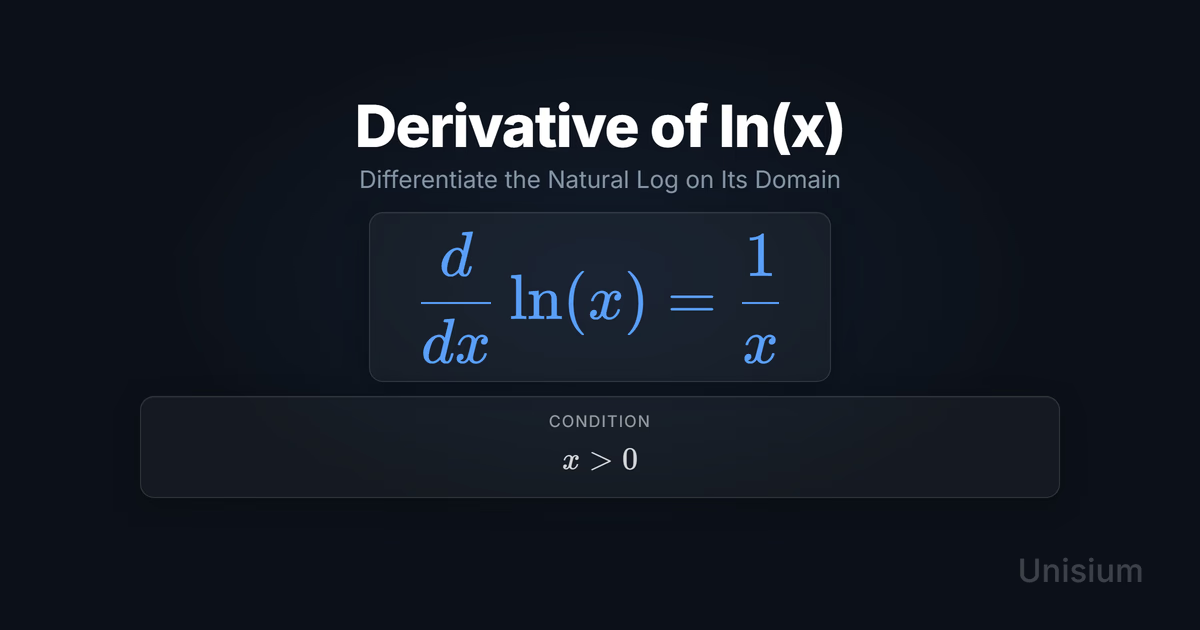
Derivative of ln(x) gives the direct derivative of the natural logarithm: . The condition is , so the rule applies only on the real domain of and should not be confused with the composite case , where chain rule takes over. Check both the domain and the local logarithm structure before committing to the move.
On this page: The Principle | Conditions | Failure Modes | EE Questions | Retrieval Practice | Practice Ground | Solve a Problem | FAQ | How This Fits
The Principle
The move: Differentiate the direct logarithmic form by replacing it with .
The invariant: This gives the exact derivative of the real-valued function on its domain .
Pattern:
| Legal ✓ | Illegal ✗ |
|---|---|
Left: the condition holds, so the rule applies. Right: is not a real-valued function at , so writing there invents a derivative at a point outside the domain. The contrast is about applicability: the expression looks familiar, but the condition fails.
Conditions of Applicability
Condition:
Before applying, check: confirm that the local pattern is the bare logarithm rather than a composite form , and that the current input satisfies .
If the condition is violated: is not a real-valued differentiable function there, so substituting creates a derivative where the original function is not defined.
- The condition is a domain guard, not extra decoration. It tells you when the logarithm exists as a real-valued function.
- If the local expression is instead of , chain rule governs the step: on intervals where .
- At or any negative input, the direct rule is unavailable because itself is unavailable there.
Want the complete framework behind this guide? Read Masterful Learning.
Common Failure Modes
Failure mode: treat every logarithm as though it were the bare pattern → you either drop the chain factor in or apply the rule where the domain condition fails.
Debug: ask two questions before differentiating: “Is this exactly ?” and “Does the current input satisfy ?”
Elaborative Encoding
Use these questions to build deep understanding. (See Elaborative Encoding for the full method.)
Within the Principle
- Why does the derivative formula for naturally produce , and why is that output itself sensitive to the domain where the logarithm exists?
- What does the condition protect here: the algebraic rewrite, the function’s existence, or both?
For the Principle
- What is the fastest two-part check you can run before using the derivative of in a larger derivative computation?
- How does your decision process change when the expression is instead of the bare pattern ?
Between Principles
- How does the rule for differentiating connect to the derivative chain rule when the logarithm’s input is not just ?
Generate an Example
- Describe a derivative step that looks like a direct case but fails because the condition is not satisfied.
Retrieval Practice
Answer from memory, then click to reveal and check. (See Retrieval Practice for the full method.)
State the move in one sentence: _____Differentiate the direct logarithmic form ln(x) by replacing it with 1/x, provided x>0.
Write the canonical equation: _____
State the canonical condition: _____
Practice Ground
Use these exercises to build move-selection fluency. (See Self-Explanation for how to use worked examples effectively.)
Procedure Walkthrough
Starting from , differentiate assuming .
| Step | Expression | Operation |
|---|---|---|
| 0 | — | |
| 1 | Sum rule | |
| 2 | Direct rule on the first term because the condition is assumed | |
| 3 | Chain rule on the composite logarithm | |
| 4 | Power rule and constant rule inside the composite term | |
| 5 | Simplify |
Drills
Forward step (Format A)
Apply the rule once. Assume .
Reveal
This is the direct canonical pattern, so the rule applies immediately:
Does the direct rule apply to the whole expression below? Assume .
Reveal
No. The logarithm is defined here because , but the local pattern is not the bare form. It is a composite logarithm, so chain rule governs the step:
Differentiate this expression. Assume .
Reveal
Use the constant multiple rule, then the direct rule:
Which of the following derivative steps use the direct rule as written? Assume every logarithm shown is defined.
Reveal
Only uses the direct rule as written.
- : yes — direct pattern, with condition
- : no — composite logarithm, so chain rule is required
- : no — different function and different domain statement
This is the essential move-selection check: direct pattern versus neighboring log structures.
Differentiate this expression. Assume .
Reveal
Differentiate term by term:
A student writes . What is wrong with that move?
Reveal
The step treats as though it were the direct pattern. It is not. The input is , so chain rule is required:
for . The tempting move misses the inner derivative and misidentifies the local structure.
Action label (Format B)
What was done between these two steps? Assume .
Reveal
The direct rule was applied. The move is valid because the canonical condition is assumed.
What was done between these two steps? Assume .
Reveal
Constant multiple rule preserved the factor , then the direct rule turned into .
A student writes . What error occurred?
Reveal
The student used the direct rule on a composite logarithm and dropped the inner derivative. The logarithm may be defined, but the local structure is , not bare . The correct derivative is
Name the rule used on each term in this derivative. Assume .
Reveal
- term: the direct rule for differentiating
- term: derivative of
The whole derivative also uses the sum rule to split the expression into two local derivative steps.
Transition identification (Format C)
Which transition uses the direct rule, and which one uses chain rule? Assume .
Reveal
Transition (2) uses the direct rule. It changes into .
- Transition (1): sum rule
- Transition (2): direct rule
- Transition (3): chain rule on the composite logarithm
- Transition (4): simplify after differentiating the inner polynomial
In the chain below, which transition is invalid, and why?
Reveal
Transition (1) is invalid. It applies the direct rule to a composite logarithm and skips the inner derivative.
The correct move is to use chain rule first, which is what Transition (2) starts to supply:
Solve a Problem
Apply what you’ve learned with Problem Solving.
Problem: Differentiate for .
Full solution
| Step | Expression | Move |
|---|---|---|
| 0 | — | |
| 1 | Sum rule and constant multiple rule | |
| 2 | Direct rule on the first term | |
| 3 | Chain rule on the second logarithm | |
| 4 | Power rule and constant rule inside the composite term | |
| 5 | Simplify |
FAQ
What is the derivative of ?
The derivative of is , but the real-valued rule is used on the domain .
Why does the condition say ?
Because the real-valued natural logarithm is defined only for positive inputs. The derivative rule inherits that domain guard instead of bypassing it.
Can I use this rule at ?
No. is not defined as a real number, so this rule is not applicable there.
What if the expression is instead of ?
Then chain rule governs the step: on intervals where . This rule covers only the bare pattern .
How is the derivative of related to the derivative of ?
The functions and are inverse functions on their real domains, so derivative of and the derivative of sit next to each other in the calculus derivative family.
What is the derivative of ?
For , the derivative is also . But is a different function from , so do not treat it as the same canonical direct pattern.
How This Fits in Unisium
Within the calculus subdomain, the derivative of is a compact example of why transformational fluency is more than memorizing a formula. You need the pattern, domain guard, and structure check all at once: bare uses this rule, calls for the derivative chain rule, and mixed expressions still depend on habits built through retrieval practice and self-explanation.
Explore further:
- Calculus Subdomain Map — Return to the calculus hub to see where the natural logarithm rule sits beside the other derivative families
- Derivative chain rule — extend the logarithm derivative to nested inputs
- Derivative of — compare the paired exponential rule
- Principle Structures — see where this rule lives in the calculus derivative map
Ready to practice it in context? See Unisium’s 14-day free trial or explore the full framework in Masterful Learning.

Masterful Learning
The book behind these guides: a study system for physics, math, & programming built on retrieval, connection, explanation, and problem solving.
Ready to apply this strategy?
Unisium turns these evidence-based techniques into guided study sessions for math and physics. Places are limited during early access. Check current availability to start a trial; joining the mailing list is optional.
See plans and availability Read More GuidesAlready have access? Sign in