Calculus: The Principle Map
Calculus is the mathematics of change and accumulation. This guide provides a principle map of single-variable computational calculus: limits, derivatives, integrals, and problem-native applications. Each principle represents one atomic step you can use in problem-solving.
Here for retrieval practice? Jump to the practice section.
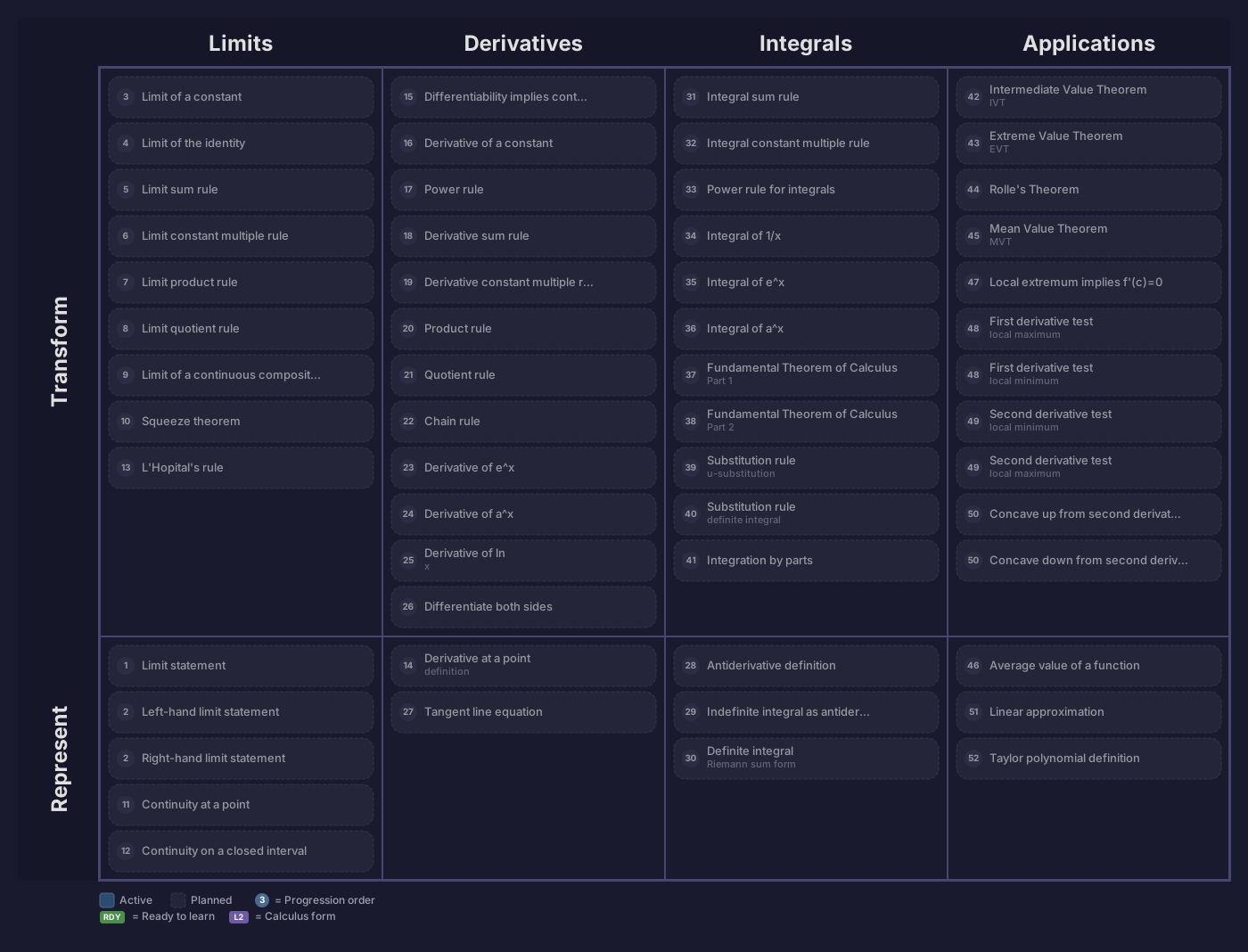
This reference map shows the core single-variable calculus principles in one inspectable structure. Use it to see where limits, derivatives, integrals, and applications sit, and to distinguish principles that define objects from principles that transform expressions or justify moves.

Names-only reference map: a complete reference map of 47 single-variable calculus principles organized by topic (limits, derivatives, integrals, applications) and role (representational or transformational).
On this page
- Why Learn Calculus?
- Prerequisites
- The Principle Map
- Practice recalling the principles
- Core Principles
- What’s Next?
- How This Fits in Unisium
Why Learn Calculus?
Calculus is the foundational mathematical language for physics, engineering, economics, biology, and nearly every quantitative science. It answers two fundamental questions: How fast is something changing? (derivatives) and How much accumulates over time? (integrals).
Without calculus, you can’t model motion, optimize designs, analyze rates of change, or compute areas under curves. Every time you take a derivative, apply the chain rule, or use the Fundamental Theorem of Calculus, you’re making an atomic, defensible step that can be checked for correctness.
This subdomain focuses on computational calculus: the techniques and theorems you need to solve problems. Rigorous convergence theory and proof-heavy analysis live in the Real Analysis Foundations subdomain.
Prerequisites
Mathematics:
- Algebra fluency: equation solving, factoring, exponent rules
- Functions: composition, inverse functions, exponential and logarithmic models
Prior Subdomains:
- Algebra (required for symbolic manipulation)
- Functions (required for function operations)
The Principle Map
The calculus principle map organizes 47 core single-variable calculus principles along two axes:
X-axis (Topics):
- Limits — The foundation: what does approach as ?
- Derivatives — Instantaneous rate of change
- Integrals — Accumulation and area under curves
- Applications — Optimization, averaging, and approximation
Y-axis (Principle Role):
- Representational — Definitions and object forms (what things are)
- Transformational — Computation rules and inference steps (valid moves)
Represent appears above Transform: first establish the objects and relationships in the model, then use valid transformations in the procedure. The learning sequence moves across both rows.
Progression numbers provide a recommended path through the subject. They may contain gaps when a later principle depends on work grouped elsewhere in the map, so treat them as a guide to sequence rather than a promise of strict numerical continuity.
The map shows dependencies: most principles require understanding earlier ones in their progression sequence.
Practice recalling the principles
This flashcard tool helps make the main calculus principles stronger and easier to access from memory. You practice recalling each principle’s equation or form and its conditions before revealing the answer.
Use it if you often recognize calculus rules after seeing them, but struggle to remember which form to use, what it means, or when it applies. Start with the first part of the map, then add more topics or principle roles when you want a broader review.
Why this works
This practice format is adapted from research on structured retrieval practice of physics principle structures. The direct studies were in introductory physics, but the learning move is the same here: retrieve the principle’s equation/form and conditions before relying on the completed map. The broader strategy is explained in the retrieval practice for equations and conditions guide.
Research basis:
- Gjerde, Holst, & Kolstø (2020). Retrieval practice of a hierarchical principle structure in university introductory physics: Making stronger students. Physical Review Physics Education Research, 16(1), 013103.
- Gjerde, Havre Paulsen, Holst, & Kolstø (2022). Problem solving in basic physics: Effective self-explanations based on four elements with support from retrieval practice. Physical Review Physics Education Research, 18(1), 010136.
- Gjerde, Marisaldi, Oksavik, Olafsson, Spångberg, & Holst (2025). Mandatory retrieval test to incentivize retrieval practice of physics principles. Physical Review Physics Education Research, 21(1), 010119.
Equation/form
Conditions
No principles match those filters. Choose at least one topic, principle role, and layer.
Core Principles
Conditions tell you when a principle applies. They’re intentionally concise—think of them as the main assumptions. You’ll refine what they really mean through practice.
Limits: Foundations (P1–3)
| Principle | Equation | Condition |
|---|---|---|
| Limit statement | ||
| Left-hand limit statement | ||
| Right-hand limit statement |
These principles establish the language of limits: what it means for to approach a value as approaches . One-sided limits distinguish behavior from the left and right.
Limits: Computation Rules (P4–10)
| Principle | Equation | Condition |
|---|---|---|
| Limit of a Constant | c constant | |
| Limit of the Identity | ||
| Limit Sum Rule | both limits exist | |
| Limit Constant Multiple Rule | limit exists | |
| Limit Product Rule | both limits exist | |
| Limit Quotient Rule | ; both limits exist | |
| Limit of a Continuous Composition | ; f continuous at L |
These are the arithmetic rules for limits: how to break down complex limits into simpler pieces. They’re the workhorses of limit computation.
Limits: Continuity and Advanced Techniques
| Principle | Equation | Condition |
|---|---|---|
| Squeeze theorem | near a; | |
| Continuity at a point | f(a) defined; limit exists | |
| L’Hopital’s rule | ; f and g differentiable near a; |
The squeeze theorem traps a limit between two known bounds. Continuity connects pointwise limit matching to function values and piecewise checks. L’Hôpital’s rule resolves indeterminate quotient forms using derivatives.
Derivatives: Definition
| Principle | Equation | Condition |
|---|---|---|
| Derivative at a point | limit exists |
The derivative definition is the cornerstone of differential calculus. It supplies the core derivative object that later rule families, tangent-line work, and local classification build on.
Derivatives: Basic Rules (P16–19)
| Principle | Equation | Condition |
|---|---|---|
| Derivative of a Constant | c constant | |
| Power rule | ; | |
| Derivative sum rule | f and g differentiable | |
| Derivative constant multiple rule | c constant; f differentiable |
These are the fundamental differentiation rules: constants vanish, powers decrease by one, and derivatives distribute over sums.
Derivatives: Product, Quotient, and Chain (P20–22)
| Principle | Equation | Condition |
|---|---|---|
| Product rule | f and g differentiable | |
| Quotient rule | f and g differentiable; | |
| Chain rule | f differentiable at g(x); g differentiable at x |
The product and quotient rules handle combinations of functions. The chain rule is essential for composite functions and appears everywhere in calculus.
Derivatives: Exponential and Logarithmic Functions (P23–25)
| Principle | Equation | Condition |
|---|---|---|
| Derivative of e^x | always applies | |
| Derivative of a^x | ||
| Derivative of ln(x) |
Exponential functions have the remarkable property that they’re their own derivative (up to a constant). Logarithms have derivatives that are rational functions.
Derivatives: Applications (P26–27)
| Principle | Equation | Condition |
|---|---|---|
| Differentiate both sides | identity or implicit relation; u and v differentiable | |
| Tangent Line Equation | f’(a) exists |
These principles support implicit differentiation and finding tangent lines, which are key applications of derivatives.
Integrals: Definitions (P28–30)
| Principle | Equation | Condition |
|---|---|---|
| Antiderivative definition | F differentiable on the interval | |
| Indefinite integral as antiderivative | F’(x)=f(x) | |
| Definite integral (Riemann sum form) | f integrable on [a, b] |
Integrals come in two flavors: indefinite (antiderivatives) and definite (accumulation over an interval). The Riemann sum definition connects integrals to the limit of finite sums.
Integrals: Basic Rules (P31–36)
| Principle | Equation | Condition |
|---|---|---|
| Integral sum rule | both integrals exist | |
| Integral constant multiple rule | c constant; integral exists | |
| Power rule for integration | ||
| Integral of 1/x | ||
| Integral of e^x | always applies | |
| Integral of a^x |
These are the fundamental antidifferentiation formulas, derived by reversing the derivative rules.
Integrals: Fundamental Theorems (P37–38)
| Principle | Equation | Condition |
|---|---|---|
| Fundamental Theorem of Calculus (Part 1) | f continuous; | |
| Fundamental Theorem of Calculus (Part 2) | F’(x)=f(x) |
These are the two halves of the Fundamental Theorem of Calculus, which connect differentiation and integration. FTC1 says derivatives undo integrals; FTC2 says antiderivatives compute definite integrals.
Integrals: Advanced Techniques (P39–41)
| Principle | Equation | Condition |
|---|---|---|
| Substitution rule (u-substitution) | ||
| Substitution rule (definite integral) | u=g(x); u(a)=g(a); u(b)=g(b) | |
| Integration by parts | u and v differentiable |
Substitution (the “reverse chain rule”) and integration by parts (the “reverse product rule”) are the two main techniques for computing complex integrals.
Applications: Optimization and Approximation
| Principle | Equation | Condition |
|---|---|---|
| Average value of a function | ; integral exists | |
| First derivative test (local maximum) | f’ changes (+ to -) at c | |
| First derivative test (local minimum) | f’ changes (- to +) at c | |
| Second derivative test (local minimum) | ||
| Second derivative test (local maximum) | ||
| Linear Approximation | x near a; f’(a) exists | |
| Taylor polynomial definition | f has derivatives up to order n at a |
These principles support scalar optimization, local classification, averaging, and approximation. They are the application-layer tools that still survive as honest direct steps in the current calculus problem system.
What’s Next?
Enabled Subdomains:
- Real Analysis Foundations — Rigorous convergence theory, epsilon-delta proofs, and Riemann integral theory
- Multivariable Calculus — Partial derivatives, gradients, multiple integrals, and vector calculus
- Differential Equations — Techniques for solving ODEs using calculus tools
- Physics — Classical Mechanics principle map, electromagnetism, and other physics subdomains rely heavily on calculus
Suggested Learning Path:
- Master limits first (P1–13): Build intuition for convergence and continuity before tackling derivatives
- Learn derivatives systematically (P14–27): Start with the definition, then basic rules, then product/quotient/chain
- Connect derivatives to integrals (P28–41): Understand antiderivatives, then the Fundamental Theorem
- Apply the application layer: use optimization tests, averaging formulas, and approximation principles after the computational backbone is stable
Suggested routes through this map:
- Start with limit language and continuity: Limit statement, Left-hand limit statement, Right-hand limit statement, Squeeze theorem, Continuity at a Point, and Limit of a Continuous Composition build the idea of approach, one-sided behavior, and continuity at a point.
- Then learn the core limit rules: Limit of a Constant, Limit of the Identity, Limit Sum Rule, Limit Constant Multiple Rule, Limit Product Rule, Limit Quotient Rule, and L’Hopital’s rule cover the main ways real calculations move from setup to evaluation.
- Build derivative fluency around the definition and structural rules: Derivative at a point, Derivative of a Constant, Derivative constant multiple rule, Derivative sum rule, Power rule, Product rule, Quotient rule, and Chain rule form the main differentiation backbone.
- Use the derivative applications together: Derivative of e^x, Derivative of a^x, Derivative of ln(x), Differentiate both sides, Tangent Line Equation, Linear Approximation, and Taylor polynomial definition extend the core rules into exponential, logarithmic, implicit, and local-model problems.
- Move into integration as the reverse and companion side of calculus: Antiderivative definition, Indefinite integral as antiderivative, Definite integral (Riemann sum form), Integral sum rule, Integral constant multiple rule, Power rule for integration, Integral of 1/x, Integral of e^x, Integral of a^x, Fundamental Theorem of Calculus (Part 1), Fundamental Theorem of Calculus (Part 2), Substitution rule (u-substitution), Substitution rule (definite integral), and Integration by parts cover the main accumulation and antiderivative routes.
- Finish with the optimization and averaging layer: Average value of a function, First derivative test (local maximum), First derivative test (local minimum), Second derivative test (local minimum), and Second derivative test (local maximum) turn derivative and integral tools into classification and estimation decisions.
How This Fits in Unisium
In the Unisium Study System, each step in calculus problem-solving ties to at least one principle. This means your work stays locally checkable, and gaps in understanding become visible and fixable.
Unisium trains calculus in two complementary ways:
Principles in isolation (fast, targeted)
- Elaborative Encoding: answer short questions to build understanding
- Retrieval Practice: recall equations and conditions
Principles in context (real problem skill)
- Self-Explanation: step through worked solutions and justify moves
- Problem Solving: solve new problems and practice selecting the right principle under uncertainty
The principle map is your navigation layer: it shows what to learn next, and it explains why some problems feel harder (they require chaining principles across topics—limits into derivatives, derivatives into optimization).
Planning ahead for a course? See how to get ready for calculus over the summer using this map for pre-learning.
Good first focus: Limits and derivatives form the first practical spine of the subject. Once that backbone is stable, integrals and the application guides extend the same logic into accumulation, optimization, averaging, and approximation.
Learn calculus well enough to solve problems on your own. Practise in Unisium with a 14-day free trial.
Learn calculus with Unisium
Masterful Learning
The book behind these guides: a study system for physics, math, & programming built on retrieval, connection, explanation, and problem solving.
Ready to apply this strategy?
Unisium turns these evidence-based techniques into guided study sessions for math and physics. Places are limited during early access. Check current availability to start a trial; joining the mailing list is optional.
See plans and availability Read More GuidesAlready have access? Sign in