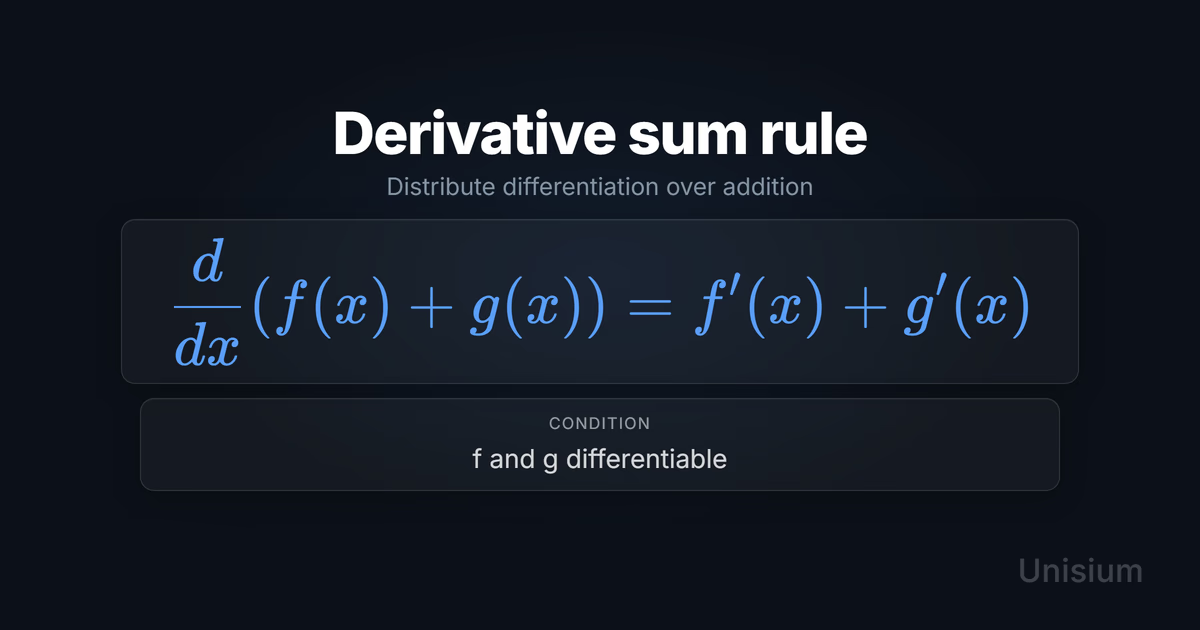
Derivative sum rule: Distribute differentiation over addition
The derivative sum rule lets you distribute over a sum: replace with , producing an equivalent expression at every point where both terms are differentiable. It applies when both and are differentiable. Recognizing when this move is legal and checking the condition automatically is a core fluency skill practiced in the Unisium Study System.
On this page: The Principle | Conditions | Failure Modes | EE Questions | Retrieval Practice | Practice Ground | Solve a Problem | FAQ
The Principle
The move: Distribute over a sum — replace the derivative of a sum with the sum of the separate derivatives.
The invariant: This produces an equivalent derivative expression at any point where both and are differentiable.
Pattern:
| Legal ✓ | Illegal ✗ |
|---|---|
| ; both differentiable everywhere | ; neither component differentiable at |
In the Illegal column: the sum is the constant function zero — differentiable everywhere, including at with derivative . But does not exist at (left-hand derivative , right-hand derivative ), so the condition “f and g differentiable” fails for both components. A differentiable sum does not authorize the split — only individually differentiable components do.
Conditions of Applicability
Condition: f and g differentiable
Both and must be differentiable at the point (or on the interval) where you apply the rule. A function can be continuous everywhere but fail to be differentiable at an isolated point — at is the standard example — so continuity alone does not authorize the split.
Before applying, check: confirm that both and are differentiable at the evaluation point.
- When either term in the sum lacks a derivative at the evaluation point, splitting references a value that does not exist — the move is not valid there.
- Polynomials, , , , and power functions with integer (away from for ) are differentiable on their standard domains; the condition holds automatically for sums of these functions.
Want the complete framework behind this guide? Read Masterful Learning.
Common Failure Modes
Failure mode: apply the derivative sum rule to — treating multiplication like addition — and write instead of the correct product-rule result .
Debug: check whether the two expressions are joined by (sum rule: split cleanly) or (product rule: cross-multiply). Differentiation distributes over addition, not multiplication.
Elaborative Encoding
Use these questions to build deep understanding. (See Elaborative Encoding for the full method.)
Within the Principle
- The condition says “f and g differentiable” — does it require differentiability everywhere on , or just at the point of evaluation? What if one term is differentiable on but not at ?
- Differentiation distributes over addition. Does it also distribute over multiplication? Why or why not — and what rule handles the multiplication case?
For the Principle
- When differentiating a polynomial , how many times would you apply the sum rule, and why does the condition always hold for polynomial terms?
- If is differentiable and is continuous but not differentiable at a point, can you apply the sum rule there? What does your answer reveal about the importance of the individual-term check?
Between Principles
- The derivative sum rule and the power rule are applied together in almost every polynomial derivative. In what order do the two rules appear in the chain, and why does the sum rule come first?
Generate an Example
- Construct a sum where the combined sum is differentiable at every real number, but at least one of and is not differentiable at some point. What does this tell you about the direction in which the sum rule can operate?
Retrieval Practice
Answer from memory, then click to reveal and check. (See Retrieval Practice for the full method.)
State the move in one sentence: _____Distribute d/dx over a sum: the derivative of f(x)+g(x) is f'(x)+g'(x).
Write the canonical equation: _____
State the canonical condition: _____f and g differentiable
Practice Ground
Use these exercises to build move-selection fluency. (See Self-Explanation for how to use worked examples effectively.)
Procedure Walkthrough
Starting from , reach the evaluated derivative.
| Step | Expression | Operation |
|---|---|---|
| 0 | — | |
| 1 | Derivative sum rule — both and are differentiable everywhere; condition satisfied | |
| 2 | Power rule on : ✓, bring exponent down as coefficient | |
| 3 | Arithmetic: ; standard result |
Drills
Action label: Identify the rule applied
What rule was used between these two states?
Reveal
Derivative sum rule — a single derivative of a sum was split into the sum of two separate derivatives. Both and are differentiable everywhere, so the condition holds.
What rule was used between these two states?
Reveal
Derivative sum rule. Both and are differentiable on , so the split is valid for .
[Near-miss — negative] Is this step valid? Explain.
Reveal
Invalid. The sum is the constant function zero — differentiable everywhere, with derivative at . But does not exist at : the left-hand derivative is and the right-hand derivative is , so has a corner there. The condition “f and g differentiable” fails for both components, so the split cannot be applied at that point. This is the canonical near-miss: a differentiable sum does not authorize the split — only individually differentiable components do.
[Negative] Which of these derivative sum rule applications is valid at ? Give a one-line reason for each.
(a)
(b)
(c)
Reveal
(a) Valid — and are both differentiable at .
(b) Invalid — is not differentiable at ; the condition fails for the first term.
(c) Invalid — is not differentiable at (the derivative diverges as ); the condition fails for the second term.
Forward step: Apply the rule
Apply the derivative sum rule, then differentiate each term.
Reveal
Both terms are differentiable everywhere; condition holds.
Apply the derivative sum rule, then differentiate each term.
Reveal
Both and are differentiable everywhere.
Apply the derivative sum rule to a three-term sum (apply twice).
Reveal
First application:
Second application:
Evaluate:
Each application is valid — all three functions are differentiable everywhere.
Apply the derivative sum rule, then differentiate each term (restrict to ).
Reveal
Both and are differentiable on ; condition holds for all .
Apply the derivative sum rule, then differentiate each term ().
Reveal
Both and are differentiable on .
Transition identification: Locate the rule in a chain
The following evaluation has three transitions. Which transition uses the derivative sum rule?
| Transition | From | To |
|---|---|---|
| 0→1 | ||
| 1→2 | ||
| 2→3 |
Reveal
Transition 0→1 uses the derivative sum rule — a single derivative of a sum is split into two separate derivatives.
Transition 1→2 applies the derivative constant multiple rule to (pulling the factor outside) and the standard derivative .
Transition 2→3 applies the power rule: , so .
In this chain, identify which step uses the derivative sum rule and which uses the power rule.
Reveal
- Step 0→1: derivative sum rule — splits the derivative of a sum into two separate derivatives.
- Step 1→2: power rule — and .
Solve a Problem
Apply what you’ve learned with Problem Solving.
Problem: Starting from , find the derivative using the derivative sum rule.
Full solution
| Step | Expression | Move |
|---|---|---|
| 0 | — | |
| 1 | Derivative sum rule — all three terms differentiable; condition satisfied | |
| 2 | Derivative sum rule again | |
| 3 | Constant multiple + power rule; ; | |
| 4 | Collect signs |
Related Principles
| Principle | Relationship |
|---|---|
| Derivative at a point | Foundation — the sum rule is a reusable consequence of the derivative definition, and it only makes sense after the derivative object is established |
| Power rule | Applied immediately after the sum rule in polynomial and mixed-term derivatives; the sum rule splits, then the power rule differentiates each term |
| Derivative constant multiple rule | Companion to the sum rule — together they handle any linear combination without needing the product rule |
| Product rule | Handles ; the sum rule does not distribute over multiplication, so these two rules are complementary entry points depending on whether terms are added or multiplied |
FAQ
What is the derivative sum rule?
The derivative sum rule states that differentiation distributes over addition: if and are both differentiable at the evaluation point, then . The rule authorizes replacing the derivative of a sum with the sum of the separate derivatives whenever both component functions are differentiable there.
When does the derivative sum rule apply?
It applies when both and are differentiable at the evaluation point. Polynomials, , , , and (on ) are differentiable on their standard domains. Functions with cusps, corners, or vertical tangents — such as at or at — are not differentiable at those specific points, so the rule cannot be applied there even though the sum may be differentiable.
Does the derivative sum rule work for three or more terms?
Yes. Apply it repeatedly: split a three-term sum by using the rule twice, a four-term sum three times, and so on. For any polynomial , the condition holds everywhere, so you can apply the rule repeatedly across all terms. Each individual application of the rule is independently valid.
How is the derivative sum rule different from the product rule?
The sum rule distributes cleanly: . The product rule does not: requires a cross-multiply form. Writing (applying the sum rule to a product) is a common misapplication that produces a wrong result in almost every case. Check whether the operation between the two expressions is (sum rule) or (product rule) before choosing.
What happens when one term in the sum is not differentiable at the evaluation point?
The split cannot be applied at that point — distributing would reference a component derivative that does not exist. Note that the sum might still be differentiable at that point (as with ), but the rule cannot be used to find that derivative by splitting. You would need a different approach, such as the limit definition.
How This Fits in Unisium
The derivative sum rule is a move-selection exercise as much as a mechanical step. The fluency built here — recognizing that addition allows splitting, confirming differentiability before applying the rule, and distinguishing sum-rule transitions from product-rule transitions in a worked chain — transfers to every multi-term derivative in calculus. Unisium trains this pattern with state-transition drills so that condition checking becomes automatic rather than something you have to consciously remember under exam pressure.
Explore further:
- Calculus Subdomain Map — Return to the calculus hub to see how the linearity rules and structural rules fit into the same derivative cluster
- Power rule — The rule most commonly paired with the sum rule when differentiating polynomial and mixed expressions
- Elaborative Encoding — Build deep understanding of why “f and g differentiable” is a real constraint, not a formality
- Retrieval Practice — Make the equation and condition retrievable without effort
Ready to master the derivative sum rule? See Unisium’s 14-day free trial or explore the full learning framework in Masterful Learning.
Masterful Learning
The book behind these guides: a study system for physics, math, & programming built on retrieval, connection, explanation, and problem solving.
Ready to apply this strategy?
Unisium turns these evidence-based techniques into guided study sessions for math and physics. Places are limited during early access. Check current availability to start a trial; joining the mailing list is optional.
See plans and availability Read More GuidesAlready have access? Sign in