Fundamental Theorem of Calculus (Part 1): Differentiate accumulation integrals directly
Fundamental Theorem of Calculus (Part 1) lets you differentiate an accumulation function of the form and recover the running input , preserving the accumulation-to-rate link. It applies when is continuous and the upper limit is exactly ; if the upper limit is or the lower limit moves, check the chain-rule factor or sign before writing the derivative.
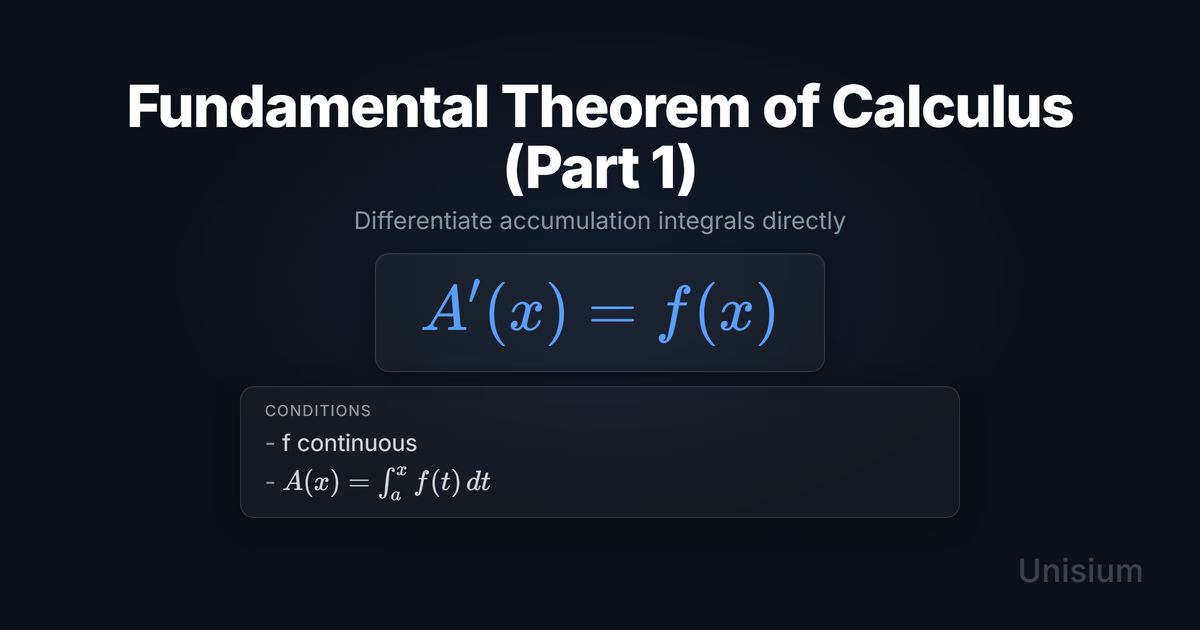
On this page: The Principle | Conditions | Failure Modes | Puzzle | EE Questions | Retrieval Practice | Practice Ground | Solve a Problem | FAQ | How This Fits
The Principle
The move: Differentiate an accumulation integral with fixed lower limit and upper limit by returning the integrand at .
The invariant: Under the stated condition, differentiating the accumulation function returns the integrand at the moving endpoint.
Pattern:
| Applies directly ✓ | Does not apply directly ✗ |
|---|---|
Left: the accumulation function matches the exact FTC1 form. Right: substituting the upper limit without the chain factor is still incomplete, because the upper limit is , not , and the chain rule still has work to do.
When accumulation rises, falls, or peaks
Because , the height of tells you how fast the accumulated amount changes. On an interval where , increases; where , decreases. Even when is falling, keeps increasing as long as remains positive.
If changes from positive to negative at a point, has a local maximum there: it rises before the point and falls afterward. This is the first derivative test applied to , whose derivative is . A zero of alone does not guarantee a maximum; check the signs on both sides.
If increases throughout the interval before that point and decreases throughout the interval afterward, the peak is also the greatest value on the whole interval, including its endpoints.
Conditions of Applicability
Condition: f continuous;
Before applying, check: is this a genuine accumulation function with fixed lower limit , upper limit exactly , and a continuous integrand?
If the condition is violated: a one-step write-down of can miss a chain-rule factor, miss a sign from a moving lower limit, or apply the theorem to an expression that is not in FTC1 form.
- The direct pattern is . If the upper limit is instead, use FTC1 together with the chain rule rather than this one-step form.
- If the lower limit depends on , the sign structure changes. This guide only covers the fixed-lower-limit, upper-limit- pattern.
- Continuity is the standard classroom hypothesis that lets the accumulation function differentiate back to the integrand.
Want the complete framework behind this guide? Read Masterful Learning.
Common Failure Modes
Failure mode: replace every derivative of an integral with the inside function without checking the endpoint structure → chain-rule factors or sign changes disappear, so the derivative is wrong.
Debug: ask two questions before writing anything: “is the upper limit exactly ?” and “is the lower limit fixed?” If either answer is no, this direct FTC1 step is not the whole move.
Try This Puzzle
Where is F(x) greatest?
The graph shows f for t from 0 to 5.5, and F(x) is the integral of f from 0 to x. Where on this interval is F(x) greatest?
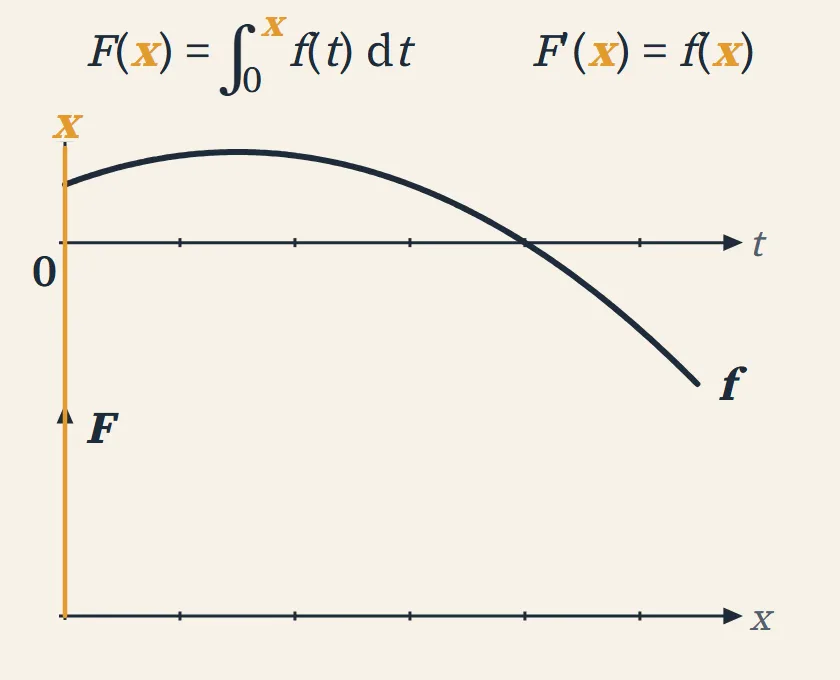
The graph of f starts above the horizontal axis, rises to a peak, then falls through zero. Beneath it, the graph of the accumulated amount F is blank except for its starting point at zero.
Watch the animation, or go straight to the result.
The animation could not play here. Open the animation, or read the result below.
Check your answer
F is greatest where f changes from positive to negative.
Why does that happen? Explain it to yourself in a sentence or two, then compare.
Show the explanation
F′(x) = f(x): the value of f is the rate at which F changes, not the size of F. After the peak of f at t = 1.5, f is smaller but still positive, so F is still increasing; it stops increasing only where f reaches zero.
The integral counts the part of f below the t-axis negatively. Past the zero crossing f is negative, so F′(x) = f(x) < 0 and F decreases; integrating further does not keep adding.
Here plays the same role as in the guide: it accumulates the continuous function from the fixed lower limit to the moving upper limit . FTC1 therefore gives
The value of is the rate at which changes. After reaches its peak, it becomes smaller but stays positive until the zero crossing. So keeps increasing throughout that part of the interval.
After the crossing, is negative. Those contributions subtract from the accumulated amount, and decreases. The first derivative test gives a maximum where changes from positive to negative. Because increases throughout the interval before the crossing and decreases throughout the interval afterward, this is its greatest value on the whole interval, including the endpoints.
In the animation: As the upper limit moves right, the shaded area under f grows and the graph of F is drawn. F keeps rising after f peaks, reaches its greatest value at the zero crossing, and falls as the shaded contributions become negative.
Choose your prediction, then watch what happens.
Elaborative Encoding
Use these questions to build deep understanding. (See Elaborative Encoding for the full method.)
Within the Principle
- Why does differentiating an accumulation function return the running input rather than the whole accumulated area again?
- In , why is a dummy variable while controls the amount of area accumulated?
For the Principle
- How do you decide whether a derivative of an integral is a direct FTC1 match or a larger composition that needs another outer rule first?
- Why does continuity belong in the condition even when many classroom examples use polynomials or trig functions where it is automatic?
Between Principles
- How does FTC1 connect the definite integral (Riemann sum form) to derivatives, and how is that connection different from the antiderivative evaluation step in FTC2?
Generate an Example
- Create one derivative-of-an-integral step where FTC1 applies directly and one near-miss where the upper limit is not , then explain what structural check separates them.
Retrieval Practice
Answer from memory, then click to reveal and check. (See Retrieval Practice for the full method.)
State the move in one sentence: _____Differentiate an accumulation integral with fixed lower limit and upper limit x by returning the integrand at x.
Write the canonical equation: _____
State the canonical condition: _____
Practice Ground
Use these exercises to build move-selection fluency. (See Self-Explanation for how to use worked examples effectively.)
Procedure Walkthrough
Starting from , reach a simplified derivative while naming the local step that uses FTC1.
| Step | Expression | Operation |
|---|---|---|
| 0 | - | |
| 1 | , where | Name the accumulation function so the direct FTC1 pattern is visible |
| 2 | Evaluate at | FTC1: is continuous and the upper limit is exactly |
| 3 | Substitute |
Drills
Forward step (Format A)
Apply FTC1 directly and simplify.
Reveal
This is a direct FTC1 match, so
Apply FTC1 directly and simplify.
Reveal
The lower limit is fixed and the upper limit is , so FTC1 applies directly:
Does FTC1 apply directly to the whole step? Explain before writing anything else.
Reveal
No. The expression is a near-miss, not a direct FTC1 match.
The tempting move
is the classic chain-factor omission. The upper limit is , not , so the direct FTC1 form fails and the outer change still has to be differentiated. The correct derivative is
Does FTC1 apply directly to the whole step? Explain.
Reveal
No. The lower limit depends on , so this is not the direct pattern.
Writing
would miss the sign change from the moving lower limit. In fact,
Which items are direct FTC1 matches?
(i) \quad (ii) \quad (iii) \quad (iv)
Reveal
(i) and (iii).
- (i) has fixed lower limit and upper limit exactly .
- (iii) also has fixed lower limit and upper limit exactly .
- (ii) is a near-miss because the upper limit is .
- (iv) is a near-miss because the lower limit, not the upper limit, depends on .
Action label (Format B)
What was done between these two steps?
Reveal
FTC1 applied directly. The derivative of the accumulation integral returns the integrand evaluated at the upper limit .
Name the rule combination used in this completed step.
Reveal
The derivative constant multiple rule pulled out the factor , and FTC1 handled .
What tempting move was attempted here, and why does it not apply directly?
Reveal
An overextended direct use of FTC1 was attempted.
The issue is structural: the upper limit is , not , so the direct condition fails. The correct derivative keeps the upper-limit substitution and the chain factor:
Transition identification (Format C)
Which transition uses FTC1 directly?
Reveal
Transition (2) uses FTC1 directly.
- (1) is the derivative sum rule.
- (2) applies the power rule to and FTC1 to the accumulation integral.
- (3) is just cleaned notation; the expression is already simplified.
Which transition does not apply directly, and why?
Reveal
Transition (1) does not apply directly.
The move incorrectly treats the upper limit as though it were the bare variable . The direct FTC1 condition fails, so the derivative is not . In fact,
Goal micro-chain (Format D)
Starting from , reach a simplified derivative in the minimum number of moves.
Reveal
First use the derivative sum rule:
Apply FTC1 and the power rule:
Combine like terms:
Solve a Problem
Apply what you’ve learned with Problem Solving.
Problem: Compute
and simplify the result.
Full solution
| Step | Expression | Move |
|---|---|---|
| 0 | - | |
| 1 | Derivative constant multiple rule and derivative of | |
| 2 | FTC1 on the accumulation integral | |
| 3 | Distribute the factor | |
| 4 | Simplify |
Check: differentiating the original accumulation term gives , and differentiating gives , so the result is consistent.
Related Principles
| Principle | Relationship |
|---|---|
| Definite integral (Riemann sum form) | FTC1 explains how the accumulation function built from a definite integral differentiates back to its input |
| Derivative chain rule | Handles the near-miss cases where the upper limit is instead of the bare variable |
| Integral sum rule | Often helps simplify the integrand before or after you recognize an accumulation structure |
FAQ
What does Fundamental Theorem of Calculus (Part 1) say?
It says that if and is continuous, then . Differentiating the accumulation function returns the running input.
When can I use FTC1 directly?
Use it directly when the lower limit is fixed, the upper limit is exactly , and the integrand is continuous. That is the direct-match pattern this guide trains.
What if the upper limit is instead of ?
Then the direct FTC1 step is not the whole move. You differentiate the accumulation part and also account for the outer change in , which is why these cases connect to the chain rule.
What if the lower limit is and the upper limit is constant?
That is not the direct form. A sign change appears, so writing down without adjustment gives the wrong derivative.
Why is the variable inside the integral written as instead of ?
The inside variable is a dummy variable of integration. It marks the running summation variable inside the accumulation, while controls the endpoint and therefore the amount of area accumulated.
How This Fits in Unisium
In Unisium, FTC1 is trained as a move-selection principle rather than a slogan: you learn to see the exact accumulation pattern, reject near-misses with moving endpoints, and connect the theorem back to retrieval practice, self-explanation, and the broader logic of Masterful Learning. The point is to recognize when the direct FTC1 form is complete and when nearby structure means another rule still has work to do.
Explore further:
- Principle Structures - See where FTC1 fits in the broader calculus map
- Definite integral (Riemann sum form) - Reconnect the accumulation function to the quantity being differentiated
- Fundamental Theorem of Calculus (Part 2) - Pair the derivative-of-accumulation result with the endpoint-evaluation theorem that runs in the other direction
- Derivative chain rule - Contrast the direct FTC1 pattern with moving-upper-limit near-misses
- Retrieval Practice - Make the condition and pattern easier to recall under time pressure
To keep building the same derivative-integral fluency across calculus, practice directly in the Unisium app after you can identify the direct FTC1 form on sight.

Masterful Learning
The book behind these guides: a study system for physics, math, & programming built on retrieval, connection, explanation, and problem solving.
Ready to apply this strategy?
Unisium turns these evidence-based techniques into guided study sessions for math and physics. Places are limited during early access. Check current availability to start a trial; joining the mailing list is optional.
See plans and availability Read More GuidesAlready have access? Sign in