Integral sum rule: Split an integral before integrating each part
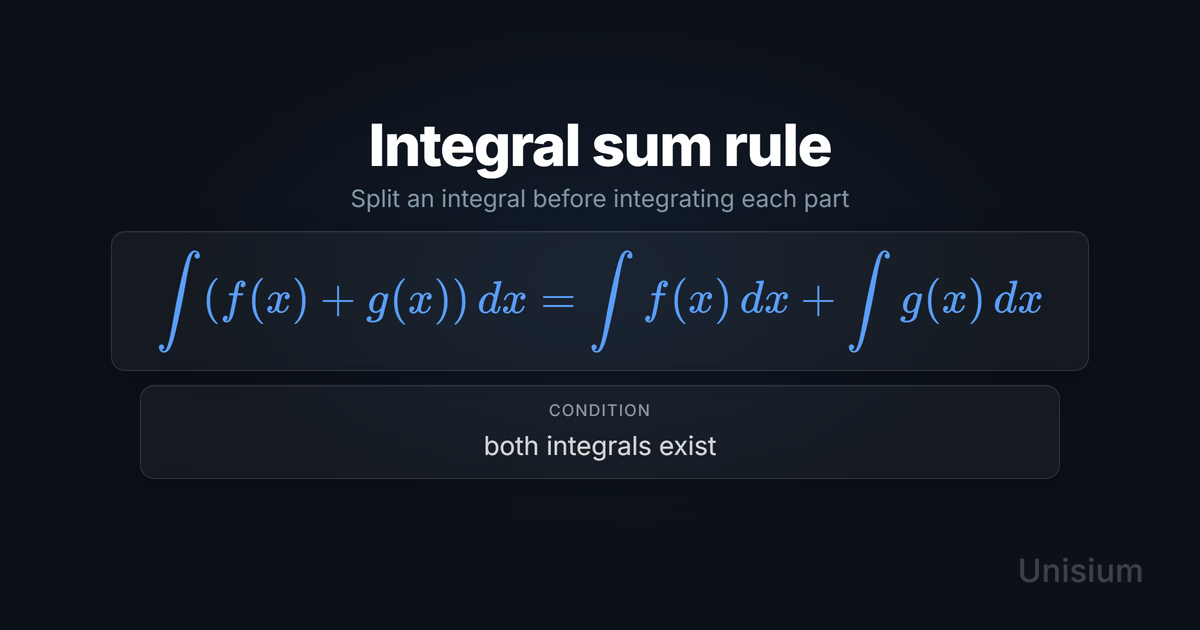
The integral sum rule lets you replace with , preserving the antiderivative family term by term. It applies when both integrals exist, so the key move-selection habit is checking that each piece has an antiderivative on the working interval before you split. The near-miss is splitting by shape alone: both term integrals must exist on the same working interval before the sum can be split.
On this page: The Principle | Conditions | Failure Modes | EE Questions | Retrieval Practice | Practice Ground | Solve a Problem | Related Principles | FAQ
The Principle
The move: Replace one integral of a sum with a sum of two separate integrals.
The invariant: This does not change the antiderivative result: after splitting, you still get functions whose derivative is the original sum on the same interval.
Pattern:
| Legal ✓ | Illegal ✗ |
|---|---|
| On , |
In the Illegal column, the pattern looks eligible because the integrand is a visible sum, but the term has no antiderivative on an interval crossing . That means the condition fails before the split starts. The point of the contrast is exactly that shape alone is not enough: interval legality decides whether the move exists.
Conditions of Applicability
Condition: both integrals exist
Both and must make sense on the same working interval or domain. The rule does not create missing antiderivatives for pieces that are undefined there.
Before applying, check: can you write an antiderivative for each term on the same interval you are using?
If the condition is violated: the split is blocked because at least one piece is not a valid integral on the stated interval.
- If one term fails to have an antiderivative on the working interval, splitting is not justified even when the combined integrand simplifies to something easy.
See indefinite integral as antiderivative for the object you are preserving when you split, and compare this move with both the forward-looking derivative sum rule and the neighboring integral constant multiple rule.
Want the complete framework behind this guide? Read Masterful Learning.
Common Failure Modes
Failure mode: split across a term that has no antiderivative on the working interval → you turn a valid simplification target into two invalid pieces and lose track of where the rule was allowed.
Debug: ask “do both pieces exist as integrals on this interval?” before splitting; if one piece breaks the domain, simplify or restrict the interval first.
Elaborative Encoding
Use these questions to build deep understanding. (See Elaborative Encoding for the full method.)
Within the Principle
- The condition says “both integrals exist.” Does that mean each term must have an antiderivative on the same interval, or is it enough that each term is integrable somewhere else?
- Why does the split preserve the antiderivative family, but still require only one final after the separate antiderivatives are recombined?
For the Principle
- When integrating a polynomial like , why does the condition hold automatically for every term, and why is the sum rule a useful first move?
- If one term is easy to integrate and the other is undefined on the working interval, why is it still wrong to split and integrate the easy piece alone?
Between Principles
- The integral sum rule and the integral constant multiple rule are usually chained together. Which one changes the number of integrals, and which one changes where a constant sits?
Generate an Example
- Build an expression where the whole integrand simplifies before you integrate, but splitting first would be invalid on the stated interval. What does that tell you about checking applicability before pattern-matching?
Retrieval Practice
Answer from memory, then click to reveal and check. (See Retrieval Practice for the full method.)
State the move in one sentence: _____Replace the integral of a sum with the sum of the separate integrals.
Write the canonical equation: _____
State the canonical condition: _____both integrals exist
Practice Ground
Use these exercises to build move-selection fluency. (See Self-Explanation for how to use worked examples effectively.)
Procedure Walkthrough
Starting from , reach an antiderivative.
| Step | Expression | Operation |
|---|---|---|
| 0 | — | |
| 1 | Integral sum rule — both component integrals exist, so split the sum | |
| 2 | Integral constant multiple rule on each term | |
| 3 | Evaluate both integrals and write one final constant of integration |
Drills
Forward step: Apply the rule
Apply the integral sum rule as the first step, then integrate.
Reveal
Both component integrals exist for all real .
Apply the integral sum rule, then finish the antiderivative.
Reveal
The split is valid because both integrals exist on all real numbers.
Apply the integral sum rule twice to the three-term sum.
Reveal
First split:
Second split:
Evaluate:
[Negative] On the interval , should you apply the integral sum rule first to ? Give a one-line reason.
Reveal
No. The term has no antiderivative on an interval containing , so the condition “both integrals exist” fails on . You must address the interval issue before any split.
Action label: Identify the rule applied
What rule was used between these two states?
Reveal
Integral sum rule. One integral of a sum was split into the sum of two separate integrals, and both component integrals exist.
What rule was used between these two states?
Reveal
Integral sum rule. On , both component integrals exist, so the split is valid on that interval.
[Near-miss — negative] Is this split valid on the interval ? Explain.
Reveal
Invalid. The sum pattern is visible, but the interval matters first. On , the term is undefined at and has no antiderivative on an interval crossing , so the condition “both integrals exist” fails. That means the split is blocked before any execution step. This is a near-miss because the algebraic shape looks correct for the rule, but the interval makes the move unavailable.
Transition identification: Locate where the move is eligible
In which transition(s) is the integral sum rule used?
| Transition | From | To |
|---|---|---|
| 0→1 | ||
| 1→2 | ||
| 2→3 | ||
| 3→4 |
Reveal
Only transition 0→1 uses the integral sum rule. It changes one integral of a sum into two separate integrals.
Transition 1→2 uses the integral constant multiple rule.
Transition 2→3 evaluates the antiderivatives.
Transition 3→4 simplifies coefficients and writes the final combined constant.
Which of these proposed transitions are eligible applications of the integral sum rule on the stated interval?
- On :
- On :
- On :
Reveal
Eligible transitions: 1 and 3.
- 1 is valid because both and exist on .
- 2 is invalid because has no antiderivative on an interval crossing .
- 3 is valid because both component integrals exist on all real numbers.
Goal micro-chain: Reach the target efficiently
Starting from , reach a finished antiderivative in the minimum number of moves.
Reveal
One efficient chain is:
The first move is the integral sum rule. The second is the integral constant multiple rule. The last two are antiderivative evaluation and simplification.
Solve a Problem
Apply what you’ve learned with Problem Solving.
Problem: Starting from , find an antiderivative using the integral sum rule.
Full solution
| Step | Expression | Move |
|---|---|---|
| 0 | — | |
| 1 | Integral sum rule, applied twice | |
| 2 | Integral constant multiple rule | |
| 3 | Evaluate the three antiderivatives | |
| 4 | Simplify |
Related Principles
| Principle | Relationship |
|---|---|
| Indefinite integral as antiderivative | Gives the object the sum rule preserves: the antiderivative family of the original integrand |
| Integral constant multiple rule | Usually follows the sum rule: first split the sum, then pull constant factors out of the separate integrals |
| Derivative sum rule | The forward differentiation analogue: differentiation distributes over addition the way integration splits across sums |
FAQ
What is the integral sum rule?
The integral sum rule states that the integral of a sum can be split into a sum of integrals: . It is a linearity rule for antiderivatives, and it applies when both component integrals exist on the working interval.
When can I apply the integral sum rule?
Apply it when each term in the sum already has an antiderivative on the same interval or domain. For common classroom examples like polynomials, exponentials, and trig functions, that condition is automatic on their standard domains. For terms like or , the interval matters.
What is the most common near-miss?
Splitting across a term that is undefined on the working interval. For example, on you should not split because has no antiderivative there. The expression may look like a sum-rule problem, but the condition fails before the move starts.
Do I put on every separate integral?
No. You can write temporary constants while thinking, but after recombining the antiderivative family you keep one final . Separate additive constants collapse into a single arbitrary constant.
How is the integral sum rule different from the integral constant multiple rule?
The integral sum rule changes one integral into several by splitting across addition: . The integral constant multiple rule does a different job: it moves a constant factor outside one integral, as in . In real work, you often use the sum rule first and the constant multiple rule second.
Does the integral sum rule also work for differences?
Yes. A difference is a sum with a negative term: . So the same condition and the same splitting logic apply.
How This Fits in Unisium
Unisium places the integral sum rule inside the calculus principle map as one of the first linearity moves that turns a large antiderivative task into smaller pieces. The rule matters because it changes one decision point into several local ones: first verify the condition, then split, then pair each term with the right antiderivative rule. That is why this guide emphasizes action labels, forward steps, and eligibility checks rather than one long narrative example.
Explore further:
- Principle Structures — See where the integral sum rule sits in the broader calculus principle map
- Indefinite integral as antiderivative — Revisit what an indefinite integral represents
- Integral constant multiple rule — The companion linearity move that often follows immediately after splitting a sum
- Retrieval Practice — Make the condition and pattern easy to recall under time pressure
- Self-Explanation — Narrate why the split is legal before you execute it
Ready to build faster integration fluency? See Unisium’s 14-day free trial or explore the full learning framework in Masterful Learning.

Masterful Learning
The book behind these guides: a study system for physics, math, & programming built on retrieval, connection, explanation, and problem solving.
Ready to apply this strategy?
Unisium turns these evidence-based techniques into guided study sessions for math and physics. Places are limited during early access. Check current availability to start a trial; joining the mailing list is optional.
See plans and availability Read More GuidesAlready have access? Sign in