Derivative at a Point (Definition): The Difference Quotient
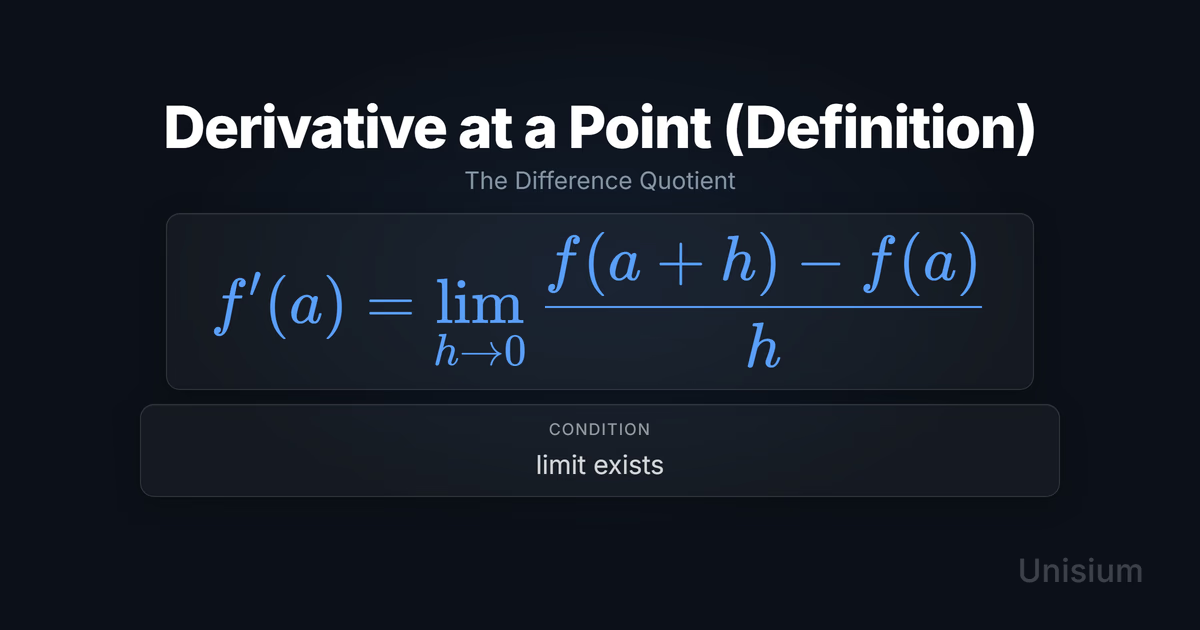
The derivative at a point is defined by —the instantaneous rate of change of at input and the slope of the tangent line to the graph at . The derivative exists when that limit exists. This definition underlies the standard differentiation rules used throughout calculus and is foundational to differential calculus.
On this page: The Principle | Conditions | Misconceptions | EE Questions | Retrieval Practice | Worked Example | Solve a Problem | FAQ
The Principle
Statement
The derivative of at a point , written , is the limit of the difference quotient as . The numerator measures how much ‘s output changes when the input shifts by a small amount ; the denominator records the size of that shift. Taking the limit collapses the secant slope to the tangent slope at —the instantaneous rate of change of at that input.
Mathematical Form
Where:
- = a real-valued function defined in an open interval containing
- = the input value at which the derivative is computed
- = the increment in input (approaches but is never during the limit)
- = the resulting change in output over the increment
Alternative Forms
In different notational contexts, the derivative at a point appears as:
- Leibniz notation:
- Increment notation:
Conditions of Applicability
Condition: limit exists
Practical modeling notes
- “Limit exists” means the two-sided limit of the difference quotient is a finite real number—both the left-hand and right-hand limits of as agree and are finite.
- must be defined on an open interval containing so that is meaningful for small nonzero on both sides.
- For polynomials, rational functions (at points in their domain), and standard transcendental functions, the limit typically exists at interior points and the power, sum, product, quotient, and chain rules compute it efficiently. The limit definition is the governing concept; the rules are derived shortcuts.
When It Doesn’t Apply
The derivative at fails to exist in two main ways:
- Limit does not exist (corner, cusp, or oscillation): The left-hand and right-hand limits of the difference quotient disagree, or the quotient oscillates without settling. Example: at has left-hand quotient limit and right-hand quotient limit , so the two-sided limit fails.
- Limit is infinite or not defined near : If the difference quotient grows without bound, or is defined only on one side of , no finite derivative exists. Example: at has a vertical tangent—the quotient grows like , so is undefined.
Want the complete framework behind this guide? Read Masterful Learning.
Common Misconceptions
Misconception 1: “The difference quotient and the derivative are the same thing”
The truth: The difference quotient is a secant slope for a fixed nonzero . The derivative is the limit of that expression as —a single number, not a ratio with still in it.
Why this matters: Treating the quotient itself as the derivative leads to answers that still contain , or to believing the derivative is undefined simply because the expression has in the denominator.
Misconception 2: “You can substitute directly to find the derivative”
The truth: Direct substitution yields —an indeterminate form with no value. Algebraic simplification (factoring out , cancellation) is required to remove the from the denominator before evaluating the limit.
Why this matters: Skipping simplification produces either a wrong answer or an undefined expression, and it obscures the limit as the conceptual core of differentiation.
Misconception 3: “A function continuous at must be differentiable at ”
The truth: Continuity at is necessary but not sufficient for differentiability. is continuous at but has a corner there; the left- and right-hand limits of the difference quotient disagree, so does not exist.
Why this matters: Conflating the two conditions skips the independent check on the difference quotient limit—the actual condition the definition imposes.
Elaborative Encoding
Use these questions to build deep understanding. (See Elaborative Encoding for the full method.)
Within the Principle
- In the difference quotient , what does measure geometrically, and what does measure? What does the full ratio represent before the limit is taken?
- Why does the definition use a two-sided limit as rather than a one-sided limit? What would it mean for only of the difference quotient to exist?
For the Principle
- How would you decide when to apply the limit definition directly versus a differentiation rule like the power rule? What signals that the definition itself is required?
- What happens to the definition if has a jump discontinuity at ? Can the difference quotient limit be finite in that case?
Between Principles
- Continuity at requires . Differentiability at requires the limit of the difference quotient to exist. Which condition is strictly stronger, and why can one hold without the other?
Generate an Example
- Construct a function that is continuous at but not differentiable there. What does the graph look like at that point, and how does the difference quotient behave as ?
Retrieval Practice
Answer from memory, then click to reveal and check. (See Retrieval Practice for the full method.)
State the principle in words: _____The derivative of f at a is the limit of the difference quotient (f(a+h)-f(a))/h as h approaches 0, provided that limit exists.
Write the canonical equation: _____
State the canonical condition: _____limit exists
Worked Example
Use this worked example to practice Self-Explanation.
Problem
Let . Use the definition of the derivative to find .
Step 1: Verbal Decoding
Target:
Given:
Constraints: quadratic function; evaluation point fixed at
Step 2: Visual Decoding
Draw a coordinate plane and sketch the parabola near . Mark the point on the curve. Draw a secant from to a displaced point and label the rise and the run . (The secant approaches the tangent at as .)
Step 3: Mathematical Modeling
Step 4: Mathematical Procedures
Step 5: Reflection
- Graphical meaning: The tangent line to at has slope ; the parabola rises steeply at that point.
- Verification: Applying the power rule gives , so —consistent with the limit.
- Limiting behavior: At the quotient is undefined as ; only after cancelling from numerator and denominator does the limit evaluate to a finite number.
Before moving on: self-explain the model
Try explaining Step 3 out loud (or in writing): why this instantiation of the definition is the right model for the problem, what each symbol in represents geometrically, and why Step 4 began with expanding rather than substituting .
Mathematical model with explanation
Principle: Derivative at a Point (Definition) — .
Conditions: is defined everywhere; at both one-sided limits of the difference quotient equal , so the limit exists.
Relevance: No differentiation rule is specified; the problem asks to use the definition. The polynomial is the canonical case for illustrating how the factoring step resolves the indeterminate form.
Description: Substituting gives in the numerator. Expanding and cancelling the factor of removes the form; the remaining expression evaluates cleanly by direct substitution.
Goal: Compute the instantaneous rate of change of at by collapsing the secant slope to the tangent slope.
Solve a Problem
Apply what you’ve learned with Problem Solving.
Problem
Let . Use the definition of the derivative to find for any real number .
Hint (if needed): Compute and simplify before taking the limit.
Show Solution
Step 1: Verbal Decoding
Target: for arbitrary
Given: ,
Constraints: linear function; arbitrary real input
Step 2: Visual Decoding
Draw a coordinate plane and sketch the line . Mark a base point and a displaced point on the same line. Draw the segment connecting them and label the rise and run. (For a linear function, every secant through two points on the line is the line itself.)
Step 3: Mathematical Modeling
Step 4: Mathematical Procedures
Step 5: Reflection
- Verification: The derivative of via the constant-multiple and sum rules is —consistent with the limit.
- Graphical meaning: A line has constant slope; the tangent at every point is the line itself, so for all .
- Connection to concept: This confirms the definition reduces to slope for linear functions and that the result is independent of .
Related Principles
| Principle | Relationship to Derivative at a Point |
|---|---|
| Limit statement | Prerequisite — the derivative is the limit statement applied to the specific expression |
| Continuity at a point | Differentiability at implies continuity at ; continuity is necessary but not sufficient for differentiability |
| Derivative of a Constant | First derived rule: the definition shows immediately why constant expressions have zero rate of change |
| Power rule | Derived from the definition for monomials; computes what the limit yields for without repeating the algebra |
| Tangent Line Equation | Immediate geometric successor: once is known, it becomes the slope in the tangent-line model at |
See Principle Structures for how these relationships fit hierarchically.
FAQ
What is the derivative at a point?
The derivative is the limit of the difference quotient as . It gives the instantaneous rate of change of at input —the slope of the tangent line to the graph at .
What is the difference quotient?
The difference quotient is the slope of the secant line through and . It is well-defined for any and approximates the derivative when is small.
Why instead of ?
Setting produces , which is undefined. The limit asks what value the ratio approaches as gets arbitrarily small without ever equalling ; algebraic simplification removes the troublesome factor before substitution.
Does every function have a derivative at every point?
No. The derivative exists at only when the limit of the difference quotient exists. Functions with corners (), cusps, vertical tangents, or discontinuities at fail to be differentiable there because that limit fails.
How is the derivative related to the slope of the tangent line?
The tangent line to the graph of at is defined as the line through that point with slope . The derivative is the limiting slope of the secant as the second point approaches .
Is continuity at enough to guarantee differentiability at ?
No. Continuity is necessary but not sufficient. is continuous at but not differentiable there: the left- and right-hand limits of the difference quotient are and respectively, so the two-sided limit fails.
Related Guides
- Calculus Subdomain Map — Return to the calculus hub to see how the derivative definition anchors the first derivative-rule cluster
- Principle Structures — Organize the derivative definition in a hierarchical framework with limits and differentiation rules
- Self-Explanation — Practice explaining each step of the difference quotient simplification as you work through problems
- Retrieval Practice — Make the definition and its equation instantly accessible before exams
- Problem Solving — Apply the Five-Step Strategy to derivative definition problems systematically
How This Fits in Unisium
Unisium structures the derivative at a point as a representational principle: the equation is the definition you model, and the algebraic simplification of the difference quotient is the procedure. The platform surfaces this principle in elaborative encoding exercises, retrieval prompts, and problem sets so you build the habit of applying the limit definition precisely—not just reciting the power rule. Because every differentiation rule in calculus descends from this definition, and because the tangent line equation turns into the first geometric application, mastering it here strengthens every derivative calculation that follows.
Ready to master the derivative at a point? See Unisium’s 14-day free trial or explore the full learning framework in Masterful Learning.

Masterful Learning
The book behind these guides: a study system for physics, math, & programming built on retrieval, connection, explanation, and problem solving.
Ready to apply this strategy?
Unisium turns these evidence-based techniques into guided study sessions for math and physics. Places are limited during early access. Check current availability to start a trial; joining the mailing list is optional.
See plans and availability Read More GuidesAlready have access? Sign in