Substitution rule (definite integral): Change variables and bounds together
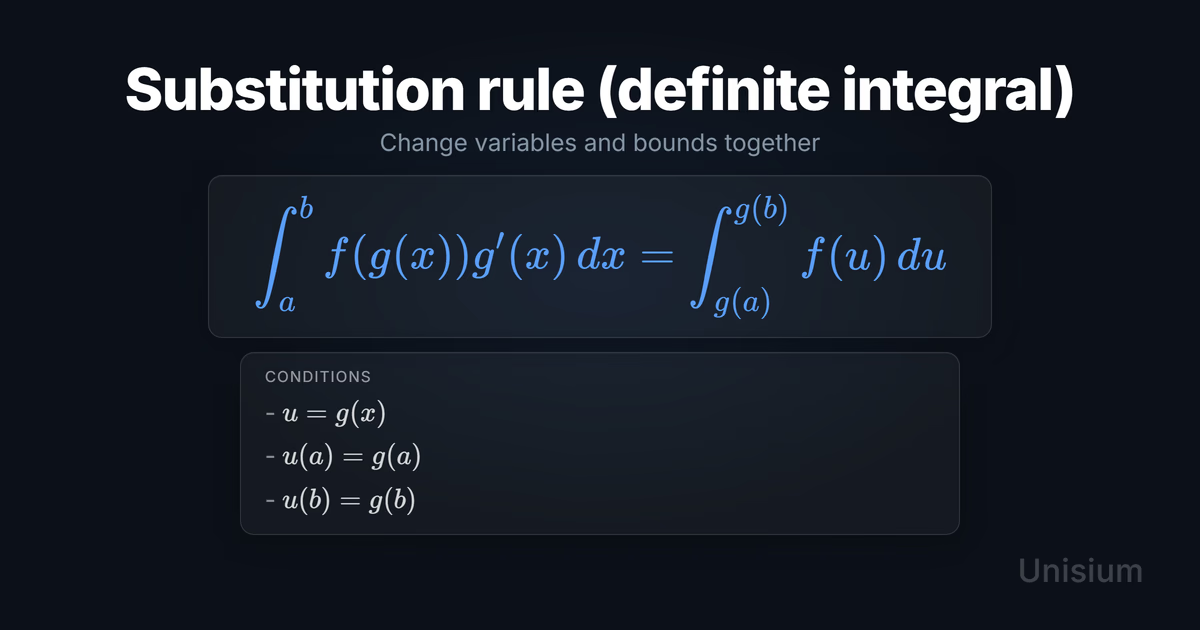
Substitution rule (definite integral) lets you change variables inside a definite integral while preserving the integral’s value, provided you change the bounds to match the new variable. It applies when one check holds together: choose , convert the matching differential piece to , and rewrite both endpoints as and so no stray remains.
On this page: The Principle | Conditions | Failure Modes | EE Questions | Retrieval Practice | Practice Ground | Solve a Problem | FAQ | How This Fits
The Principle
The move: Rewrite a definite integral in a new variable and convert the endpoints into that same variable.
The invariant: Under the stated condition, substitution preserves the value of the definite integral while keeping the rewritten integral entirely in one variable.
Pattern:
| Condition satisfied ✓ | Condition not satisfied ✗ |
|---|---|
Left: the substitution changed both the variable and the bounds. Right: the integrand changed to , but the bounds stayed in the original variable, so the rewrite is incomplete and the rule has not been applied correctly.
Conditions of Applicability
Condition: ; ;
Before applying, check: after choosing , can you rewrite the differential piece and both endpoints in the new variable without leaving stray symbols behind?
If the condition is violated: the rewritten integral mixes variables or uses the wrong interval, so the value of the new integral no longer matches the original one.
- Choose so a visible factor becomes , then convert and into the corresponding -values before evaluating.
- After substitution, the new integral should be entirely in : integrand, differential, and both bounds. If still appears anywhere, the move is unfinished.
Want the complete framework behind this guide? Read Masterful Learning.
Common Failure Modes
Failure mode: substitute inside the integrand but keep the original -bounds → the rewritten integral mixes variables, so later evaluation is inconsistent or wrong.
Debug: after the rewrite, scan for exactly one variable. If the integrand is in , then the limits and differential must be in too.
Elaborative Encoding
Use these questions to build deep understanding. (See Elaborative Encoding for the full method.)
Within the Principle
- Why does definite-integral substitution require new bounds while indefinite substitution can stop after rewriting the integrand and differential?
- In , what part of the original interval is encoded by and ?
For the Principle
- How do you decide whether a proposed makes both the differential and the new bounds simpler rather than harder?
- Why is changing the bounds part of the rule itself instead of an optional cleanup step after integration?
Between Principles
- How does this rule connect the chain rule to definite integral (Riemann sum form), and how is that connection different from Fundamental Theorem of Calculus (Part 1)?
Generate an Example
- Create one definite integral where substitution works cleanly after changing bounds and one near-miss where someone forgets the new limits, then explain what structural check separates them.
Retrieval Practice
Answer from memory, then click to reveal and check. (See Retrieval Practice for the full method.)
State the move in one sentence: _____Rewrite a definite integral in a new variable and change the bounds to match that variable.
Write the canonical equation: _____
State the canonical condition: _____
Practice Ground
Use these exercises to build move-selection fluency. (See Self-Explanation for how to use worked examples effectively.)
Procedure Walkthrough
Starting from , reach a rewritten -integral and evaluate it.
| Step | Expression | Operation |
|---|---|---|
| 0 | - | |
| 1 | Use , so , and change bounds from to | |
| 2 | Integrate in | |
| 3 | Evaluate |
Drills
Forward step (Format A)
Use to rewrite the integral with new bounds.
Reveal
Since , we have . The bounds change from to , so
Use to rewrite and evaluate the integral.
Reveal
With , we get . The bounds change from to , so
Does the rule apply directly with the suggested substitution? Explain before writing anything else. Use .
Reveal
No. The condition is not yet satisfied because , but the integral does not contain the needed factor.
The tempting rewrite
is invalid as a direct substitution step. Choosing does not by itself rewrite the differential correctly.
A student writes
What is wrong, and what is the corrected rewrite if ?
Reveal
The variable changed to , but the bounds stayed at the original -values. Since , the correct bounds are and , so
Use to rewrite the integral with new bounds.
Reveal
Since , we have . The bounds change from to , so
Action label (Format B)
What was done between these two steps?
Reveal
Used , so , rewrote as , and changed the bounds from to .
Name the rule used in this completed step.
Reveal
Definite-integral substitution with . Then , and the bounds change from to .
A student ends with
What step is missing?
Reveal
The antiderivative was written in , but the bounds were left in . With , the new limits are and , so the correct evaluation is
Equivalently, you could convert back to before applying the original bounds.
Transition identification (Format C)
Which transition uses the definite-integral substitution rule directly?
Reveal
Transition (2) uses the rule directly.
- (1) sets up the substitution.
- (2) rewrites the definite integral in the new variable and changes the bounds.
- (3) integrates in .
- (4) evaluates the antiderivative.
Which completed rewrites are eligible direct uses of the rule?
(i) with
(ii) with
(iii) with
(iv) with
Reveal
(i) and (iii) are eligible direct rewrites.
- (i) works because , so , and the bounds become and .
- (iii) works because , and the bounds become and .
- (ii) fails because the needed differential factor is missing.
- (iv) fails because the new bounds should both be , not and .
Goal micro-chain (Format D)
Starting from , reach a fully evaluated answer in the minimum number of moves.
Reveal
Let , so and . The bounds change from to , so
Integrate and evaluate:
Solve a Problem
Apply what you’ve learned with Problem Solving.
Problem: Compute
and simplify the result.
Full solution
| Step | Expression | Move |
|---|---|---|
| 0 | - | |
| 1 | Use , so , and change bounds from to | |
| 2 | Integrate | |
| 3 | Evaluate | |
| 4 | Simplify |
Check: the integrand is positive on , so a small positive result is reasonable, and matches that sign check.
Related Principles
| Principle | Relationship |
|---|---|
| Derivative chain rule | The substitution pattern reverses the same inner-outer structure that the chain rule creates in derivatives |
| Definite integral (Riemann sum form) | Definite substitution preserves the accumulated quantity while re-expressing the interval in a new variable |
| Fundamental Theorem of Calculus (Part 1) | FTC1 differentiates accumulation integrals; definite substitution rewrites them before evaluation |
FAQ
What does the substitution rule for definite integrals say?
It says that if you set inside a definite integral, then you must also change the bounds to the corresponding -values. The rewritten integral has the same value as the original one when the whole expression is consistently converted.
Do I always have to change the bounds in a definite integral substitution?
Yes, if you want to stay in the new variable all the way through. The point of the rule is that the bounds move with the variable change.
What goes wrong if I keep the old bounds after writing the integral in ?
You create a mixed-variable expression: the integrand is in , but the endpoints still refer to . That means the rewrite is not complete, and evaluating it directly is not justified.
What if the needed derivative factor is missing from the integrand?
Then the substitution does not apply directly in one clean step. You may need algebraic manipulation, a different substitution, or a different technique altogether.
Can I change variables and then switch back to before evaluating?
Yes. That is a valid alternative workflow. This guide focuses on the cleaner definite-integral version where you change the bounds immediately and finish in the new variable.
How This Fits in Unisium
In Unisium, definite-integral substitution is trained as a move-selection principle: notice the inner function and its differential partner, convert the bounds immediately, and reject half-finished rewrites that mix variables. That makes the rule easier to retrieve under pressure and connects naturally to retrieval practice, self-explanation, and the broader logic of Masterful Learning.
Explore further:
- Derivative chain rule - See the derivative pattern that substitution reverses
- Substitution rule (u-substitution) - Revisit the indefinite version of the same inner-function matching pattern
- Definite integral (Riemann sum form) - Reconnect the rewritten integral to the quantity it still accumulates
- Fundamental Theorem of Calculus (Part 1) - Contrast rewriting an integral before evaluation with differentiating an accumulation directly
- Retrieval Practice - Make the bound-change check easier to recall under time pressure
To keep building the same substitution fluency across calculus, practice directly in the Unisium app after you can spot the full variable-and-bounds pattern on sight.
Masterful Learning
The book behind these guides: a study system for physics, math, & programming built on retrieval, connection, explanation, and problem solving.
Ready to apply this strategy?
Unisium turns these evidence-based techniques into guided study sessions for math and physics. Places are limited during early access. Check current availability to start a trial; joining the mailing list is optional.
See plans and availability Read More GuidesAlready have access? Sign in