Limit of the Identity: Direct Substitution Base Case
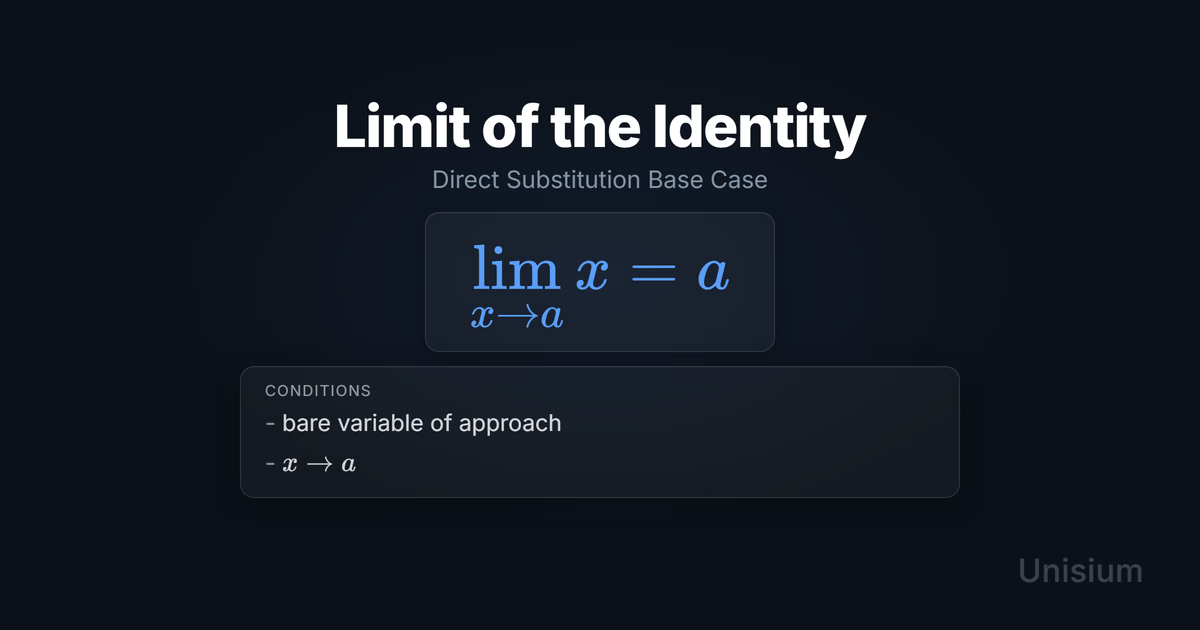
The limit identity rule states that — the limit of the variable as approaches is simply . The rule applies when the expression under the limit is exactly the identity function — the bare variable and nothing else. Recognizing whether an expression qualifies, and applying this rule immediately when it does, is a core fluency skill in the Unisium Study System.
On this page: The Principle | Conditions | Failure Modes | EE Questions | Retrieval Practice | Practice Ground | Solve a Problem | FAQ | How This Fits
The Principle
The move: Replace with directly.
The invariant: This replaces an eligible identity sub-limit with its approach value without changing the value of the overall limit expression.
Pattern:
| Legal ✓ | Illegal ✗ |
|---|---|
| — condition fails: is not the bare variable (correct limit: ) |
Conditions of Applicability
Condition: bare variable of approach;
Before applying, check: is the expression under the limit exactly the bare variable — with no coefficients, exponents, or other modifications?
- If the expression is , , , or any other composite expression, the identity rule does not apply; use the appropriate limit law instead.
- The rule applies regardless of the approach value (including and ) and regardless of the variable name (, , or any symbol — as long as the expression IS that symbol).
Want the complete framework behind this guide? Read Masterful Learning.
Common Failure Modes
Failure mode: applying the identity rule to any expression that contains the variable — treating “the expression involves ” as the same as “the expression is ” → wrong limit value for expressions like , , or .
Debug: ask “is the expression under the limit literally just the variable — not a function of it?” If any coefficient, power, or offset is present, a different rule is required.
Elaborative Encoding
Use these questions to build deep understanding. (See Elaborative Encoding for the full method.)
Within the Principle
- What does the “identity function” mean precisely, and why does its limit equal the approach value rather than some other value?
- Why does the rule hold for all real , including and negative values?
For the Principle
- How do you identify, inside a multi-rule limit chain, exactly which sub-limit qualifies for the identity rule?
- If the expression under the limit is or , would the identity rule apply directly? What must be done first?
Between Principles
- How does the identity rule differ structurally from the constant rule ? What precise property distinguishes the two?
Generate an Example
- Construct a limit expression where the identity rule appears exactly once as a sub-step. Identify the sub-limit and the value it produces.
Retrieval Practice
Answer from memory, then click to reveal and check. (See Retrieval Practice for the full method.)
State the move in one sentence: _____Replace the limit of the variable of approach with the approach value.
Write the canonical pattern: _____
State the canonical condition: _____
Practice Ground
Use these exercises to build move-selection fluency. (See Self-Explanation for how to use worked examples effectively.)
Procedure Walkthrough
Before reading on: at which step in the chain below does the identity-rule condition first need to be checked?
Evaluate by decomposing into sub-limits.
| Step | Expression | Operation |
|---|---|---|
| 0 | — | |
| 1 | Limit sum rule: split the sum | |
| 2 | Identity rule: (expression is ; evaluate directly) | |
| 3 | Constant rule: | |
| 4 | Arithmetic |
Drills
Action label (Format B)
Which of the following limits satisfy the identity-rule condition and can be evaluated directly with the identity rule? For those that cannot, name the rule you would apply instead.
| Expression | Applies? |
|---|---|
| ? | |
| ? | |
| ? | |
| ? | |
| ? |
Reveal
| Expression | Identity rule? | Reason |
|---|---|---|
| ✓ Yes → | Expression is the bare variable | |
| ✗ No | is constant; use the constant rule | |
| ✗ No | is not the identity; use the power rule | |
| ✓ Yes → | Expression is the bare variable (variable name is irrelevant) | |
| ✗ No | has a coefficient; use the constant multiple rule |
Eligibility check: the identity rule applies only when the expression under the limit is the bare variable — no coefficient, power, or offset.
What rule was applied in this step?
Reveal
Limit identity rule. The expression is the bare variable, so directly.
What rule was applied in this step?
Reveal
Limit identity rule. The expression is and the approach value is , so the limit equals .
Was the identity rule applied correctly here? Explain.
A student evaluates and writes: “I used the identity rule — , so the limit is .”
Reveal
No. The expression being limited is (a constant), not . The correct rule is the constant rule (). The coincidence that the approach value and the constant are both does not make the expression equal to .
This is a near-miss: the notation suggests the identity context, but the expression under the limit is a constant, not the variable.
Identify the error in this application of the identity rule.
Reveal
The expression is , not . The identity rule requires the expression under the limit to be the bare variable — no exponent. The correct value is , found using the power rule.
Forward step (Format A)
Apply the identity rule to evaluate this limit.
Reveal
is the bare variable. By the identity rule:
Apply the identity rule to evaluate this limit.
Reveal
Apply the identity rule. The variable of approach is , not .
Reveal
is the bare variable for this limit. By the identity rule:
The rule applies regardless of the variable name, as long as the expression IS that variable.
Does the identity rule apply? Find the correct value.
Reveal
No. The expression is not the identity function — it is a transformation of . The expression-is-variable condition is not satisfied, so the identity rule does not apply.
Near-miss: the expression contains and the result is a simple number, but is not the bare variable.
Transition identification (Format C)
In the chain below, which step uses the identity rule?
| Step | Expression | Rule applied |
|---|---|---|
| 0 | — | |
| 1 | Sum rule | |
| 2 | Constant rule | |
| 3 | ??? | |
| 4 | Arithmetic |
Reveal
Step 3 applies the identity rule: (the expression is the bare variable ).
In the chain below, identify the step where the identity rule applies and how many times it is used.
| Step | Expression | Rule applied |
|---|---|---|
| 0 | — | |
| 1 | Sum rule | |
| 2 | Power rule + constant multiple rule | |
| 3 | ??? | |
| 4 | Arithmetic |
Reveal
Step 3 applies the identity rule twice: is used for both the sub-limit inside and the sub-limit multiplied by . Both evaluate to by the identity rule.
Solve a Problem
Apply what you’ve learned with Problem Solving.
Problem: Evaluate using limit laws. Clearly identify the step where the identity rule applies and how many times it is used.
Full solution
| Step | Expression | Move |
|---|---|---|
| 0 | — | |
| 1 | Sum rule | |
| 2 | Constant multiple rule on first term | |
| 3 | Power rule on second term | |
| 4 | Identity rule: , applied to both remaining sub-limits | |
| 5 | Arithmetic: |
The identity rule appears at step 4 and is applied twice — once for the sub-limit in and once for the sub-limit in .
FAQ
What is the limit identity rule?
The limit identity rule states that for any real number . Because the identity function returns its input exactly, its limit as approaches is simply — no computation beyond reading off the approach value.
When is the limit identity rule valid?
The rule is valid when the expression being limited is exactly the variable of approach — the bare , , or whatever symbol is approaching . If any coefficient, exponent, or other modification is present, the expression is not the identity function and a different rule is required.
What goes wrong if I apply the identity rule to an expression that is not the identity function?
You read off the approach value instead of computing the actual limit. For , incorrectly applying the identity rule gives ; the correct answer is . This usually gives the wrong value, and even when the result happens to match numerically, the reasoning is still invalid.
How does the identity rule differ from the constant rule?
The constant rule handles expressions with no variable: . The identity rule handles the opposite extreme — the expression IS the variable: . Together they cover the two simplest sub-limits inside any multi-term limit evaluation.
Does the identity rule apply to one-sided limits?
Yes. Both and hold — the identity function approaches from either side. One-sided identity sub-limits appear when evaluating limits of piecewise expressions at boundary points.
How This Fits in Unisium
Within the calculus subdomain, the limit identity rule is one of the simplest limit-law moves, but it appears as a sub-step inside nearly every multi-term limit evaluation that begins with a limit statement. Unisium builds fluency through action-label drills (naming which rule was applied between two states) and forward-step drills (applying the rule within a chain), so that the condition check — is this expression exactly ? — becomes automatic before you progress to more complex limit laws. Avoiding near-misses like or under the identity rule is a recurring diagnostic that separates fluent limit work from brittle pattern-matching.
Explore further:
- Calculus Subdomain Map — Return to the calculus hub to see where the identity rule sits in the executable limit-law family
- Limit statement — The prerequisite claim that tells you which expression is approaching which value
- Limit of a Constant — The matching base-case rule for expressions that contain no approach variable at all
- Limit Sum Rule — The first decomposition rule that repeatedly exposes identity sub-limits inside polynomial and linear expressions
- Limit Constant Multiple Rule — The next move once the bare variable is scaled by a constant factor
- Elaborative Encoding — Build deep understanding of why the identity condition matters
- Retrieval Practice — Make the pattern instantly accessible under pressure
- Self-Explanation — Strengthen understanding while working through limit chains
Ready to master the limit identity rule? See Unisium’s 14-day free trial or explore the full learning framework in Masterful Learning.
Masterful Learning
The book behind these guides: a study system for physics, math, & programming built on retrieval, connection, explanation, and problem solving.
Ready to apply this strategy?
Unisium turns these evidence-based techniques into guided study sessions for math and physics. Places are limited during early access. Check current availability to start a trial; joining the mailing list is optional.
See plans and availability Read More GuidesAlready have access? Sign in