Limit constant multiple rule: Pull a constant factor out of a limit
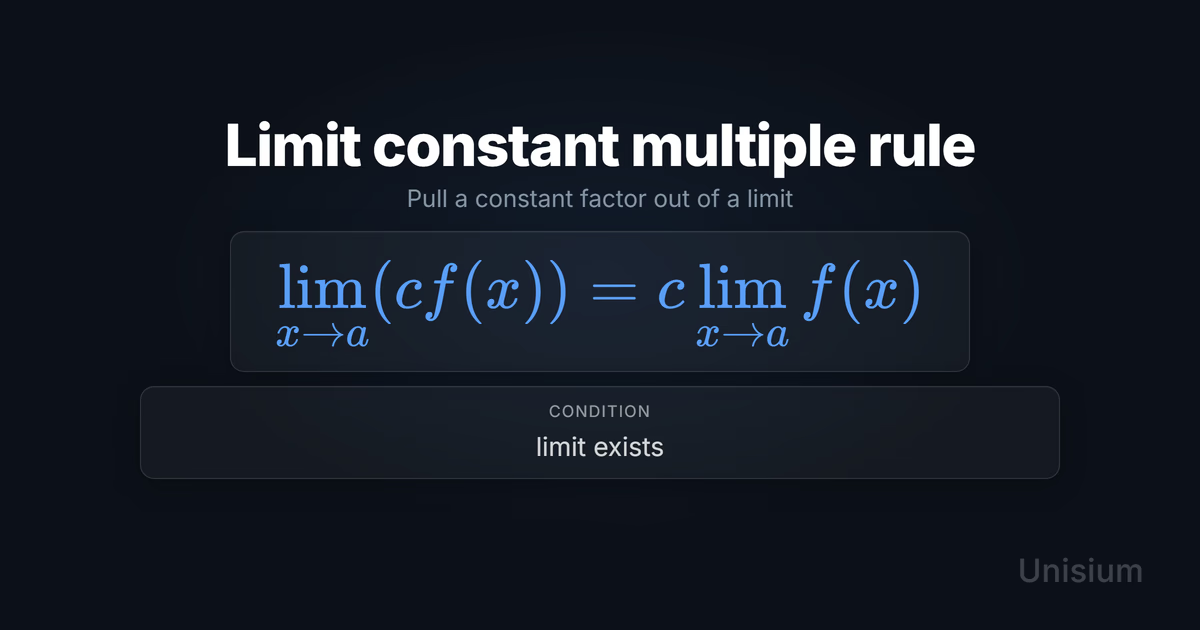
The limit constant multiple rule lets you replace with — pulling the constant factor outside the limit sign without changing the value of the limit, provided the limit of at exists. Checking that condition before factoring out the constant is the core move-selection skill practiced in the Unisium Study System.
On this page: The Principle | Conditions | Failure Modes | EE Questions | Retrieval Practice | Practice Ground | Solve a Problem | FAQ
The Principle
The move: Replace with — pull the constant factor outside the limit sign, or push it back in.
The invariant: This preserves the value of the limit: moving a true constant outside the limit does not change the final limit value, provided the condition holds.
Pattern:
| Legal ✓ | Illegal ✗ |
|---|---|
In the Illegal column: does not exist — the function has a vertical asymptote at . The condition “limit exists” fails, so the rule cannot be applied even though the constant is cleanly present. The expression looks like a textbook candidate, but the applicability condition is violated.
Conditions of Applicability
Condition: limit exists
The inner limit must exist. Before pulling the constant outside, check that approaches a well-defined value as .
Before applying, check: confirm that exists before factoring the constant outside.
- When does not exist (diverges, oscillates, or has mismatched one-sided limits), the rule cannot be applied — even though the constant is factored cleanly.
- When the limit does exist, the rule applies in both directions: factor the constant out, or absorb it back into the limit.
- For polynomial and trigonometric functions at finite points where they are defined, the limit always exists, so the condition check is automatic.
Want the complete framework behind this guide? Read Masterful Learning.
Common Failure Modes
Failure mode: factoring a constant out of when does not exist → the resulting expression is undefined, masking that the rule was not applicable.
Debug: before pulling the constant out, ask “does exist?” For polynomial and standard trigonometric terms at finite it always does; for expressions with vertical asymptotes, oscillation, or mismatched one-sided limits at , check first.
Elaborative Encoding
Use these questions to build deep understanding. (See Elaborative Encoding for the full method.)
Within the Principle
- The rule says “pull outside the limit.” Does it matter whether is positive, negative, or zero? What happens when ?
- The rule works in both directions: factoring the constant out, or absorbing it back inside the limit. When evaluating a limit algebraically, which direction is typically useful — and why?
For the Principle
- When evaluating for a polynomial , how many times would you apply the constant multiple rule — and why does the condition always hold for each term?
- If does not exist, can you use the constant multiple rule to conclude anything about ? What does this say about the rule’s direction of inference?
Between Principles
- The limit sum rule and the limit constant multiple rule share the same pattern: “split when the component limits exist.” How do they differ in what they split, and which is used first when reducing a polynomial limit?
Generate an Example
- Construct a function and a point where exists for every nonzero constant , but does not — or argue why this is impossible. What does your conclusion say about the condition in the rule?
Retrieval Practice
Answer from memory, then click to reveal and check. (See Retrieval Practice for the full method.)
State the move in one sentence: _____Pull the constant factor outside the limit sign: replace the limit of c times a function with c times the limit of the function.
Write the canonical equation: _____
State the canonical condition: _____limit exists
Practice Ground
Use these exercises to build move-selection fluency. (See Self-Explanation for how to use worked examples effectively.)
Procedure Walkthrough
Starting from , reach the numerical value using the limit constant multiple rule.
| Step | Expression | Operation |
|---|---|---|
| 0 | — | |
| 1 | Constant multiple rule — exists (polynomial at finite point); condition satisfied | |
| 2 | Evaluate: | |
| 3 | Arithmetic |
Drills
Action label: Identify the rule applied
What rule was used between these two states?
Reveal
Limit constant multiple rule — the constant factor was pulled outside the limit sign. The condition holds: exists (polynomial at a finite point).
What rule was used between these two states?
Reveal
Limit constant multiple rule — the constant was factored outside. The condition holds: exists (sine is defined and continuous at ).
[Near-miss — negative] Is this application of the limit constant multiple rule valid? Explain.
Reveal
Invalid. The constant is cleanly present, but does not exist — the function has a vertical asymptote at . The condition “limit exists” is violated. The resulting expression is undefined. This is the canonical near-miss: the constant factor looks like it can be pulled out, but the inner limit is the problem.
[Eligibility check — negative] Which of these applications of the limit constant multiple rule are valid? State yes or no for each, and give a one-line reason.
(a)
(b)
(c)
Reveal
(a) Valid — exists; condition satisfied.
(b) Invalid — does not exist (vertical asymptote at ); condition fails even though the constant is cleanly factored.
(c) Valid — exists; condition satisfied.
Forward step: Apply the rule
Apply the limit constant multiple rule as the first step, then evaluate.
Reveal
The limit exists (polynomial), so the rule applies.
Apply the limit constant multiple rule, then evaluate.
Reveal
The limit exists, so the rule applies.
Apply the limit constant multiple rule, then evaluate.
Reveal
The limit exists, so the rule applies. Note that is negative — the rule works for any real constant, including negative values.
Apply the limit constant multiple rule, then evaluate.
Reveal
The limit exists (polynomial), so the rule applies.
Transition identification: Locate the rule in a chain
The following evaluation has four transitions. Which transition(s) use the limit constant multiple rule?
| Transition | From | To |
|---|---|---|
| 0→1 | ||
| 1→2 | ||
| 2→3 | ||
| 3→4 |
Reveal
Transition 1→2 uses the limit constant multiple rule — the constant is factored out of . The condition holds: exists.
Transition 0→1 uses the limit sum rule. Transition 2→3 uses the limit identity rule (or direct substitution for a power). Transition 3→4 is arithmetic.
Which limit rule justifies the second transition below?
Reveal
The first transition uses the limit constant multiple rule — constant is pulled outside. Condition holds: exists (polynomial).
The second transition evaluates the inner limit using the limit identity (or power) rule, then applies arithmetic.
Solve a Problem
Apply what you’ve learned with Problem Solving.
Problem: Starting from , evaluate using the limit constant multiple rule (and limit sum rule as needed).
Full solution
| Step | Expression | Move |
|---|---|---|
| 0 | — | |
| 1 | Limit sum rule — both component limits exist (polynomial terms); condition satisfied | |
| 2 | Limit constant multiple rule applied to each term — both inner limits exist; condition satisfied | |
| 3 | Evaluate: , | |
| 4 | Arithmetic |
FAQ
What is the limit constant multiple rule?
The limit constant multiple rule states that for any real constant , provided the limit of at exists. It lets you factor a constant outside the limit sign — or push it back in — without changing the limiting value.
When can I apply the limit constant multiple rule?
Apply it when you have a constant factor multiplied by a function inside a limit, and you can confirm exists. Polynomial terms always satisfy the condition at finite points. Rational, trigonometric, and root functions satisfy it wherever they are defined at .
What goes wrong if the limit of does not exist?
The rule cannot be applied. Pulling the constant out produces an undefined expression — even though the constant itself is perfectly finite. The cleanest example: has an undefined inner limit, so writing is not a valid step.
How is the limit constant multiple rule different from the limit product rule?
The limit constant multiple rule applies when one factor is a true constant , so you rewrite as , provided the inner limit exists. The limit product rule applies when both factors vary with , so you need both and to exist. In that sense, the constant multiple rule is a special case of the product rule where one factor is fixed rather than variable.
Does the rule work when ?
Yes — formally, whenever the limit exists, since for any finite . But in practice, directly from the limit of a constant rule, which is simpler. The constant multiple rule with is valid but rarely the right tool.
How This Fits in Unisium
Within the calculus subdomain, the limit constant multiple rule sits just after the limit statement base cases and before the heavier product and quotient decompositions. Practicing this rule in Unisium means drilling the condition check first: before pulling the constant out, confirm the inner limit exists. The primary drill formats — action label (name the rule between two states) and forward step (apply the rule to produce the next state) — mirror the two ways this move appears on exams and in multi-step evaluations.
Explore further:
- Calculus Subdomain Map — Return to the calculus hub to see where scalar-factor limits sit inside the algebraic rule family
- Limit statement — The prerequisite expression every algebraic limit rule is trying to evaluate safely
- Limit of a Constant — The base-case rule for the factor itself when the whole expression collapses to a constant
- Limit of the Identity — The base-case rule that often evaluates the inside once the constant factor is pulled out
- Limit Sum Rule — Common companion when the remaining inside expression is a sum of terms
- Limit Product Rule — The broader multiplicative sibling that generalizes beyond fixed scalar factors
- Principle Structures — See where the limit constant multiple rule sits in the calculus principle hierarchy
- Elaborative Encoding — Build deep understanding of why the condition matters, not just what the rule says
- Retrieval Practice — Make the condition and pattern automatically accessible under time pressure
- Self-Explanation — Narrate the condition check aloud while working through each limit evaluation
Ready to master the limit constant multiple rule? See Unisium’s 14-day free trial or explore the full learning framework in Masterful Learning.

Masterful Learning
The book behind these guides: a study system for physics, math, & programming built on retrieval, connection, explanation, and problem solving.
Ready to apply this strategy?
Unisium turns these evidence-based techniques into guided study sessions for math and physics. Places are limited during early access. Check current availability to start a trial; joining the mailing list is optional.
See plans and availability Read More GuidesAlready have access? Sign in