First derivative test (local minimum): Infer a local minimum from a sign chart
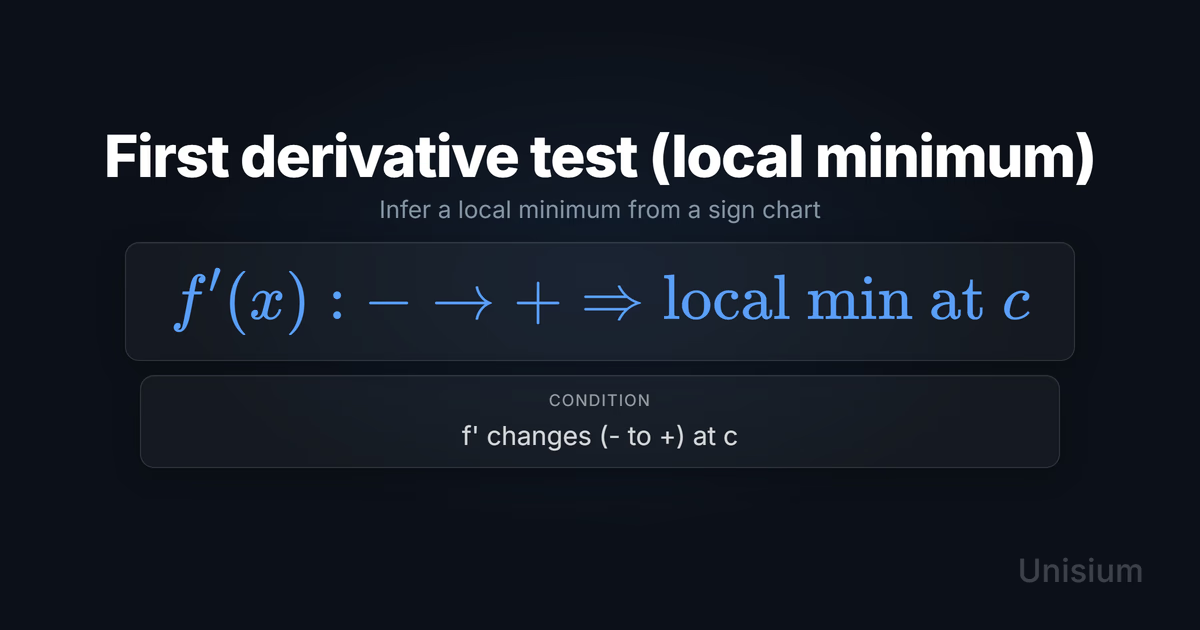
First derivative test (local minimum) lets you infer a local minimum at c from the sign of near . It applies when is continuous at , differentiable just to either side, and changes from negative to positive across . The function then goes from decreasing to increasing there. Recognizing that left-right sign pattern before concluding anything is a core fluency skill in the Unisium Study System.
On this page: The Principle | Conditions | Failure Modes | EE Questions | Retrieval Practice | Practice Ground | Solve a Problem | Related Principles | FAQ | How This Fits
The Principle
The move: Infer that has a local minimum at when is continuous at , differentiable immediately to either side, and the derivative is negative on the left and positive on the right.
The invariant: The sign of tracks local behavior: negative means decreasing and positive means increasing, so a change is the pattern that supports the minimum conclusion.
Pattern:
\begin{gathered} f\text{ is continuous at }c,\\ f'(x)<0\text{ for }c-\varepsilon<x<c,\\ f'(x)>0\text{ for }c<x<c+\varepsilon \end{gathered} \quad\Longrightarrow\quad f\text{ has a local minimum at }c$$ In the comparison below, assume $f$ is continuous at the candidate point and differentiable on the two listed open intervals. | Applies ✓ | Does not apply ✗ | |---|---| | $f'(x)<0$ on $(1,2)$ and $f'(x)>0$ on $(2,3) \Rightarrow f$ has a local minimum at $x=2$ | $f'(x)>0$ on $(-1,0)$ and $f'(x)>0$ on $(0,1) \not\Rightarrow f$ has a local minimum at $x=0$ | Left: the derivative changes from negative to positive, so $f$ goes from decreasing to increasing and the local-minimum conclusion is justified. Right: the derivative stays positive on both sides, so the condition fails even though the point may still look special for some other reason. --- <h2 id="conditions">Conditions of Applicability</h2> **Condition:** f is continuous at c; f' negative just left of c; f' positive just right of c This test is a local-behavior inference, not a shortcut from $f'(c)=0$ alone. Continuity keeps the function value at $c$ attached to the nearby behavior. The derivative signs on the two open intervals show that the function decreases toward $c$ and increases away from it. **Before applying, check:** can you justify continuity at $c$, differentiability immediately to either side, $f'(x)<0$ on the left, and $f'(x)>0$ on the right? **If the condition is violated:** the local-minimum conclusion is not available from this test; the point could be a local maximum, neither, or require a different argument. - A critical point by itself is not enough. The theorem needs a left-right sign change, not only $f'(c)=0$ or an undefined derivative. - Any reliable sign analysis works: factor $f'$, simplify it, or test interval signs directly. - If your sign chart shows $+ \to -$, you have the local-maximum pattern instead. If it shows $+ \to +$ or $- \to -$, this minimum test does not apply. - The sign chart depends on having the correct derivative first, so rules such as the [derivative chain rule](/guides/derivative-chain-rule) and [derivative product rule](/guides/derivative-product-rule) often matter before the test itself starts. <BookInline /> --- <h2 id="misconceptions">Common Failure Modes</h2> **Failure mode:** treat any critical point as a local minimum → you infer a minimum where $f'$ never changes from negative to positive, so the conclusion is not justified. **Debug:** mark one sign slot for $f'$ on each side of $c$ before concluding anything; if you cannot write $-\mid+$, stop. --- <h2 id="elaborative-encoding">Elaborative Encoding</h2> Use these questions to build deep understanding. (See **[Elaborative Encoding](/guides/elaborative-encoding)** for the full method.) ### Within the Principle - Why does a change from $f'(x)<0$ to $f'(x)>0$ mean the function goes from decreasing to increasing near $c$? - Why is the pair of one-sided signs for $f'$ more informative than the single number $f'(c)$? ### For the Principle - When you factor $f'$ to build a sign chart, what minimum evidence do you need before the first derivative test can certify a local minimum? - If you know only that $f'(c)=0$, what additional work is needed before you can conclude a local minimum? ### Between Principles - How does the first derivative test build on [derivative at a point](/guides/derivative-at-a-point), and why does that make it a stronger local-behavior tool than a tangent-line statement alone? ### Generate an Example - Create a point where $f'(c)=0$ but the first derivative test does not prove a local minimum because the sign of $f'$ fails to change from negative to positive. --- <h2 id="retrieval-practice">Retrieval Practice</h2> Answer from memory, then click to reveal and check. (See **[Retrieval Practice](/guides/retrieval-practice)** for the full method.) <ClozeLine prompt="State the move in one sentence" answerText="Infer that a function has a local minimum at c when it is continuous at c, differentiable just to either side, and f' changes from negative to positive across c." /> <ClozeLine prompt="Write the canonical equation" answerLatex="\exists \varepsilon>0:\ \lim_{x\to c}f(x)=f(c),\ x\in(c-\varepsilon,c) \Rightarrow f^{\prime}(x)<0,\ x\in(c,c+\varepsilon) \Rightarrow f^{\prime}(x)>0" /> <ClozeLine prompt="State the canonical condition" answerText="f is continuous at c; f' negative just left of c; f' positive just right of c" /> --- <h2 id="worked-example">Practice Ground</h2> Use these exercises to build move-selection fluency. (See **[Self-Explanation](/guides/self-explanation)** for how to use worked examples effectively.) ### Procedure Walkthrough Starting from $f'(x)=3(x-1)(x+1)$, determine what the first derivative test says about $x=1$. | Step | Expression | Operation | |------|-----------|-----------| | 0 | $f'(x)=3(x-1)(x+1)$ | — | | 1 | Near $x=1$, the factors $3$ and $(x+1)$ are positive | Isolate the fixed positive factors | | 2 | Near $x=1$, the sign of $f'$ is controlled by $(x-1)$ | Reduce the sign check to the changing factor | | 3 | $f'(x)<0$ just left of $1$ and $f'(x)>0$ just right of $1$ | Read the two-sided sign change | | 4 | $f$ is decreasing just left of $1$ and increasing just right of $1$ | Translate derivative signs into local behavior | | 5 | $f$ has a local minimum at $x=1$ | First derivative test (local minimum) | --- ### Drills Unless a prompt says otherwise, assume $f$ is continuous at each candidate point and differentiable on the listed open intervals around it. #### Action label **What principle was used in the step below, and why is the conclusion justified?** $$f'(x)<0 \text{ on } (1,4),\ f'(x)>0 \text{ on } (4,6) \quad\Longrightarrow\quad f \text{ has a local minimum at } x=4$$ <details> <summary>Reveal</summary> The **first derivative test for a local minimum** was used. The conclusion is justified because the derivative changes from negative to positive at $x=4$, which is exactly the canonical condition. </details> --- **Does the theorem apply here? Name the issue before deciding.** $$f'(x)>0 \text{ on } (-2,0),\ f'(x)>0 \text{ on } (0,3) \quad\Longrightarrow\quad f \text{ has a local minimum at } x=0$$ <details> <summary>Reveal</summary> **No.** This is a tempting near-miss, but the condition fails: the derivative is positive on both sides of $0$, so there is no $(- \to +)$ sign change. The first derivative test does not justify a local-minimum conclusion here. </details> --- **What sign-change fact justifies the conclusion below?** $$f'(x)=(x-2)(x+1)^2 \quad\Longrightarrow\quad f \text{ has a local minimum at } x=2$$ <details> <summary>Reveal</summary> Near $x=2$, the factor $(x+1)^2$ stays positive, so the sign of $f'$ is controlled by $(x-2)$. That makes $f'(x)<0$ just left of $2$ and $f'(x)>0$ just right of $2$, which is the local-minimum pattern. </details> --- **Does the theorem apply here? If not, explain why the condition fails.** $$f'(x)<0 \text{ on } (-3,-1),\ f'(x)<0 \text{ on } (-1,2) \quad\Longrightarrow\quad f \text{ has a local minimum at } x=-1$$ <details> <summary>Reveal</summary> **No.** The derivative stays negative on both sides of $-1$, so there is no negative-to-positive change. The point may be critical for some other reason, but this test does not prove a local minimum there. </details> --- #### Transition identification **Which transition uses the first derivative test for a local minimum directly?** $$f'(x)<0 \text{ on } (0,3),\ f'(x)>0 \text{ on } (3,5) \xrightarrow{(1)} f \text{ decreases on } (0,3) \text{ and increases on } (3,5) \xrightarrow{(2)} f \text{ has a local minimum at } x=3$$ <details> <summary>Reveal</summary> **Transition (2)** uses the first derivative test directly. Transition (1) interprets derivative signs as monotonic behavior; transition (2) turns that decreasing-then-increasing pattern into the local-minimum conclusion. </details> --- **Which proposed transitions are justified applications of the first derivative test for a local minimum?** 1. $f'(x)<0$ left of $c$, $f'(x)>0$ right of $c$ $\Longrightarrow$ $f$ has a local minimum at $c$ 2. $f'(x)>0$ left of $c$, $f'(x)<0$ right of $c$ $\Longrightarrow$ $f$ has a local minimum at $c$ 3. $f'(x)<0$ left of $c$, $f'(x)<0$ right of $c$ $\Longrightarrow$ $f$ has a local minimum at $c$ <details> <summary>Reveal</summary> Only **1** is justified. - **1** matches the required $(- \to +)$ sign change. - **2** is the local-maximum pattern, not the local-minimum pattern. - **3** shows no sign change at all, so the condition fails. </details> --- **At which labeled point(s) does the first derivative test for a local minimum apply?** Sign chart for $f'$: $$(-\infty,-2): + \qquad (-2,1): - \qquad (1,4): + \qquad (4,\infty): +$$ Candidate points: $x=-2$, $x=1$, $x=4$ <details> <summary>Reveal</summary> The test applies only at **$x=1$**. - At $x=-2$, the sign change is $(+ \to -)$, which matches a local maximum. - At $x=1$, the sign change is $(- \to +)$, which matches a local minimum. - At $x=4$, the sign is $(+ \to +)$, so there is no minimum conclusion from this test. </details> --- **Which transition, if any, is a justified first-derivative-test move?** $$f'(x)\ge 0 \text{ on both sides of } c \xrightarrow{(1)} f'(c)=0 \xrightarrow{(2)} f \text{ has a local minimum at } c$$ <details> <summary>Reveal</summary> **Neither transition is a justified use of this principle.** The first derivative test needs a negative-to-positive sign change. Nonnegative values on both sides and the isolated fact $f'(c)=0$ do not meet the condition. </details> --- #### Forward step **Apply the first derivative test once at $c=0$.** $$f'(x)=x(x-3)^2$$ <details> <summary>Reveal</summary> Near $x=0$, the factor $(x-3)^2$ stays positive, so the sign of $f'$ matches the sign of $x$. That gives $f'(x)<0$ just left of $0$ and $f'(x)>0$ just right of $0$. Therefore, **$f$ has a local minimum at $x=0$**. </details> --- **Should you conclude a local minimum at $c=0$ from the derivative below? Explain your decision.** $$f'(x)=x^2(x-1)$$ <details> <summary>Reveal</summary> **No.** Near $x=0$, the factor $x^2$ is nonnegative and $(x-1)$ is negative, so $f'(x)$ is negative on both sides of $0$. There is no $(- \to +)$ sign change, so the first derivative test for a local minimum does not apply. </details> --- <h2 id="solo-problem">Solve a Problem</h2> Apply what you've learned with **[Problem Solving](/guides/problem-solving)**. **Problem:** For $f'(x)=x(x-2)^2(x-5)$, determine what the first derivative test says about $x=0$, $x=2$, and $x=5$. <details> <summary>Full solution</summary> | Step | Expression | Move | |------|-----------|------| | 0 | $f'(x)=x(x-2)^2(x-5)$ | — | | 1 | Sign chart for $f'$: $( -\infty,0): +$, $(0,2): -$, $(2,5): -$, $(5,\infty): +$ | Sign analysis across the critical points | | 2 | At $x=0$, the sign change is $(+ \to -)$ | This is the local-maximum pattern, not the local-minimum pattern | | 3 | At $x=2$, the sign change is $(- \to -)$ | No sign change, so this local-minimum test does not apply | | 4 | At $x=5$, the sign change is $(- \to +)$ | First derivative test (local minimum) | | 5 | $f$ has a local minimum at $x=5$ only | Final conclusion | The square factor at $x=2$ is the key diagnostic detail: it touches zero without changing sign, so it creates a tempting critical point that does not satisfy the test. </details> --- <h2 id="related-principles">Related Principles</h2> | Principle | Relationship | |---|---| | [First derivative test (local maximum)](/guides/first-derivative-test-local-maximum) | Uses the same sign-chart method, but the sign change is $+ \to -$ instead of $- \to +$ | | [Derivative at a point](/guides/derivative-at-a-point) | Supplies the derivative object whose sign you inspect on each side of $c$ | | [Derivative chain rule](/guides/derivative-chain-rule) | Often appears before the test when you need the correct derivative formula to build a sign chart | --- <h2 id="faq">FAQ</h2> ### What does the first derivative test for a local minimum say? It says that if $f$ is continuous at $c$, differentiable immediately to either side, and $f'$ changes from negative to positive across $c$, then $f$ has a local minimum at $c$. The logic is decreasing first, then increasing. ### Is $f'(c)=0$ enough to prove a local minimum? No. A zero derivative at one point only tells you that the point is critical or flat in some sense. The first derivative test also needs continuity at $c$ and the left-right sign change in $f'$. ### Can the test fail even when a point looks special? Yes. A point can be critical while the derivative keeps the same sign on both sides. In that case the local-minimum conclusion is not justified by this test. ### How is this different from the local-maximum version of the test? The local-minimum version looks for $(- \to +)$. The local-maximum version looks for $(+ \to -)$. The same sign-chart method is used, but the direction of the change matters. ### What if the derivative sign chart is hard to compute? Then the bottleneck is the derivative analysis, not the theorem statement. Factor when possible, track repeated factors carefully, and use derivative rules cleanly before trying to read the sign pattern. --- <h2 id="how-this-fits">How This Fits in Unisium</h2> In Unisium, the first derivative test is trained as a move-selection theorem: you do not stop at finding a critical point, you verify the derivative sign pattern that makes the extremum conclusion justified. That fits directly with [retrieval practice](/guides/retrieval-practice), [self-explanation](/guides/self-explanation), and the broader logic of [Masterful Learning](/masterful-learning), where accuracy comes from recognizing the right move under the right condition. To keep building that fluency across calculus, practice directly in [the Unisium app](/pricing) once you can read a derivative sign chart without hesitation. **Explore further:** - **[First derivative test (local maximum)](/guides/first-derivative-test-local-maximum)** - Contrast the $(- \to +)$ local-minimum pattern with the $(+ \to -)$ local-maximum version - **[Derivative at a point](/guides/derivative-at-a-point)** - Rebuild the meaning of $f'$ before using its sign as evidence - **[Problem Solving](/guides/problem-solving)** - Use multi-step practice once the sign-change trigger feels automatic - **[Retrieval Practice](/guides/retrieval-practice)** - Make the $(- \to +)$ condition easy to recall under pressure <BookFooterCTA variant="compact" utm={{ utm_source: 'guides', utm_medium: 'cta', utm_campaign: 'first-derivative-test-local-minimum' }} />Ready to apply this strategy?
Unisium turns these evidence-based techniques into guided study sessions for math and physics. Places are limited during early access. Check current availability to start a trial; joining the mailing list is optional.
See plans and availability Read More GuidesAlready have access? Sign in