Tangent Line Equation: Slope from the Derivative
The tangent line equation gives the line tangent to the graph of at the point , where the derivative supplies the slope and anchors the line to the curve. It applies whenever exists as a finite real number—the direct geometric translation of the derivative into a linear equation. The main mistake is using the derivative as the slope but forgetting that anchors the line to the curve.
On this page: The Principle | Conditions | Misconceptions | EE Questions | Retrieval Practice | Worked Example | Solve a Problem | FAQ
The Principle
Statement
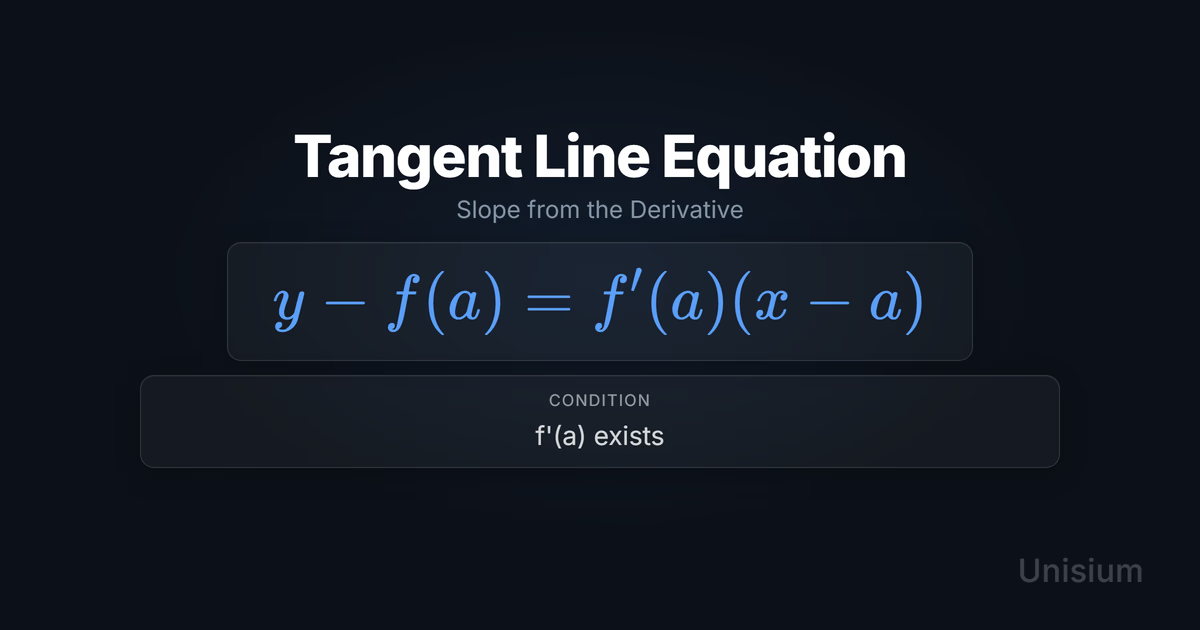
The tangent line equation at a point on the graph of is . This is the point-slope form of a line where the slope is the derivative and the base point is . Because is the instantaneous rate of change of at —the limit of the secant slope as the second point approaches —this equation encodes what it means for a line to be tangent to a curve at a single input.
Mathematical Form
Where:
- = coordinates of any point on the tangent line
- = the input value at which the derivative is evaluated (the point of tangency)
- = the output of at (the -coordinate of the tangency point)
- = the derivative of at (the slope of the tangent line)
Alternative Forms
In different contexts, the same tangent line appears as:
- Slope-intercept form:
- Linearization (local approximation):
Conditions of Applicability
Condition: f’(a) exists
Practical modeling notes
- “Exists” means the two-sided limit of the difference quotient is a finite real number at . Compute using the power rule, product rule, or another differentiation rule; then substitute , , and into the equation.
- Point-slope form is typically easier to set up than slope-intercept; convert to only if the problem asks for it.
- A horizontal tangent () gives ; this is a valid special case.
When It Doesn’t Apply
When does not exist as a finite real number, this equation does not apply:
- Corner: at has left derivative and right derivative ; the two-sided limit of the difference quotient fails.
- Vertical tangent: If the difference quotient limit diverges to , this point-slope equation breaks down because no finite slope exists—though the curve does have a vertical tangent line in a geometric sense.
- Discontinuity: Any jump or removable discontinuity at prevents differentiability there.
Want the complete framework behind this guide? Read Masterful Learning.
Common Misconceptions
Misconception 1: The tangent line touches the curve at exactly one point
The truth: Tangency at means the line has slope and passes through . It can cross or re-touch the curve elsewhere. At an inflection point, the tangent line crosses the curve at the point of tangency itself.
Why this matters: Students who expect a single intersection may incorrectly discard correct tangent lines or get confused when a tangent crosses the curve in a second-derivative problem.
Misconception 2: Knowing is enough to write the tangent line
The truth: The equation has two required inputs: the slope and the anchor point . The derivative alone determines the slope but not which point on the curve the tangent passes through.
Why this matters: Computing correctly but omitting (or substituting in its place) produces a line with the right slope but the wrong intercept—it does not pass through on the curve.
Misconception 3: The tangent line equation only applies to smooth, “nice” functions
The truth: It applies to any function differentiable at , which includes piecewise functions, rational functions at interior domain points, and compositions. The criterion is solely whether exists.
Elaborative Encoding
Use these questions to build deep understanding. (See Elaborative Encoding for the full method.)
Within the Principle
- In , what role does each of and play geometrically? How would the tangent line change if were doubled while stayed fixed?
- Why is the tangent line equation written in point-slope form rather than slope-intercept? What advantage does keeping on the left side give when setting up the problem?
For the Principle
- How do you decide whether to write the tangent at in point-slope form or slope-intercept form? What signals in a problem prompt one choice over the other?
- What happens to the tangent line equation if has a corner at ? Why can’t you simply pick one of the one-sided slopes?
Between Principles
- The derivative at a point gives as a number; the tangent line equation turns that number into a geometric object. What information does the line carry that the scalar alone does not?
Generate an Example
- Describe a function and a value where . What does the tangent line look like in that case, and what does the equation reduce to?
Retrieval Practice
Answer from memory, then click to reveal and check. (See Retrieval Practice for the full method.)
State the principle in words: _____The tangent line to the graph of f at the point (a, f(a)) has slope f'(a) and equation y - f(a) = f'(a)(x - a), valid whenever f'(a) exists.
Write the canonical equation: _____
State the canonical condition: _____f'(a) exists
Worked Example
Use this worked example to practice Self-Explanation.
Problem
A function is differentiable at , with and . Write the equation of the tangent line to the graph of at .
Step 1: Verbal Decoding
Target: equation of the tangent line at
Given: ,
Constraints: differentiable at ; ;
Step 2: Visual Decoding
Draw a coordinate plane and mark the point . Draw a line through with slope —descending to the right. (The tangent line falls away from the anchor point as increases.)
Step 3: Mathematical Modeling
Step 4: Mathematical Procedures
Step 5: Reflection
- Verification: At : ✓.
- Graphical meaning: Slope at means the graph is falling steeply for inputs near .
- Limiting case: If , the equation reduces to —a horizontal tangent through the anchor point.
Before moving on: self-explain the model
Try explaining Step 3 out loud (or in writing): what and each contribute to the equation, why no derivative computation was needed in Step 4, and what would change if the slope were positive.
Mathematical model with explanation
Principle: Tangent Line Equation — instantiated at .
Conditions: is a finite real number, so exists and the condition is satisfied.
Relevance: Both required inputs— and —are given directly, so the problem isolates the substitution step of the tangent line equation.
Description: Substitute , , into the point-slope template and expand.
Goal: Produce the slope-intercept form of the tangent line at .
Solve a Problem
Apply what you’ve learned with Problem Solving.
Problem
Let . Find the equation of the tangent line to the graph of at .
Hint (if needed): Compute and separately before substituting into the tangent line equation.
Show Solution
Step 1: Verbal Decoding
Target: equation of the tangent line at
Given: ,
Constraints: polynomial function; evaluation point fixed at
Step 2: Visual Decoding
Draw a coordinate plane and sketch near . Mark the point on the curve. Draw a line through that appears to just touch the curve there. (The curve passes through ; the tangent line at that point has a positive slope.)
Step 3: Mathematical Modeling
Step 4: Mathematical Procedures
Step 5: Reflection
- Verification: At : ✓.
- Graphical meaning: Slope at means the cubic is rising at unit rate, so the tangent makes a angle with the -axis.
- Connection to concept: is a finite real number, confirming the condition is satisfied and the tangent line equation applies.
Related Principles
| Principle | Relationship to Tangent Line Equation |
|---|---|
| Derivative at a Point | Prerequisite — the derivative is the slope required by the tangent line equation; without it, the equation has no input |
| Continuity at a Point | Differentiability at (required here) implies continuity at ; the converse fails, so continuity alone does not guarantee a tangent line exists |
| Derivative of a Constant | Common substep: constant terms often vanish while computing the derivative that supplies the tangent slope |
| Power Rule | The most common tool for computing for polynomial functions before substituting into the tangent line equation |
| Linear Approximation | Immediate application: the tangent-line formula becomes an approximation model once the same line is used to estimate nearby function values |
See Principle Structures for how these relationships fit hierarchically in calculus.
FAQ
What is the tangent line equation?
The tangent line equation is . It gives the line tangent to the graph of at the point , where is the slope. It applies whenever the derivative exists as a finite real number.
When does the tangent line equation apply?
It applies whenever exists as a finite real number—that is, whenever the function is differentiable at . Functions with corners, cusps, or discontinuities at are not differentiable there. A vertical tangent is a separate case: the slope is infinite and the point-slope equation breaks down, though a vertical line exists geometrically.
How is the tangent line different from a secant line?
A secant passes through two distinct points on the curve. The tangent at is the limiting case of the secant as the second point approaches —the slope of the secant approaches .
What if ?
The equation reduces to , a horizontal line through the tangency point. This occurs at local maxima, local minima, and saddle points of .
Can the tangent line cross the curve?
Yes. Tangency at means the line has slope and passes through ; it can cross or re-touch the curve at other -values. At an inflection point, the tangent line crosses the curve right at the tangency point.
How do I find and in practice?
Differentiate to get , then substitute to get . Separately evaluate by direct substitution. Both values are needed before writing the equation.
Related Guides
- Calculus Subdomain Map — Return to the calculus hub to see where tangent-line work sits after the derivative definition and early differentiation rules
- Linear Approximation — Use the tangent line you just built as a nearby-value estimate rather than only as a geometric object
- Principle Structures — Organize the tangent line equation in a hierarchical framework with the derivative definition and differentiation rules
- Self-Explanation — Practice explaining why is the slope and what anchors as you work through tangent line problems
- Retrieval Practice — Make the equation and condition instantly accessible before exams
- Problem Solving — Apply the Five-Step Strategy to tangent line problems systematically
How This Fits in Unisium
Within the calculus subdomain, Unisium structures the tangent line equation as a representational principle: the equation is the model you instantiate, and evaluating and for a specific function is the procedure. The platform surfaces this principle in elaborative encoding exercises, retrieval prompts, and worked problem sets so you build a reliable habit of identifying the point and slope before writing the line—rather than trying to recall the form under pressure. Because the derivative at a point supplies the slope input, and because the tangent line equation reappears in linear approximation, Newton’s method, and implicit differentiation, mastering it here pays dividends throughout calculus.
Ready to master the tangent line equation? See Unisium’s 14-day free trial or explore the full learning framework in Masterful Learning.

Masterful Learning
The book behind these guides: a study system for physics, math, & programming built on retrieval, connection, explanation, and problem solving.
Ready to apply this strategy?
Unisium turns these evidence-based techniques into guided study sessions for math and physics. Places are limited during early access. Check current availability to start a trial; joining the mailing list is optional.
See plans and availability Read More GuidesAlready have access? Sign in