Elaborative Encoding: Learn Faster with Better Connections
Elaborative encoding is a study method where you actively link new ideas to what you already know by answering targeted questions about meaning, conditions, contrasts, and examples. It works because each meaningful link becomes a retrieval cue, making recall easier and transfer more reliable. Use it when reading feels “familiar” but you can’t explain the concept, state when it applies, or use it in a math or physics problem without notes.
What is elaborative encoding? It’s the study method that turns raw input into retrievable and useful knowledge. Instead of passively receiving isolated facts, you ask precise questions and forge precise links—creating a connected knowledge network.
Elaborative encoding is a deep-processing method where you link new ideas to prior knowledge with targeted questions, creating multiple retrieval cues and better transfer.
Most students treat reading and videos as “the learning.” They’re not. They’re input—raw material. Real learning happens when you actively connect that input to what you already know through targeted questioning and deliberate linking. This prior knowledge activation transforms isolated information into an integrated network.
This guide draws from Masterful Learning, which provides a complete framework for integrating elaborative encoding with self-explanation, retrieval practice, and systematic problem solving.
On this page: Overview · Three Steps · Four Question Types · Domain Guidance · When to Use · FAQ
The core idea
Elaborative encoding is the umbrella process of actively linking new ideas to what you know using targeted questions. Elaborative interrogation—a subset focused on “why” questions—is one powerful technique within this broader approach. The more meaningful connections you create, the more retrieval cues you have—and the easier it becomes to recall and apply knowledge.
This elaborative-encoding loop is one of the core loops inside the Unisium Study System.
Do this in three steps: (1) Identify the principle’s scope and conditions (by principle we mean a general rule or law you apply to cases), (2) interrogate it with the four question types below, and (3) test your understanding by attempting retrieval without notes.
Start now: Pick one principle, answer 3-5 prompts, write down key connections, then test recall tomorrow (no notes).
Key Takeaways
- More connections = easier retrieval and faster recognition: Each meaningful link you create becomes a cue that helps you recall and apply principles when you need them.
- Questions drive encoding: Asking “What does this mean? When does it apply? How is it different?” transforms passive reading into active learning.
- Input isn’t learning: Reading textbooks and watching videos are just the start—elaborative encoding is what makes information stick and transfer.
What Is Elaborative Encoding?
Elaborative encoding is the process of actively searching for connections between new principles and what you already know. Instead of treating each concept as isolated, you deliberately link it to related ideas, concrete examples, and conditions of use.
Think of your knowledge as a network. Each principle is a node, and elaborative encoding creates the pathways between nodes. The more pathways you build, the easier it becomes to:
- Retrieve information when you need it (multiple paths lead to the same destination)
- Recognize when to apply knowledge (you understand the conditions)
- Transfer learning to new contexts (connections reveal patterns)
This is fundamentally different from rereading or highlighting, which create shallow, disconnected memories.
Rereading vs. Elaborative Encoding
| Aspect | Rereading | Elaborative Encoding |
|---|---|---|
| Goal | Familiarity with text | Retrievable, connected knowledge |
| Process | Passive exposure | Active questioning and linking |
| Outcome | Recognition (“I’ve seen this”) | Recall + application (“I know when to use this”) |
| Transfer | Weak (context-dependent) | Strong (principle-driven) |
The difference: rereading creates the illusion of learning through shallow processing at the surface level. Elaborative encoding builds a rich knowledge network through deep processing—the foundation for future learning and problem solving.
How to Do Elaborative Encoding in Three Steps
Step 1: Identify the Principle
Start by clearly naming the principle (a general rule or law you apply to cases) and understanding its scope:
- What is it called? (e.g., “Newton’s Second Law,” “Chain Rule,” “DRY Principle”) — knowing the true name is essential for retrieval.
- What domain does it operate in? (mechanics, calculus, programming design patterns)
- What are its exact conditions of applicability?
This gives you the anchor point for all subsequent connections.
Step 2: Interrogate With Four Question Types
Use these four categories to systematically build connections. You don’t need to answer every question—focus on what reveals the most insight.
Within-Principle Questions
Understand the internal structure:
- What do the symbols, terms, or components mean?
- What units apply (in physics/math)?
- What happens if one variable doubles? Goes to zero?
- What are the parts of compound elements?
Example (Physics - Kinematic equation): In , identify (initial position), (uniform motion contribution), (acceleration contribution). If acceleration doubles, displacement increases by a factor of four.
For-Principle Questions
Understand what it describes and when it applies:
- What phenomenon or relationship does this principle describe?
- What are the exact conditions for its validity?
- What are edge cases or limitations?
- Why do these conditions matter?
Example (Math - Derivative): Describes instantaneous rate of change. Condition: function must be differentiable at the point. Edge case: sharp corners (like at ) aren’t differentiable. Matters because: can’t find tangent line without differentiability.
Between-Principles Questions
Understand relationships to other principles:
- How is this similar to or different from related principles?
- What more fundamental principle does this derive from?
- What principles does this enable or build upon?
- Are there analogies across domains?
Example (Physics - Rotational motion): Angular acceleration is directly analogous to linear acceleration . See how this pattern works across mechanics in Principle Structures.
Examples and Applications Questions
Ground it in concrete reality:
- Can you identify a real-world example?
- Can you construct a counterexample (where it doesn’t apply)?
- Can you draw a diagram, graph, or visual representation?
- Can you write a small code snippet demonstrating it?
Example (Programming - DRY): Before DRY: same validation logic in 5 places. After DRY: one validateInput() function called from 5 places. Counterexample: duplicating a constant’s value is acceptable if contexts are truly independent (magic numbers in tests vs. production).
Step 3: Test Your Understanding Through Retrieval
After interrogating the principle, validate and consolidate your encoding with retrieval practice. Retrieving strengthens the new links (spacing + reconsolidation) and exposes weak spots—so you know exactly what to elaborate next.
Test by attempting to:
- Retrieve the principle without looking at notes
- State when it applies and what conditions make it valid
- Generate an example from memory
- Explain why this principle works the way it does
Examples of well-connected understanding:
- Archimedes’ Principle: You can recall that buoyancy depends on displaced fluid volume and density, explain why steel ships float (large displaced volume despite high density), and predict what happens when ice melts in a glass (water level stays constant because ice already displaced its weight in water).
- Chain Rule: You remember it handles composite functions, can explain why you multiply derivatives (rate-of-change composition), and generate examples like where outer function is sine, inner is .
- SOLID (Single Responsibility): You understand it prevents classes from having multiple reasons to change, can identify violations (a User class that also handles database connections and email sending), and explain the maintenance benefit (changes to email logic don’t risk breaking user authentication).
Domain-Specific Guidance
Physics & Math
- Start with conditions: Principles are logically precise. Understanding when they apply is as important as understanding what they say.
- Work through derivations (optional): If you want deep understanding beyond exam requirements, trace how principles derive from more fundamental ones.
- Use visual representations: Graphs, force diagrams, and geometric interpretations make abstract relationships concrete.
Programming
- Focus on intent: Unlike physics laws, programming principles are best practices. Ask: “What problem does this solve? What happens if I ignore it?”
- Study real examples: Find open-source code demonstrating the principle. Generate small code snippets yourself.
- Connect patterns: Many principles (like SOLID) work together as frameworks. Understand how they reinforce each other.
When to Use Elaborative Encoding
Before and after consuming content. Don’t just read or watch passively. Ask questions before starting (“What should I understand about derivatives?”), then answer them as you go.
When retrieval feels vague. If you can barely recall a principle, or it feels like disconnected symbols, you need more elaboration.
After failed retrieval attempts. When retrieval practice reveals gaps, return to elaborative encoding with your textbook or notes to build missing connections.
Before self-explanation (or after an attempt). Elaborative encoding prepares you to self-explain worked examples effectively. You’re usually not ready to solve problems from reading alone—it’s fine to try, but expect to fall back to self-explanation (and more EE) to bridge the gap.
When you encounter surprising results. Surprise reveals mismatches between your expectations and reality. Use that moment: “Why did this happen? What principle explains it? What assumption was wrong?”
If you want to see how elaborative encoding fits into a full weekly plan for math and physics—alongside retrieval practice, self-explanation, and problem solving—see How to Self-Study Math and Physics Effectively.
Common Mistakes to Avoid
Turning it into mini-lectures. Writing walls of text doesn’t help. Focus on answering specific questions and forming testable connections.
Collecting trivia connections. Not all links are useful. Prioritize connections that help you recognize when to use knowledge and how to apply it.
Skipping the conditions. In physics and math especially, principles are precise. Knowing exactly when they’re valid is critical for problem solving.
Never testing recall. Elaboration without retrieval is incomplete. Test yourself the next day to ensure the connections stuck.
Expecting to go straight to problem solving. Elaborative encoding prepares you for self-explanation, which prepares you for problem solving. Don’t expect to be able to skip steps.
Pair It With Other Strategies
You don’t learn by encoding alone. Chain elaborative encoding with other strategies:
- Elaborative Encoding (this guide) — Build meaningful connections
- Self-Explanation — Turn worked examples into solution rules
- Retrieval Practice — Lock principles in with spacing and recall
Elaboration encodes. Retrieval consolidates.
If you want concrete prompt patterns and workflows for using AI to amplify elaborative encoding—so it keeps you thinking instead of replacing you—see How to Study Physics and Math with AI (Without Letting It Think for You).
Elaborative Encoding in 5 Minutes
Short on time? Here’s the essential cycle:
-
Name the principle — What’s it called? What’s its scope and conditions?
-
Answer 3 prompts — Pick one from each: Within (what do symbols mean?), For (when does it apply?), Between (how does it relate to X?).
-
Generate one example and test it — Create a concrete case where the principle works. Then try to explain why.
-
Retrieve it tomorrow without notes — Can you reconstruct it? If yes, you encoded it well. If no, that’s feedback on which connections to strengthen.
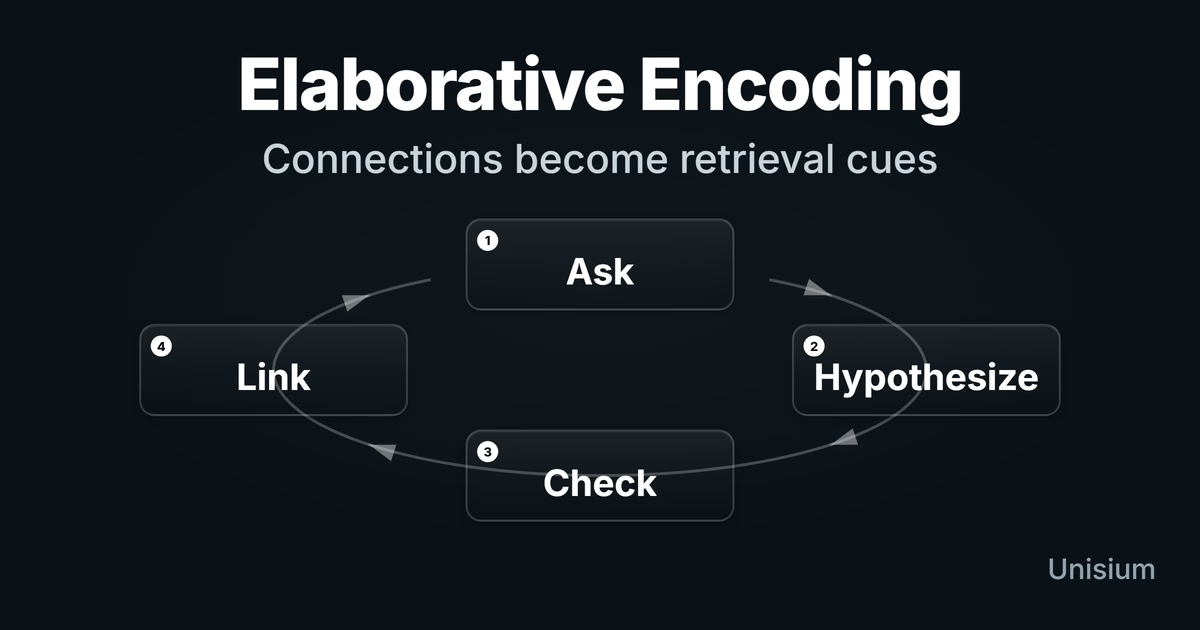
This rapid cycle of questioning → hypothesis generation → testing → retrieval is the core of elaborative encoding.
FAQ: Common Questions About Elaborative Encoding
What is elaborative encoding?
A study method where you ask targeted questions to form meaningful links between new ideas and prior knowledge. Each connection becomes a retrieval cue, making recall easier and transfer more likely.
Is elaborative encoding the same as elaborative interrogation?
They’re nearly synonymous, with elaborative interrogation being a specific subset. Elaborative encoding is the umbrella process of linking knowledge through questioning, hypothesis generation, and feedback. Elaborative interrogation is a specific technique within that process, focused primarily on “why” questions. Both involve active connection-making rather than passive review.
When should I use elaborative encoding?
Before or after reading or videos (don’t consume passively), when a concept feels vague (you can name it but can’t explain when it applies), after failed retrieval attempts (gaps revealed), and before self-explaining worked examples (preparation step).
How long should elaborative encoding take per principle?
5-10 minutes per principle is often enough to move the needle. You don’t need perfect understanding—just enough meaningful connections to support retrieval and future elaboration as your knowledge grows.
Should I take notes during elaborative encoding?
During the questioning loop, no. Elaborative encoding is a thinking loop; writing mid-loop slows you down. After you finish, consider writing ultra-brief notes (1–3 bullets, a contrast, a condition, one concrete example) as cues for tomorrow’s retrieval. You can also write while testing yourself with retrieval practice—closed-book recall can be effective for consolidating the memories.
How do I know when I’ve elaborated enough?
When you can mentally reconstruct the principle during retrieval practice with a sense of what it means and when it applies. You don’t need perfect understanding initially—elaboration deepens over time as you solve problems and encounter the principle in new contexts.
The Bottom Line
Reading and watching videos aren’t learning—they’re input. Elaborative encoding is what transforms that input into retrievable, usable knowledge.
What passive reading gives you: Surface familiarity.
What elaborative encoding gives you: A web of meaningful, useful connections that boost recall and help you make sense of new problems and examples.
The difference is the gap between “I’ve seen this before” and “I know when and how to use this.”
Start Now
-
Pick one principle from your current course (1 min) — It can be a physics law, a math theorem, or a programming design pattern.
-
Ask 3-5 questions from the four categories above (3 min) — Write down your answers. Focus on: What does it mean? When does it apply? How does it relate to what I know?
-
Generate a concrete example and one counterexample (3 min) — Where does this principle work? Where doesn’t it apply?
-
Test your recall tomorrow without notes (2 min test) — Can you reconstruct the principle? Explain when it applies? Generate an example?
If you can retrieve the principle and explain its conditions from memory, your elaborative encoding worked. If not, identify which connections are missing—that’s feedback showing you where to elaborate more.
Related Learning Guides
Self-Explanation: Learning from Worked Solutions — After elaborative encoding, use self-explanation to understand how principles are applied in worked examples. This bridges the gap between understanding concepts and solving problems.
Problem Solving: Turn Knowledge into Skill — Once you’ve encoded principles and self-explained examples, use deliberate problem-solving to convert understanding into automatic skill. The combination of elaboration + self-explanation + practice builds mastery.
Principle Structures: Building Mental Frameworks — Organize your elaborated principles into hierarchical structures for powerful retrieval practice. Spatial anchoring + meaningful connections = maximum retention.
Get the Complete System
This guide draws from Masterful Learning, which provides the complete research-backed framework for integrating elaborative encoding with retrieval practice, self-explanation, and problem solving. The book shows you how these strategies work together to build mastery in physics, math, and programming.
How This Fits in Unisium
Unisium is a learning app for physics and math that bakes these ideas into the actual study flow. The Unisium Study System turns this strategy into concrete cards and schedules it for you: elaborative-encoding cards prompt you to answer “what/when/how” questions first, then use AI to critique your answers, ensuring you build the meaningful connections yourself before seeing a model answer.
Elaborative encoding is domain-general—it works in sciences, humanities, arts, and professional practice. The examples here use STEM and programming, but the same questions apply to any field: define the principle, probe conditions, contrast with neighbors, ground in examples.
← Prev: Highlighting and Underlining | Next →: Self-Explanation
Ready to apply this strategy?
Unisium turns these evidence-based techniques into guided study sessions for math and physics. Places are limited during early access. Check current availability to start a trial; joining the mailing list is optional.
See plans and availability Read More GuidesAlready have access? Sign in