Math and Physics Retrieval Practice: Stop Forgetting Equations and When They Apply
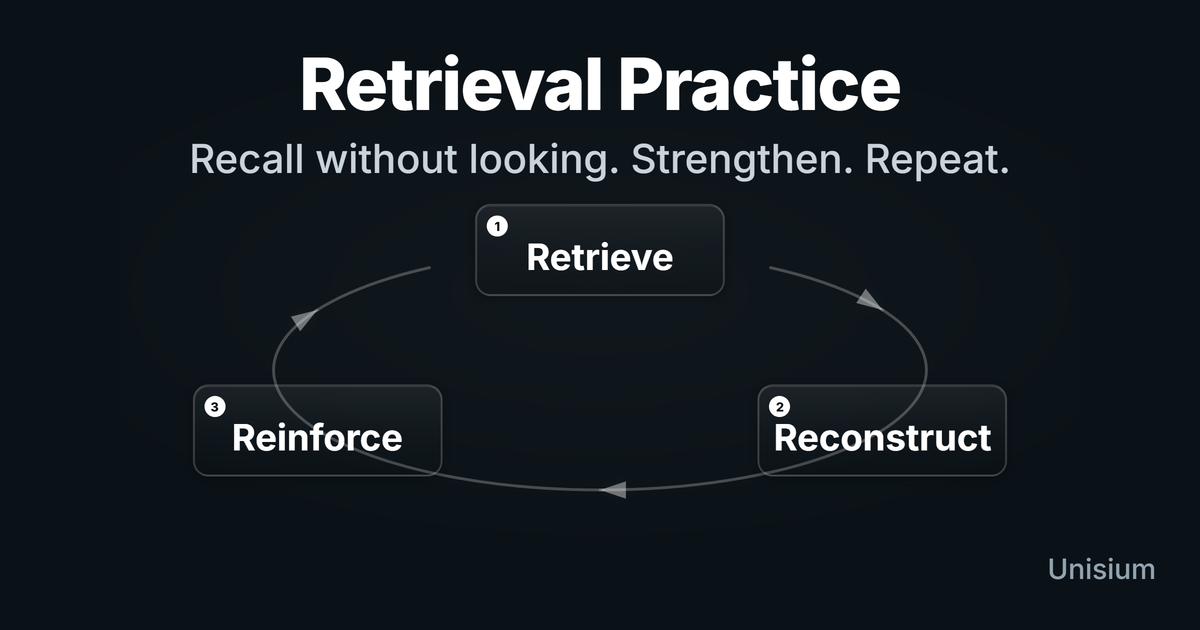
Retrieval practice is deliberately recalling what you’ve learned—without looking—so the memory strengthens and becomes easier to access under pressure. If elaborative encoding builds the network, retrieval hardens the key nodes—the principles you’ll use to solve problems.
Why it matters: Solving problems depends on recognizing the right principles fast and using them fluently. Retrieval practice improves both accessibility and speed of recall.
If you understand an example while reading but later cannot remember the equation, the condition, or even what the idea is called, retrieval practice is the missing step. It turns familiar-looking knowledge into available knowledge.
This guide is for math and physics students who want important ideas to come back under exam pressure, not just feel familiar during review. The target is not blind memorization. You practice recalling the name, equation or definition, conditions, contrasts, and a simple example before you look.
That is why retrieval practice has a high return: it raises the chance that the right knowledge is available when you need it, shortens the path from study to usable recall, and cuts wasted effort from rereading notes that only feel productive.
On this page: TL;DR · Why it works · Materials · Session flow · Spacing · Domain notes · When to use · FAQ
TL;DR
- Goal: Make important math and physics knowledge instantly retrievable: the name, equation or definition, conditions, and when it applies.
- Do this:
- Old principles: retrieve last week’s principles
- New principles: briefly encode, then retrieve
- Overlearn today: 3 clean recalls per new item
- Space it: lengthen intervals over time
- Measure, don’t muse: Track ✓/✗; move on.
- Use structure: Principle tables, principle structures, or flashcards—pick the one you’ll stick with.
Key takeaways: Recall beats review. Conditions matter. 3× today, space thereafter.
Why It Works
Retrieval practice strengthens memories through several interconnected mechanisms:
- Strength → Speed: Each successful recall raises baseline strength, so the principle surfaces faster during problem solving.
- Less context dependence: Stronger memories rely on fewer situational cues → better transfer to new problems. (Learn how to build these connections upfront with elaborative encoding.)
- Working-memory relief: Quick access frees bandwidth for multi-step reasoning.
- Reconstruction effect: When recall is partial, you rebuild via units, logic, or analogy; these reconstructions form new links you won’t get from rereading.
- Forward effect: Retrieving old material primes you to encode today’s content more efficiently.
Retrieval practice is domain-general. Retrieval is a fundamental memory operation: pulling knowledge from memory gives the brain a reason to strengthen that trace and make it easier to find next time. In math and physics, the useful version is not vague recall. It is recall of names, equations or definitions, conditions, contrasts, and examples.
Skeptical take: Popular “memory palaces” help with meaningless lists. For principles, you want meaningful cues (name, conditions, contrasts, equations). Use structures, not card tricks.
How long should a session take?
15–30 minutes. Old items first (5–10 min), new items with 3× successes (10–15 min), schedule the next touch (1 min). A tight session keeps focus.
Retrieval practice vs spaced repetition—are they the same?
No. Retrieval is what you do (recall without notes). Spacing is when you do it (intervals over days and weeks). Use both: retrieval is the mechanic; spacing is the schedule.
Practice Materials
Pick one to start. Add others only if it increases consistency.
1) Principle Table (fastest on-ramp)
A compact table with Name → Equation or definition → Conditions. Hide a column and recall from memory. Keep it essential—if everything is “core,” nothing is.
Many textbooks include summary tables at the end of chapters; use those as starting points and customize for your course.
2) Principle Structure (best long-term)
A hierarchical map that clusters related principles with conditions and forms. Use the complete sheet → then a blanked version for retrieval. Position acts as an extra cue, leveraging both visual and verbal memory.
See: Principle Structures for examples and step-by-step creation.
3) Flashcards (great with spacing)
One card per principle: front = name or cue, back = precise formulation + conditions. Spaced SRS (e.g., Anki) handles intervals automatically. Use multi-step reveals (name → form → conditions).
If you need card templates and workflows that keep your reviews focused on elaborative encoding, retrieval practice, and self-explanation—not trivia—see How to Study Physics and Math with Anki (Without Memorizing Trivia).
Tip: Digital flashcard apps with spaced repetition scheduling mean you stay current with minimal management overhead. Learn optimal spacing intervals below.
Session Flow
Follow this sequence each week to maximize retention and transfer.
1) Old first
- Try recalling all old items. If stuck after 10–15 seconds, peek briefly, then try again immediately.
- This “old-first” pass boosts encoding of today’s new material.
Why: Retrieving previously learned principles acts as a cognitive warm-up, activating neural networks related to the domain and suppressing unrelated thoughts.
2) New second
- If new content isn’t yet understood, do brief elaborative encoding to establish meaning (conditions, contrasts, examples).
- Immediately do a first retrieval—don’t wait.
3) Overlearn today (3×)
- For each new principle, get 3 clean recalls without looking.
- More than three tends to give diminishing returns; fewer than three means missing out on valuable consolidation.
4) Retrieve exactly or in your own words—based on purpose
- Exact when precision matters (e.g., Newton’s 2nd law, chain rule).
- Paraphrase when meaning trumps wording (most verbal definitions in programming).
5) Reconstruct when partial (units, logic, analogy)
- Use units (dimensional sanity checks), logic (what terms must appear?), and analogy (translational ↔ rotational) to rebuild the memory.
- Example: If you forget part of a kinematics equation, reason: “Position has units of meters. If I try velocity × time squared, that’s m/s × s², which gives m·s, not m. So it should be velocity × time to the first power.”
6) Verbalize concepts, not just symbols
- Say it mentally in full concepts: “Sum of forces on the system equals mass times acceleration”, not “sigma-F equals ma.” (See Names Have Power on why verbal labels are high-powered cues.)
- For programming principles, retrieve in your own words: “A class should have only one responsibility and only one reason to change.” Then apply: “This class violates SRP because it handles both authentication and data validation.”
Start Now (2 minutes)
Time-strapped? Here’s the minimum viable retrieval session:
- Pick 6–10 principles you need this week.
- Retrieve old for 2 minutes (test yourself on last week’s items).
- Encode today’s new for 1 minute (conditions + contrasts).
- Get 3 clean recalls per new item (effort is the point).
- Schedule tomorrow’s touch (mark your calendar).
This rhythm works. Consistency beats perfection.
Retrieval vs Rereading (Why Recall Beats Review)
Rereading feels smooth and fluent in the moment. But retrieval—forcing recall under effort—is what builds real strength.
- Rereading: Activates weak, context-bound pathways. Fades fast after study.
- Retrieval: Forces reconstruction of the memory. Each recall strengthens neural pathways and loosens context dependence.
- The effort: The harder you have to work to retrieve, the stronger the resulting change in memory strength.
Spacing That Works
Spacing distribution dramatically affects long-term retention:
- Day 0 (today): 3× success per new item.
- Days 1–7: Daily or every other day for items that felt effortful.
- Weeks 2–4: Weekly.
- Month 2+: Monthly spot checks; drop items you can retrieve effortlessly and can use in problems without looking. For truly critical principles, quarterly touch-ups keep them alive for your career.
Using Anki? Let the scheduler handle it automatically—this is where SRS shines.
Using paper sheets? Mimic the curve: frequent early, then stretch intervals. Start with daily touches, drop to weekly, then quarterly for career-relevant principles.
Domain Notes
If you want a full playbook for using large language models to generate retrieval prompts, critique your answers, and blend AI with the structured flow here, check How to Study Physics and Math with AI.
Physics & Math
Principles are compact and precise → retrieval shines.
Lean into:
- Conditions (when does this law apply? e.g., the algebraic form of the Impulse-Momentum Theorem requires constant net force)
- Units (dimensional analysis to reconstruct)
- Analogies (translational ↔ rotational mechanics; differentiation ↔ integration)
Programming
Principles are often verbal and context-bound. Retrieval still helps, but pair it with self-explanation of worked code.
For APIs and methods, retrieve:
- Name → Purpose → Minimal call signature (only what you can’t reliably infer or autocomplete).
For design principles, retrieve:
- Criterion and counter-example (What violates SRP? What violates DIP?)
When to Use
- Weekly, all term: Aim for ~100% on core principles each week until coverage is complete.
- Kickstart sessions: 10–15 minutes on older items clears mental noise and gets you into domain mode. Many students report this is key to entering flow state.
- Before/after elaboration: Old-first primes encoding; after elaborating on new content, retrieve to consolidate the fresh links.
- Later semesters: Quarterly spot-checks keep career-relevant principles alive for professional life.
To see how retrieval practice fits into a complete self-study week—including elaborative encoding, self-explanation, and problem solving—read How to Self-Study Math and Physics Effectively.
Common Mistakes (and the fix)
| Mistake | Fix |
|---|---|
| Always exact, never paraphrase | Use exact for formulas; paraphrase for concepts. |
| No conditions | A principle without conditions of use is a trap. Always retrieve when it applies. |
| No spacing | Massed cramming “works” tonight and fails next month. Space it. |
| Mnemonics for everything | Use meaningful cues (conditions, contrasts, examples), not theatrical imagery. |
Anti-pattern: Turning retrieval into mini-lectures. If you’re writing more than a few words, you’re not retrieving—you’re encoding.
Research Basis (plain-language)
In university physics, retrieval practice with hierarchical principle structures produced ~0.5 standard deviation gains on problem-solving assessments—roughly a letter grade—in the PRPER study “Retrieval practice of a hierarchical principle structure in university introductory physics”. The broader study loop is supported by the related PRPER paper “Problem solving in basic physics: Effective self-explanations based on four elements with support from retrieval practice”. Mandatory retrieval testing can also increase student incentive to understand, because students quickly realize it is hard to retrieve what they do not understand; see “Mandatory retrieval test to incentivize retrieval practice of physics principles”.
See: Principle Structures for published results and implementation details.
FAQ
What is retrieval practice?
Deliberately recalling information without notes to strengthen memory and make it easier to use under pressure. In Unisium we target principles: name → form → conditions → contrasts → example.
How long should I try before peeking?
10–15 seconds. Then peek briefly and immediately try again—don’t drift into rereading. The effort to retrieve is what strengthens the memory.
How many successes do I need today?
For new items: 3 clean recalls. Later sessions: 1 is enough.
Do I write anything down?
Yes—early on. In the early phase, write the equation (and minimal symbols/conditions) as you retrieve; the act of writing helps cue memory. In the middle phase, shrink to skeleton forms or key conditions. In the fluency phase, aim for mental recall first; then add a quick ✓/✗ (or a 2–3 word cue) just to track progress. Don’t let note-taking replace retrieval.
Are memory palaces useful here?
Not for principles. The vivid imagery in memory palaces (method of loci) is optimized for meaningless sequences—card order, random numbers, grocery lists. Prefer meaningful cues: conditions, contrasts, and examples tied to problem solving.
How do I know when to stop retrieving a principle?
Once you’ve recalled a principle successfully across at least four retrieval sessions over several weeks, and you can solve problems using it without looking it up, you can set it aside. Do a final test in a month to confirm.
Can I use retrieval practice alone?
No. Retrieval strengthens memory for principles; it doesn’t teach application by itself. Pair it with self-explanation and problem solving to learn when and how to use those principles.
What if I can’t remember anything during my first retrieval attempt?
That’s normal with new material. Spend brief time re-encoding the principle (conditions, examples, why it matters), then try retrieving again.
Build the Chain
You don’t learn from input alone. Effective studying chains strategies:
- Elaborative Encoding — Build meaningful connections to principles
- Retrieval Practice (this guide) — Make recall fast and reliable with spaced practice
- Self-Explanation — Learn how to apply them from worked examples
- Problem Solving — Apply principles systematically on new problems
Start with elaboration, cement with retrieval, build with explanation, automatize with problem-solving.
How This Fits in Unisium
Unisium is a learning app for physics and math that bakes retrieval practice into the core loop. Retrieval cards are strictly “you answer first”—forcing recall before revealing the answer—and the spaced repetition system handles the scheduling automatically so you always review at the optimal time. That’s the Unisium Study System applied to memory: recall first, then feedback, then spaced revisits. For a product-level overview, read What Is Unisium?, or use Is Unisium Right for You? as a fit check.
Related Guides
- Elaborative Encoding
- Principle Structures
- Self-Explanation
- Problem Solving
- Five-Step Strategy — Physics-specific problem-solving
← Prev: Principle Structures | Next → Self-Explanation
Ready to apply this strategy?
Unisium turns these evidence-based techniques into guided study sessions for math and physics. Places are limited during early access. Check current availability to start a trial; joining the mailing list is optional.
See plans and availability Read More GuidesAlready have access? Sign in