Exponent Power Rule: Multiply Exponents in a Nested Power
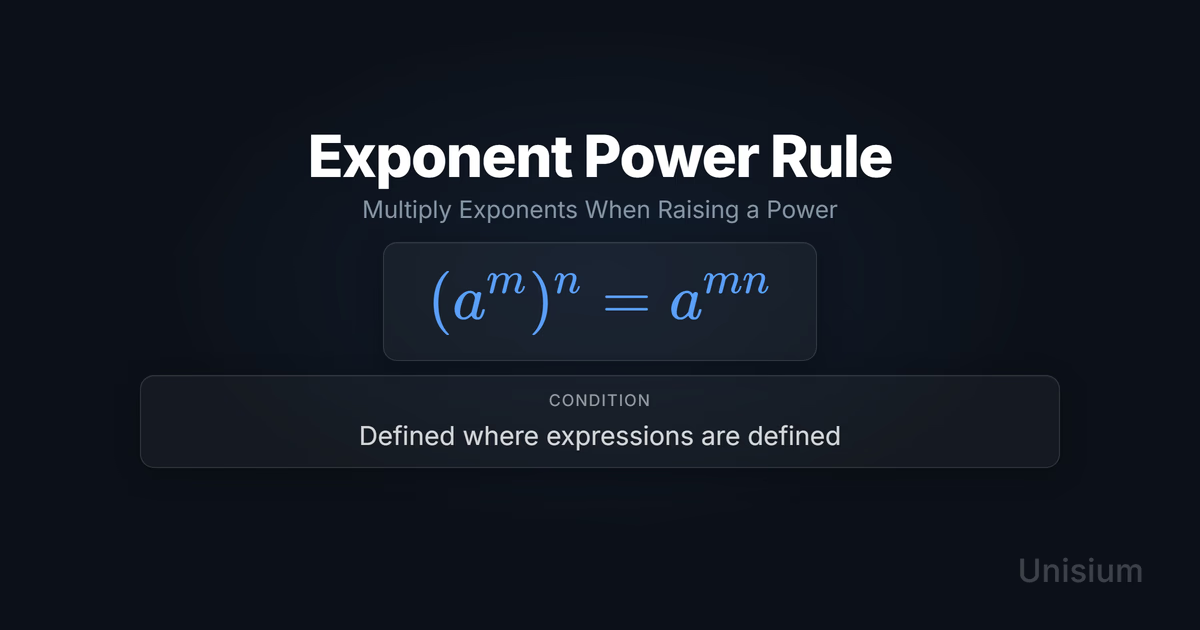
Exponent Power Rule lets you rewrite a power that is itself raised to another exponent as a single power whose exponent is the product of the two original exponents — preserving the value of the expression for every allowed variable assignment. It applies when the outer base is a single exponential expression of the form . Recognizing this structure and multiplying (not adding) the exponents is a core exponent fluency skill practiced in the Unisium Study System.
This guide sits inside the Algebra study map, where you can see the neighboring moves, models, and next-step guides that connect this principle to the rest of algebra.
On this page: The Principle | Conditions | Failure Modes | EE Questions | Retrieval Practice | Practice Ground | Solve a Problem | FAQ
The Principle
The move: Raise a power to another exponent by writing a single power whose exponent is the product of the two original exponents.
The invariant: This produces an equivalent expression with the same value for every allowed variable assignment, provided the nested power is defined. For positive integer exponents, the identity follows from counting: repeating as a factor times yields total copies of . The algebraic identity extends to negative and fractional exponents within the same allowed domain.
Pattern:
| Legal ✓ | Illegal ✗ |
|---|---|
The illegal column shows an attempted exponent distribution over a sum: raising to the second power is not the same as raising each summand to the second power and calling it done. is not in the form because the outer base is a sum, not a single power. Distributing the exponent 2 across a sum produces a result that is wrong for almost every value of and .
Conditions of Applicability
Condition: Defined where expressions are defined
Before applying, check: The expression inside the outer exponent must be a single exponential unit — not a sum, difference, or unrelated product of separate terms.
- : eligible — outer base is the single power .
- : eligible — outer base is , treated as a unit; result is .
- : not eligible — outer base is a sum; no exponent multiplication applies here.
- : not the same as — in standard right-to-left convention, ; the power rule applies only to the parenthesized form .
For fractional exponents, also verify that both the nested power and the rewritten form stay in the real-number setting — for example, requires so that is defined.
Want the complete framework behind this guide? Read Masterful Learning.
This move builds on comfort with the Exponent Product Rule. Compare it with Negative Exponent Rule when the exponent changes sign rather than nesting another power, and use it next in Exponential Model problems where repeated powers appear inside the model.
Common Failure Modes
Failure mode: distributing the outer exponent over a sum inside parentheses — e.g., writing → the base is a sum, not a single power; the move is valid only when the entire parenthesized base is a pure exponential expression .
Debug: ask “Is the base inside the outer exponent a single power or a sum/difference?” If it is a sum, the power-of-a-power rule does not apply — expand using distribution or the binomial theorem, or leave in factored form.
Elaborative Encoding
Use these questions to build deep understanding. (See Elaborative Encoding for the full method.)
Within the Principle
- For positive integer outer exponents, what does mean as repeated multiplication? Write out the first few factors and explain why the total count of -factors must equal .
- If you substitute , , , compute both and numerically. What does “equivalent expression” guarantee about this?
For the Principle
- How do you decide at a glance whether a given expression has the form ? What structural features must hold before the rule is eligible?
- What changes — if anything — when one of the exponents is negative or fractional? Does the rule still produce a valid equivalence?
Between Principles
- How does this rule relate to the Exponent Product Rule? For , you can expand to and then apply the product rule four times — does this confirm the power rule result?
Generate an Example
- Construct an expression that looks like it is in the form but is not (for example, using a sum as the base or using stacked-exponent notation without parentheses). Show why the power rule does not apply and what the correct simplification requires.
Retrieval Practice
Answer from memory, then click to reveal and check. (See Retrieval Practice for the full method.)
State the move in one sentence: _____Raise a power to a power by multiplying the exponents: the result is a single power whose exponent is the product of the two original exponents.
Write the canonical pattern: _____
State the canonical condition: _____Defined where expressions are defined
Practice Ground
Use these exercises to build move-selection fluency. (See Self-Explanation for how to use worked examples effectively.)
Procedure Walkthrough
Starting from (assume ), simplify to standard form.
| Step | Expression | Operation |
|---|---|---|
| 0 | — | |
| 1 | Rewrite radical as fractional exponent: | |
| 2 | Power rule on inner pair: | |
| 3 | Power rule on outer pair: |
Near-miss: if the original had been , neither summand is the base for the full radical — the power rule cannot be applied, and the expression has no simpler closed form.
Drills
Format A — Forward step
Apply the power rule once.
Reveal
Outer base , outer exponent . Multiply exponents: .
Apply the power rule once.
Reveal
Outer base , outer exponent . Multiply exponents: .
Apply the power rule once.
Reveal
Outer base , outer exponent . Multiply exponents: .
Is the power-of-a-power rule eligible here? Identify the eligibility check and explain.
Reveal
Not eligible. The outer base is , which is a sum — not a single exponential expression of the form . The power-of-a-power rule requires the base inside the outer exponent to be a pure power.
To simplify , you would use the binomial theorem or direct polynomial expansion. The power rule does not apply here.
Apply the power rule once.
Reveal
Outer base , outer exponent . Multiply exponents: .
Negative exponents are handled identically — the rule makes no restriction on the sign of or .
Format E — Canonicalization
Rewrite in simplified form with positive exponents.
Reveal
Multiply exponents: .
The product of two negatives gives a positive exponent.
A student writes by “applying the power rule.” Identify and correct the error.
Reveal
Error. In standard notation, is evaluated right-to-left (exponentiation is right-associative): , not .
The power-of-a-power rule applies to , where the parentheses make the nesting explicit: . Without parentheses, means raised to — a structurally different expression.
The near-miss: both notations involve two exponents on the same base, but only the parenthesized form triggers the multiply rule. Stacked notation without parentheses is right-associative and does not rewrite via .
Simplify using the power rule.
Reveal
Rewrite the radical as a fractional exponent: .
Apply the power rule: .
Simplify .
Reveal
Apply the outer power rule first: .
Then distribute the exponent over the product: .
Simplify .
Reveal
Outer base , outer exponent . Multiply exponents: .
Note: for all real , so the square root is defined without any additional domain restriction.
Solve a Problem
Apply what you’ve learned with Problem Solving.
Problem: Starting from (assume ), simplify to the form .
Full solution
| Step | Expression | Move |
|---|---|---|
| 0 | — | |
| 1 | Rewrite cube root as fractional exponent: | |
| 2 | Power rule: | |
| 3 | Power rule: | |
| 4 | Power rule: |
FAQ
What is the Exponent Power Rule?
The Exponent Power Rule is the algebraic identity : when a power is raised to another exponent, the result is a single power whose exponent is the product of the two original exponents. It is valid in the standard real-number setting when the nested power is defined and the rewrite stays within the same allowed domain.
When is the Exponent Power Rule valid?
It applies whenever an expression has the structure — a single power expression inside an outer exponent. The base can be any expression, but the inner piece must be a pure power, not a sum or difference. Compare: is eligible; is not.
Why multiply the exponents instead of adding them?
Adding exponents is the Exponent Product Rule, which applies to a product of two separate powers: . For positive integer outer exponents, means repeating as a factor times, giving total copies of — that is the basic intuition. More generally, the identity is extended to negative and fractional exponents within the same allowed domain. The structural signal that distinguishes this from the product rule: a single parenthesized power under an outer exponent, rather than two separate powers joined by multiplication.
What happens when the outer base is a sum?
If the base inside the outer exponent is a sum — such as — the power-of-a-power rule does not apply. A common error is writing , which incorrectly distributes the exponent over addition. The correct approach is to expand by multiplication or the binomial theorem.
Does the rule apply to fractional and negative exponents?
In school algebra, yes — with care. The rule holds when the nested power is defined and the result stays within the real-number setting. For integer exponents the rule is unrestricted on its domain; for fractional exponents, verify first that the base is non-negative (e.g., requires so that is defined). Negative outer exponents simply flip the result: for .
How This Fits in Unisium
The Exponent Power Rule sits at the core of the exponent family alongside the Exponent Product Rule and the negative exponent rule. Unisium builds fluency through forward-step drills (identify the eligible structure, apply once, predict the result) and canonicalization exercises (simplify nested radicals and chain-application problems with fractional or negative exponents). The critical near-miss — confusing stacked notation with the parenthesized form — is addressed directly in the drill block so learners develop the reflex to check structural eligibility before multiplying any exponents.
Explore further:
- Exponent Product Rule — The companion rule for multiplying same-base powers: add, don’t multiply
- Elaborative Encoding — Build deep understanding of why the exponent count multiplies
- Retrieval Practice — Make the canonical pattern and condition instantly accessible
Ready to master the Exponent Power Rule? Check access and join the Unisium waitlist or explore the full learning framework in Masterful Learning.
Masterful Learning
The book behind these guides: a study system for physics, math, & programming built on retrieval, connection, explanation, and problem solving.
Ready to apply this strategy?
Unisium turns these evidence-based techniques into guided study sessions for math and physics. Places are limited during early access. Check current availability to start a trial; joining the mailing list is optional.
See plans and availability Read More GuidesAlready have access? Sign in