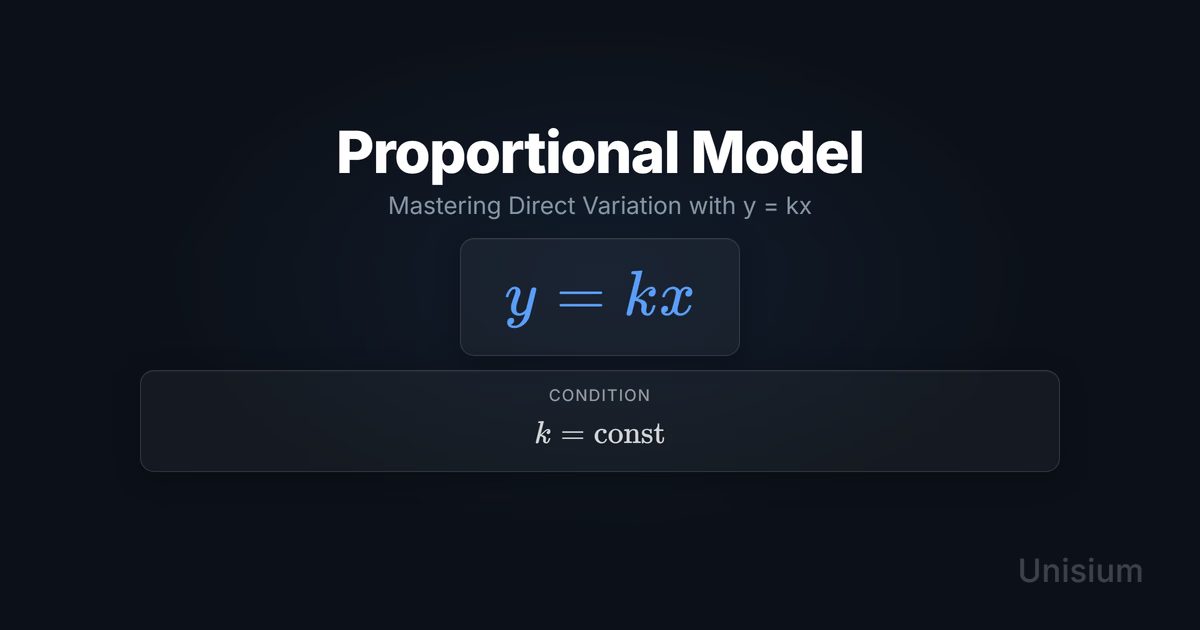
Proportional Model: Mastering Direct Variation with y = kx
The proportional model () states that two quantities and change in a fixed ratio: whenever scales by any factor, scales by the same factor, and the graph always passes through the origin. The constant , called the constant of proportionality, equals for any nonzero . Mastering this principle through elaborative encoding, retrieval practice, self-explanation, and problem solving—core strategies in the Unisium Study System—builds the pattern recognition needed to apply direct variation across algebra and science.
This guide sits inside the Algebra study map, where you can see the neighboring moves, models, and next-step guides that connect this principle to the rest of algebra.
On this page: The Principle | Conditions | Misconceptions | EE Questions | Retrieval Practice | Worked Example | Solve a Problem | Related Principles | FAQ | How This Fits
The Principle
Statement
The proportional model says that two quantities and are related by a single constant multiplier , called the constant of proportionality. The ratio is the same for every point on the relationship, and the graph is a straight line through the origin. Doubling doubles ; halving halves —the scaling is exact and symmetric.
Mathematical Form
Where:
- = dependent variable (output quantity)
- = independent variable (input quantity)
- = constant of proportionality; for any
Alternative Forms
In different contexts, this appears as:
- Ratio form: (makes the constant ratio explicit)
- Two-point form: (compares two corresponding pairs without computing explicitly)
Conditions of Applicability
Condition:
The constant of proportionality must remain fixed across the entire domain of interest. This is what separates a proportional relationship from other patterns—the ratio does not drift as changes.
Practical modeling notes
- Proportionality must be verified from data, not assumed. Compute for several points; if the values differ, the proportional model does not apply.
- The condition does not require to be an integer or positive. Any constant qualifies; gives the zero relationship , which is mathematically proportional but often not useful as a rate.
- The relationship must pass through the origin. If the data has a nonzero -intercept ( when ), use the linear model instead.
When It Doesn’t Apply
- Nonzero intercept: with is a linear relationship but not proportional. The ratio varies with , so is not constant.
- Nonlinear scaling: If one quantity grows faster than the other—for example —the ratio still changes, and the proportional model fails.
Want the complete framework behind this guide? Read Masterful Learning.
Compare this with Linear Model when deciding whether the relationship really passes through the origin. When a proportional relationship is written as a ratio or proportion, Cross Multiplication is often the next algebra move that makes the solve explicit.
Common Misconceptions
Misconception 1: “Proportional” means the same thing as “linear”
The truth: Every proportional relationship is linear, but not every linear relationship is proportional. The proportional model requires the graph to pass through the origin. The linear model with is linear but not proportional because is not constant.
Why this matters: Students who confuse the two will apply to data with a nonzero intercept, getting wrong answers for every problem.
Misconception 2: The constant must be a positive integer
The truth: can be any real number—a fraction, a negative number, or an irrational constant. A negative means and change in opposite directions (the line still passes through the origin). gives the zero relationship , which is mathematically proportional but often not useful as a rate.
Why this matters: Restricting to integers blocks correct modeling of real-world rates like unit conversions, which often involve non-integer ratios.
Misconception 3: The ratio works in both directions equally
The truth: is fixed, not . If , then . The role of and is not interchangeable unless .
Why this matters: Swapping the ratio flips the constant. Students who invert the ratio get an answer that is off by a factor of .
Elaborative Encoding
Use these questions to build deep understanding. (See Elaborative Encoding for the full method.)
Within the Principle
- In , what is the geometric meaning of on the graph? What would a larger look like compared to a smaller ?
- If doubles while stays fixed, what happens to ? If stays fixed but doubles, what happens to ?
For the Principle
- How can you determine from a table of values whether the relationship is proportional rather than merely linear?
- A scientist reports that “concentration increases proportionally with dose.” What specific check on the data supports or refutes this claim?
Between Principles
- The linear model generalizes the proportional model. What single constraint on reduces the linear model to the proportional model, and what geometric feature does that constraint enforce?
Generate an Example
- Describe a real-world situation where two quantities are proportional. Name the two quantities, give a plausible value for with units, and explain what it would mean physically if doubled overnight.
Retrieval Practice
Answer from memory, then click to reveal and check. (See Retrieval Practice for the full method.)
State the principle in words: _____Two quantities y and x change in a fixed ratio k; the graph passes through the origin, and y/x = k for every nonzero x.
Write the canonical equation: _____
State the canonical condition: _____
Worked Example
Use this worked example to practice Self-Explanation.
Problem
The variable varies directly with . When , . Find when .
Step 1: Verbal Decoding
Target: when
Given: , ,
Constraints: direct variation; is constant throughout
Step 2: Visual Decoding
Draw an – plane. Choose to the right and upward. Plot , draw the line through the origin and that point, and mark the unknown point at on the same line. (So , , , and are all positive.)
Step 3: Mathematical Modeling
Step 4: Mathematical Procedures
Step 5: Reflection
- Verification: substitute the known point : ✓ — the extracted constant satisfies the original data.
- Scaling check: increased by a factor of , so should be ✓
Before moving on: self-explain the model
Try explaining Step 3 out loud or in writing: why the proportional model applies, what the two equations represent, and how knowing one point is enough to find all others.
Mathematical model with explanation (what “good” sounds like)
Principle: Proportional Model () — two quantities share a fixed ratio; knowing one point determines the constant and the entire relationship.
Conditions: must be constant. The problem states “varies directly,” which is the definition of direct variation and guarantees is constant.
Relevance: With a direct variation statement, is the only model to use. The known point is the data needed to find .
Description: Two equations in Step 3 encode two roles of the same model: the first equation extracts from the known data point; the second equation applies that to the unknown . No new principle is needed between steps.
Goal: Solve for at by first extracting from the data, then substituting into the model.
Solve a Problem
Apply what you’ve learned with Problem Solving.
Problem
The variable varies directly with . When , . Find when .
Hint (if needed): Use the known point to find first, then apply at the new .
Show Solution
Step 1: Verbal Decoding
Target: when
Given: , ,
Constraints: direct variation; is constant
Step 2: Visual Decoding
Draw an – plane. Choose to the right and upward. Plot , draw the line through the origin and that point, and mark the unknown point at on the same line. (So , , , and are all positive.)
Step 3: Mathematical Modeling
Step 4: Mathematical Procedures
Step 5: Reflection
- Verification: substitute the known point : ✓
- Scaling check: increased by a factor of , so should be ✓
Related Principles
| Principle | Relationship to the Proportional Model |
|---|---|
| Linear Model () | Direct generalization: the proportional model is the special case |
| Cross Multiplication | Solving technique for proportion equations ; uses the fixed-ratio structure of the proportional model |
| Multiplicative Equality | The algebraic move used to isolate or in every step of solving |
See Principle Structures for how to organize these relationships in a hierarchical framework.
FAQ
What is the proportional model?
The proportional model describes two quantities and that change in a constant ratio: . The value is the same for every point on the relationship, and the graph is a straight line through the origin. It is the simplest and most fundamental model in algebra.
How is the proportional model different from a linear model?
Both are straight lines, but the proportional model requires : it must pass through the origin. A linear model with is linear but not proportional because the ratio changes as changes.
What does the constant represent?
is the constant of proportionality: the amount increases per unit increase in . In a distance-speed-time context, is speed. In a unit-price context, is price per item. It is the slope of the line and characterizes the entire relationship.
How do I tell from a data table whether a relationship is proportional?
Compute the ratio for every row. If all ratios are equal (within measurement error), the relationship is proportional. If the ratio drifts, the relationship is either linear with a nonzero intercept or nonlinear.
Can the constant be negative or a fraction?
Yes. A negative means decreases as increases—the line still passes through the origin but has a negative slope. A fractional means is a fraction of . There is no formal restriction on ; gives the zero relationship , which is mathematically proportional but often not useful as a rate.
What happens if the data does not pass through the origin?
The proportional model does not apply. Use the linear model instead, which accommodates a nonzero intercept while still allowing a constant rate of change.
Related Guides
- Principle Structures — Organize proportional and linear models in a hierarchical framework
- Self-Explanation — Learn to explain each step of a proportional model solution
- Retrieval Practice — Make instantly accessible under exam pressure
- Problem Solving — Apply the five-step strategy to direct variation problems
How This Fits in Unisium
Unisium structures the proportional model as a node in the algebra subdomain, linking it to prerequisites like Multiplicative Equality and to the Linear Model that builds on it. When you practice with Unisium, the system surfaces retrieval prompts at spaced intervals, presents worked examples that require self-explanation, and tracks which conditions and equation forms you can recall accurately—so every session builds fluency rather than just familiarity.
Ready to master the Proportional Model? Check access and join the Unisium waitlist or explore the complete learning framework in Masterful Learning.
Masterful Learning
The book behind these guides: a study system for physics, math, & programming built on retrieval, connection, explanation, and problem solving.
Ready to apply this strategy?
Unisium turns these evidence-based techniques into guided study sessions for math and physics. Places are limited during early access. Check current availability to start a trial; joining the mailing list is optional.
See plans and availability Read More GuidesAlready have access? Sign in