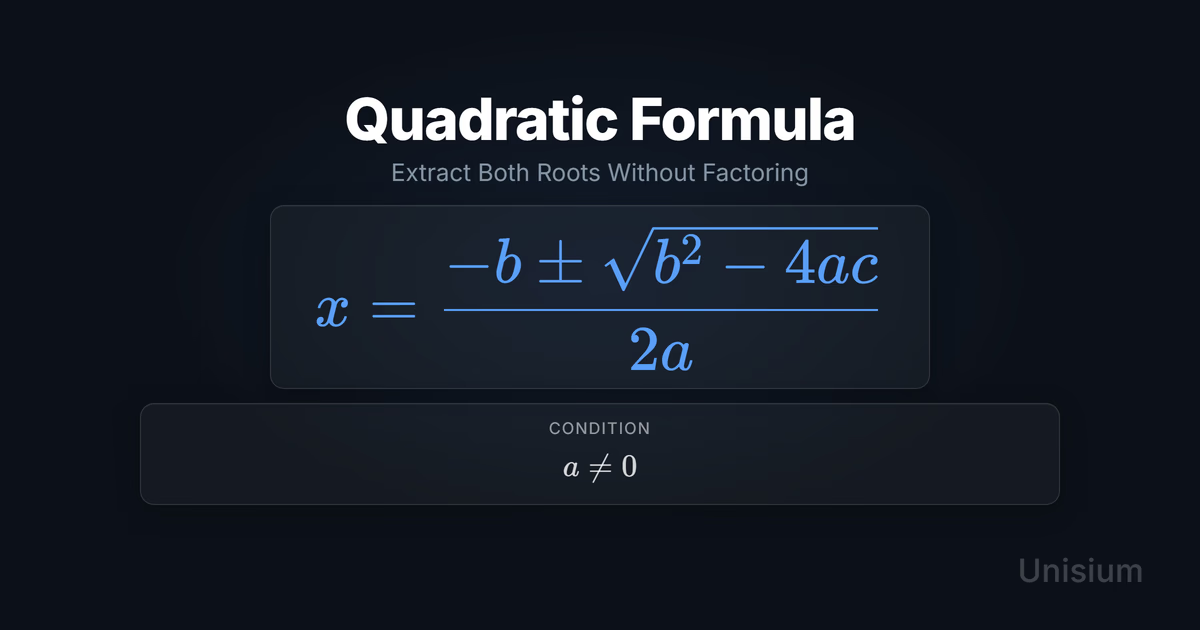
Quadratic Formula: Extract Both Roots Without Factoring
The Quadratic Formula solves any quadratic equation in standard form by substituting , , and into , giving both roots provided . Unlike factoring, it always terminates and applies to any quadratic regardless of whether it factors nicely. Move-selection fluency means recognizing when a quadratic is ready for this substitution and identifying , , without sign errors — a skill drilled systematically in the Unisium Study System.
This guide sits inside the Algebra study map, where you can see the neighboring moves, models, and next-step guides that connect this principle to the rest of algebra.
On this page: The Principle | Conditions | Failure Modes | EE Questions | Retrieval Practice | Practice Ground | Solve a Problem | FAQ
The Principle
The move: Substitute , , from the standard-form equation () into to obtain both roots simultaneously.
The invariant: This preserves the solution set: the values produced by the formula are exactly the solutions of the quadratic equation.
Pattern:
| Legal ✓ | Illegal ✗ |
|---|---|
| From : → | From : use → — wrong () |
The illegal column applies the formula before rearranging to standard form: the constant was left on the right side, so was silently misread as instead of . Both roots are wrong as a result.
Conditions of Applicability
Condition:
Before applying, check: Rewrite the equation in standard form with every term on the left side; read off , , explicitly — including cases where or .
- When : the equation is not quadratic; the denominator makes the formula undefined. Solve by linear methods instead.
- When or : the formula still applies — treat missing coefficients as zero, not absent.
The formula always yields the algebraic solutions; whether they are real or complex depends on the sign of .
Want the complete framework behind this guide? Read Masterful Learning.
This method is most transparent once you have seen its source in Completing the Square. Compare it with Quadratic Factoring when deciding whether a quick factorization exists, and use it next in Quadratic Model problems where solving for roots explains the graph.
Common Failure Modes
Failure mode: applying the formula before rearranging to standard form → one or more coefficients are read from the wrong position, and both roots are wrong.
Debug: Write explicitly — with all terms on the left and the right side equal to zero — before reading any coefficient. Never read as the value sitting on the right-hand side of the original equation. Once the coefficients are identified, write explicitly before substituting: when is negative, is positive, and skipping this step is the second most common source of wrong roots.
Elaborative Encoding
Use these questions to build deep understanding. (See Elaborative Encoding for the full method.)
Within the Principle
- Why does the numerator use rather than , and how does that sign behave when is itself negative?
- What does the symbol encode, and which property of square roots makes it necessary?
For the Principle
- How do you extract correctly from — what is the sign of , and what value enters the formula as ?
- What must be true about the form of the equation before any coefficient is identified?
Between Principles
- How does the Quadratic Formula relate to completing the square — is the formula derived from completing the square on the general form , and what does that tell you about when the two methods produce the same answer?
Generate an Example
- Write a quadratic equation where is negative. Show the substitution step explicitly, labeling , , , and separately before plugging in, and identify what a sign error at the step would produce.
Retrieval Practice
Answer from memory, then click to reveal and check. (See Retrieval Practice for the full method.)
State the move in one sentence: _____Substitute a, b, c from ax^2 + bx + c = 0 into x = (-b ± sqrt(b^2 - 4ac)) / (2a) to obtain both roots, provided a ≠ 0.
Write the canonical pattern: _____
State the canonical condition: _____
Practice Ground
Use these exercises to build move-selection fluency. (See Self-Explanation for how to use worked examples effectively.)
Procedure Walkthrough
Starting from , find both roots using the Quadratic Formula.
| Step | Expression | Operation |
|---|---|---|
| 0 | — | |
| 1 | Apply Quadratic Formula: | |
| 2 | Simplify: ; evaluate discriminant operands | |
| 3 | ;, | |
| 4 | ;, |
The negative is a diagnostic checkpoint: . A sign error here shifts both roots.
Drills
Format D — Goal-directed micro-chain
Micro-chain: Starting from , find both roots using the Quadratic Formula. Show the discriminant step explicitly.
Reveal
. Discriminant: .
or .
Verify: ✓;, ✓.
Micro-chain: Starting from , find all roots. How many distinct real roots exist?
Reveal
. Discriminant: .
One repeated root: (multiplicity 2). A discriminant of zero means the quadratic is a perfect square — both roots coincide.
Micro-chain: Starting from , evaluate the discriminant. What does its sign tell you about real roots?
Reveal
. Discriminant: .
The discriminant is negative — no real roots. The formula produces complex values , but no real number satisfies this equation.
Micro-chain (identify eligible): Which of the following can have the Quadratic Formula applied directly, which need rearrangement first, and which cannot use it at all? Explain each.
(a)
(b)
(c)
(d)
Reveal
(a) — already in standard form; apply directly with . Ready ✓
(b) — not in standard form; rearrange first: , then apply with . Needs rearrangement before applying.
(c) — linear (); the denominator is undefined. Cannot use the formula ✗ — solve as by linear methods.
(d) — standard form; apply directly with . Ready ✓
Micro-chain (catch the error): Starting from , a student reads and applies the formula to obtain , giving or . What went wrong? Apply correctly.
Reveal
Error: The formula was applied before rearranging. The right-hand side was left there, so was misread as instead of .
Correct setup: ;, .
Discriminant: .
or .
Key lesson: is the constant you see on the left side when the right side is zero — not the value that happens to appear on the right-hand side of the original equation.
Format A — Forward step
Forward step: Write the substituted expression for . Do not simplify yet — the goal is one application of the formula.
Reveal
.
The one-step result is the substituted form above. Subsequent simplification (, or ) is separate.
Forward step: From the equation , identify , , and write only the discriminant expression with values substituted but not yet evaluated.
Reveal
.
The next step (evaluating ) is a separate arithmetic transition.
Forward step: You have reached . Apply one simplification step: evaluate the radical.
Reveal
, so the next state is:
Splitting into two roots ( or ) is the following step.
Forward step: You have reached . Apply one step: evaluate the discriminant expression under the radical.
Reveal
, so the next state is:
Splitting the into two roots is the following step.
Forward step: From , identify , , and write the fully substituted formula expression. Do not simplify — just substitute. (Pay attention to the missing linear term.)
Reveal
. The term is ; there is no term, so (a real coefficient, not an absent one).
Simplification is the following step.
Solve a Problem
Apply what you’ve learned with Problem Solving.
Problem: Starting from , find both roots using the Quadratic Formula.
Full solution
| Step | Expression | Move |
|---|---|---|
| 0 | — | |
| 1 | Apply Quadratic Formula: | |
| 2 | Simplify: ;, evaluate discriminant operands | |
| 3 | ;, | |
| 4 | ;, |
Verify: ✓;, ✓.
FAQ
What is the Quadratic Formula?
The Quadratic Formula states that both solutions of () are . It is derived by completing the square on the general form and gives exact roots — rational, irrational, or complex — depending on the discriminant.
When is the Quadratic Formula valid?
The formula requires . Without a quadratic term, the denominator is zero and the formula is undefined. Subject to , it applies to any quadratic in standard form , including cases where or .
What goes wrong if I apply it before rearranging to standard form?
If constants remain on the right-hand side, is misread as zero or as some other wrong value. Both roots shift, and verification fails: substituting either candidate back into the original equation will not produce zero.
How is the Quadratic Formula different from factoring?
Factoring requires integer or simple rational root pairs and involves a guess-and-check step. The Quadratic Formula always terminates and gives exact answers for any — including irrational and complex roots. Factoring is faster when it works; the formula is the guaranteed method when it does not.
What does the discriminant tell you?
determines the root count: means two distinct real roots; means one repeated real root; means no real roots (two complex conjugate roots). Evaluating the discriminant first previews the outcome before computing the full formula.
Does the Quadratic Formula apply to inequalities, equations, or both?
The Quadratic Formula applies to quadratic equations, not directly to inequalities. For inequalities, you typically solve the related quadratic equation first to find the critical points, then analyze intervals separately to determine where the inequality holds.
How This Fits in Unisium
The Quadratic Formula is the universal exit move for quadratic equations — the technique that applies regardless of whether the equation factors over the integers. Unisium builds fluency through goal-directed micro-chain drills (start state to both roots) and forward-step drills (identify coefficients, substitute once, evaluate the discriminant). The target is automatic execution: see a quadratic in standard form, name , , without hesitation, and apply the formula in one confident pass — with no coefficient misread and no sign error on .
Explore further:
- Radical Definition — Understand the component of the formula
- Completing the Square — The derivational source of the Quadratic Formula
- Quadratic Model — The representational counterpart: when quadratic relationships describe real-world phenomena
- Elaborative Encoding — Build deep understanding of why coefficient identification is the critical first step
- Retrieval Practice — Make the formula and its condition instantly accessible
Ready to master the Quadratic Formula? Check access and join the Unisium waitlist or explore the full learning framework in Masterful Learning.
Masterful Learning
The book behind these guides: a study system for physics, math, & programming built on retrieval, connection, explanation, and problem solving.
Ready to apply this strategy?
Unisium turns these evidence-based techniques into guided study sessions for math and physics. Places are limited during early access. Check current availability to start a trial; joining the mailing list is optional.
See plans and availability Read More GuidesAlready have access? Sign in