Perfect Square Trinomial: Rewrite as a Squared Binomial
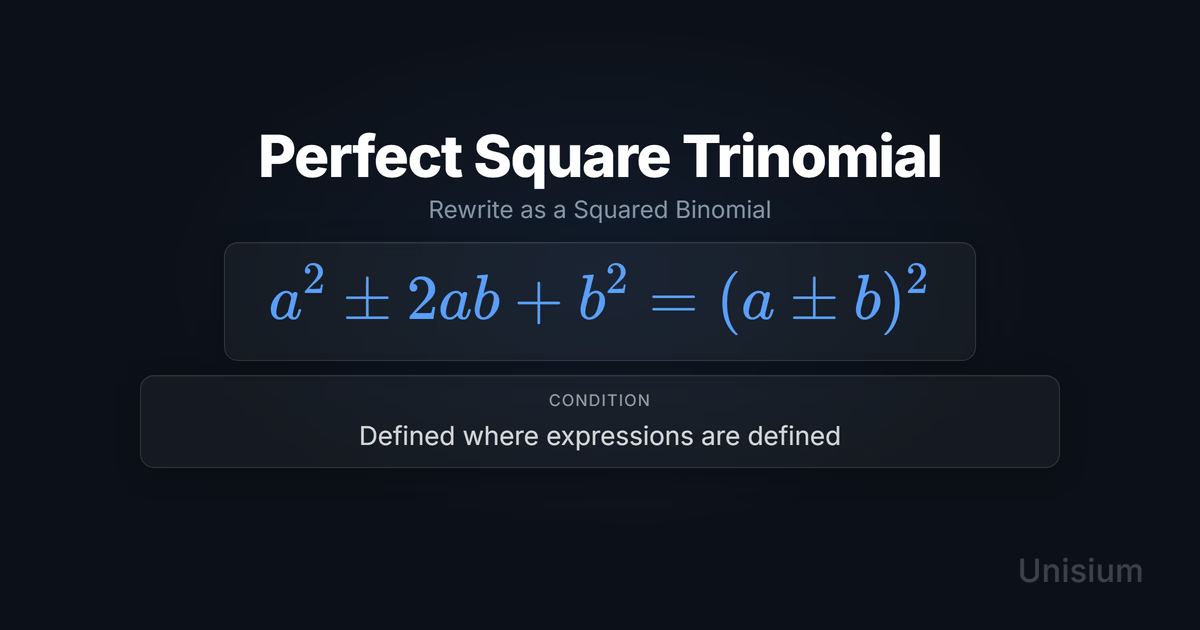
Perfect Square Trinomial lets you rewrite as , or as , producing an equivalent expression wherever the original is defined. To use it correctly, first run the pattern check: identify the square roots of the end terms and verify that the middle term is exactly . Recognizing that eligibility check quickly is a core factoring fluency skill in the Unisium Study System.
This guide sits inside the Algebra study map, where you can see the neighboring moves, models, and next-step guides that connect this principle to the rest of algebra.
On this page: The Principle | Conditions | Failure Modes | EE Questions | Retrieval Practice | Practice Ground | Solve a Problem | FAQ
The Principle
The move: Replace a three-term polynomial matching with the squared binomial .
The invariant: This produces an equivalent expression with the same value for every allowed variable assignment — the squared-binomial form and the expanded trinomial evaluate identically everywhere both are defined.
Pattern:
| Legal ✓ | Illegal ✗ |
|---|---|
The illegal column shows the attempted rewrite applied to a near-miss: expands to , not . The last slot has the wrong sign — Perfect Square Trinomial requires a final term, so a trinomial ending in subtraction does not match the pattern, regardless of the middle term.
Conditions of Applicability
Condition: Defined where expressions are defined
Before applying, check: the expression must match the pattern : identify the square roots of the first and third terms, then verify that the middle term is exactly .
- A trinomial with a minus sign in the last slot — such as — does not match the pattern because the third position requires a term; a literal subtraction in that slot breaks the pattern immediately.
- A trinomial such as also fails the pattern check: the end terms suggest and , but then ; the middle coefficient conflict disqualifies it.
Want the complete framework behind this guide? Read Masterful Learning.
This pattern is easiest to spot after working with Distributive Property enough to recognize squared binomials. Compare it with Difference of Squares when deciding which special-product structure you have, and use it next in Completing the Square where the perfect-square form is built on purpose.
Common Failure Modes
Failure mode: confirm only that the first and last terms are perfect squares, then apply the pattern without checking the middle coefficient → incorrectly factor a near-miss such as as , producing , which is not the original expression.
Debug: after identifying and from the end terms, compute and compare it to the actual middle term; if they differ, Perfect Square Trinomial does not apply.
Elaborative Encoding
Use these questions to build deep understanding. (See Elaborative Encoding for the full method.)
Within the Principle
- Why does the middle term of a perfect square trinomial always equal and not just ? (Expand step by step and trace where each term comes from.)
- When the middle term has a negative sign, how does that determine the sign inside the binomial — and why?
For the Principle
- You see a three-term polynomial. What three questions do you ask, in what order, before deciding whether Perfect Square Trinomial applies?
- What goes wrong if you identify correctly from the last term but then skip verifying the middle coefficient?
Between Principles
- How does Perfect Square Trinomial relate to Completing the Square? In which direction does each one run, and what is each one starting from?
- How does this pattern compare to Difference of Squares — specifically, what is different about the eligibility check and the number of terms involved?
Generate an Example
- Write a trinomial where the first and last terms are perfect squares but the middle coefficient is wrong, making it a near-miss. Then state exactly which condition fails.
Retrieval Practice
Answer from memory, then click to reveal and check. (See Retrieval Practice for the full method.)
State the Perfect Square Trinomial move in one sentence: _____Replace a² + 2ab + b² with (a + b)², or a² − 2ab + b² with (a − b)², producing an equivalent expression for every allowed variable assignment.
Write the canonical Perfect Square Trinomial pattern: _____
State the canonical condition: _____Defined where expressions are defined
Practice Ground
Use these exercises to build move-selection fluency. (See Self-Explanation for how to use worked examples effectively.)
Procedure Walkthrough
Starting from , reach fully factored form.
| Step | Expression | Operation |
|---|---|---|
| 0 | — | |
| 1 | Factor Common Term: GCF = 2 | |
| 2 | Reorder inner trinomial into descending powers — this is a genuine rewrite, not a shortcut | |
| 3 | Perfect Square Trinomial: , ; verify ✓, ✓, ✓; sign is |
Drills
Format A — Forward step: apply the principle once
Apply the principle once.
Reveal
Perfect Square Trinomial: , ; verify ✓, ✓; sign is
Apply the principle once.
Reveal
Perfect Square Trinomial: , ; verify ✓, ✓; sign is
Apply the principle once.
Reveal
Identify (since ) and (since ); verify ✓; sign is
Apply the principle once.
Reveal
Identify (since ) and (since ); verify ✓; sign is
Is this expression eligible for the Perfect Square Trinomial move? Explain.
Reveal
No. From the middle term , we need and , since . But then the last term would have to be , not . The middle and last slots cannot both be satisfied by the same , so the pattern does not apply.
Is this expression eligible for the Perfect Square Trinomial move? Explain.
Reveal
No. Identify (since ) and (since ). Check the middle term: .
Both end terms are perfect squares and the last term is positive — this looks like a strong candidate — but the middle coefficient fails the check. The pattern does not apply.
Apply the principle once. (The terms are not in descending order.)
Reveal
Reorder into descending powers: .
Identify (since ) and (since ); verify ✓; sign is
Note: encountering the pattern in non-standard order is common. Reordering is a genuine rewrite, not a shortcut, so it earns its own row in a chain.
Format E — Canonicalization: rewrite in fully factored form
Canonicalize: Rewrite in fully factored form.
Reveal
, : verify ✓, ✓; sign is
Canonicalize: Rewrite in fully factored form.
Reveal
(since ), (since ); verify ✓; sign is
Canonicalize: Rewrite in fully factored form.
Reveal
Identify (since ) and ; verify ✓, ✓; sign is
Canonicalize: Rewrite in fully factored form.
Reveal
Factor out the GCF first:
Now apply Perfect Square Trinomial: , ; verify ✓, ✓; sign is
Canonicalize: Determine whether is a perfect square trinomial. If not, explain why.
Reveal
No. The final slot in the pattern must be a term. Here the expression ends with (subtraction in the last position), so it fails the pattern immediately — before you even examine the middle term.
Near-miss note: the first term is ✓ and the middle term matches ✓, but the last slot’s sign defeats the pattern.
Solve a Problem
Apply what you’ve learned with Problem Solving.
Problem: Starting from , reach fully factored form.
Full solution
| Step | Expression | Move |
|---|---|---|
| 0 | — | |
| 1 | Factor Common Term: GCF = 8 | |
| 2 | Perfect Square Trinomial: , ; verify ✓, ✓, ✓; sign is | |
| 3 | Difference of Squares on : , ; sign is ✓ | |
| 4 | Distribute the outer square over the product |
FAQ
What is Perfect Square Trinomial?
Perfect Square Trinomial is a factoring identity: and . It converts a three-term polynomial — when both end terms are perfect squares and the middle coefficient equals — into the square of a binomial. The identity holds for any algebraic expressions and wherever those expressions are defined.
When is Perfect Square Trinomial valid?
The move is valid when the trinomial matches the pattern : identify the square roots of the end terms and verify the middle term equals exactly . The third slot must contain a term — a subtracting sign in the last position breaks the pattern immediately, before you even examine the middle coefficient.
What goes wrong if I skip the middle-term check?
You may factor a near-miss incorrectly. For example, looks like a candidate (both end terms are perfect squares), but , so is not the same expression. The error is invisible unless you verify the middle coefficient explicitly.
How is Perfect Square Trinomial different from Difference of Squares?
Difference of Squares applies to a two-term expression and requires the sign to be subtraction. Perfect Square Trinomial applies to a three-term expression and works with either sign in the middle. They are often chained: factoring produces , and then Difference of Squares factors each .
How does Perfect Square Trinomial relate to Completing the Square?
Completing the Square deliberately constructs a perfect square trinomial from an arbitrary quadratic by adding and subtracting a correction term. Once the trinomial is in the form, the Perfect Square Trinomial identity names the equivalence that licenses the rewrite. The two techniques run in opposite directions: Completing the Square builds the pattern; Perfect Square Trinomial collapses it.
Can or be a compound expression?
Yes. The identity works as long as both end positions evaluate to perfect squares. For example, has and , giving . Similarly , with and .
Does Perfect Square Trinomial apply to equations or inequalities?
Perfect Square Trinomial is an expression-level rewrite, not a bilateral operation like “add the same value to both sides.” That means it can absolutely be used inside an equation or inequality — as a step that rewrites one expression into an equivalent product — but it does not act on both sides of the relation simultaneously. Combine it with equation-operation rules such as Factor Common Term or the Zero Product Property when the goal is to solve.
How This Fits in Unisium
Factoring fluency depends on rapid, reliable pattern recognition: identifying the form, running the three-part eligibility check, and applying the identity — all before the move is needed inside a larger problem. Perfect Square Trinomial appears constantly inside completing-the-square procedures, quadratic solving, and simplification chains, but only when the three-way check has become automatic. Unisium builds this automaticity through short state-transition drills that specifically target near-miss forms, so the middle-term verification becomes a reflex rather than an afterthought.
Explore further:
- Difference of Squares — The two-term factoring pattern; often reached after Perfect Square Trinomial in chained factoring
- Factor Common Term — The GCF step that often precedes Perfect Square Trinomial when coefficients are involved
- Retrieval Practice — Make the three-part eligibility check and the canonical pattern instantly accessible
Ready to master Perfect Square Trinomial? Check access and join the Unisium waitlist or explore the full learning framework in Masterful Learning.
Masterful Learning
The book behind these guides: a study system for physics, math, & programming built on retrieval, connection, explanation, and problem solving.
Ready to apply this strategy?
Unisium turns these evidence-based techniques into guided study sessions for math and physics. Places are limited during early access. Check current availability to start a trial; joining the mailing list is optional.
See plans and availability Read More GuidesAlready have access? Sign in