Completing the Square (Rewrite Identity): Quadratic to Vertex Form by Pattern Substitution
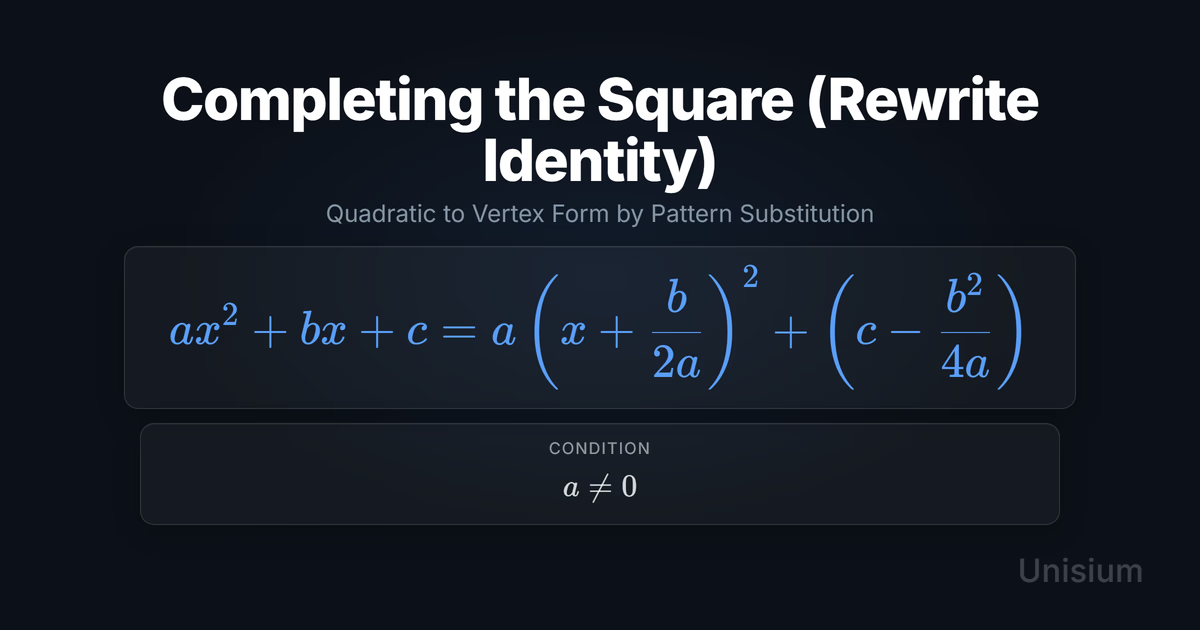
Completing the Square (Rewrite Identity) converts any quadratic into vertex form through one identity-based substitution, producing an equivalent expression for every when . Recognizing when this rewrite is legal and verifying the constant-correction term are fluency skills trained in the Unisium Study System.
This guide sits inside the Algebra study map, where you can see the neighboring moves, models, and next-step guides that connect this principle to the rest of algebra.
On this page: The Principle | Conditions | Failure Modes | EE Questions | Retrieval Practice | Practice Ground | Solve a Problem | FAQ
The Principle
The move: Substitute the coefficients , , of any quadratic into the identity below to produce the equivalent vertex form in one macro move.
The invariant: This produces an equivalent expression — the two forms yield the same value for every , provided .
Pattern:
| Legal ✓ | Illegal ✗ |
|---|---|
The illegal rewrite keeps unchanged instead of computing . Expanding gives .
Conditions of Applicability
Condition:
Before applying, check: Read the coefficient of . If it is zero, the expression is linear — the fractions and are undefined and the move is illegal.
- If : this is not a quadratic, so the identity does not apply.
- If : the identity still holds (giving ), but the rewrite adds no new structural information.
Want the complete framework behind this guide? Read Masterful Learning.
This method becomes easier once Perfect Square Trinomial patterns are familiar. Compare it with Quadratic Formula when deciding whether to build the square manually or use the general closed-form method, and use it next in Quadratic Model work where vertex form makes the structure visible.
Common Failure Modes
Failure mode: slot the original directly into the constant position — write instead of → the rewrite is not equivalent; expanding gives an extra in the constant.
Debug: expand your completed-square result and compare every term to the original; the constant terms must match exactly.
Elaborative Encoding
Use these questions to build deep understanding. (See Elaborative Encoding for the full method.)
Within the Principle
- Why does the shift term appear as inside the parentheses even though the vertex -coordinate is ? Trace the algebra of completing the square to explain the sign.
- If you substitute any specific value of into both and , what must be true about the two outputs?
For the Principle
- How can you verify a completed-square result without applying the identity a second time?
- Under what circumstances does the correction term equal zero, and what does that imply about the original quadratic?
Between Principles
- The traditional step-by-step completing-the-square technique and this identity produce the same result through different paths. Which sequence of moves does the technique perform that the identity skips, and at what point do both paths converge?
Generate an Example
- Choose a quadratic with and an odd value of (to force a fractional ), apply the identity, then verify by expanding.
Retrieval Practice
Answer from memory, then click to reveal and check. (See Retrieval Practice for the full method.)
Describe the Completing the Square (Rewrite Identity) move in one sentence: _____Rewrite ax^2 + bx + c as a(x + b/2a)^2 + (c - b^2/4a) — an equivalent expression for every x, provided a != 0.
Write the canonical equation pattern: _____
State the canonical condition: _____
Practice Ground
Use these exercises to build move-selection fluency. (See Self-Explanation for how to use worked examples effectively.)
Procedure Walkthrough
Starting from , produce the vertex form.
Read , , . Confirm . ✓
| Step | Expression | Operation |
|---|---|---|
| 0 | — | |
| 1 | Slot into identity | |
| 2 | Evaluate and | |
| 3 | Simplify constant term |
Drills
Format A — Forward Step
Apply the principle once.
Reveal
Read . Condition: . ✓
Verify: ✓
Apply the principle once.
Reveal
Read . Condition: . ✓
Verify: ✓
Eligibility check. Is the Completing the Square rewrite applicable to ? If not, identify the violation.
Reveal
Not applicable. There is no term, so the leading coefficient . The identity requires ; with both and are undefined. The expression is linear — use a different strategy.
Apply the principle once.
Reveal
Read . Condition: . ✓
Verify: ✓
Near-miss: reject or confirm. A student applies CTS to and writes . Is this correct? If not, find the error and state the correct result.
Reveal
Incorrect. The student slotted the original directly into the constant position — skipping the correction term .
Correct result with :
Verify: ✓
Expanding the wrong result: .
Format E — Canonicalization
Rewrite in vertex form .
Reveal
:
Rewrite in vertex form.
Reveal
:
Rewrite in vertex form (note: ).
Reveal
. The leading coefficient is negative, but , so the move is legal:
Verify: ✓
Rewrite in vertex form (non-integer ).
Reveal
:
Rewrite in vertex form ( edge case).
Reveal
:
Verify: ✓
Format C — Transition Identification
Identify the correct rewrite. Both chains start from . Which one applies CTS correctly, and what is the error in the other?
- Chain A:
- Chain B:
Reveal
Chain A is correct. With :
Chain B repeats the near-miss error: it keeps unchanged in the constant position instead of applying the correction.
Verify Chain A: ✓
Identify the transition. In the following chain, which step applied the Completing the Square identity?
Reveal
Step 1 → 2 applied CTS with :
Verify: ✓
Diagnose the chain. Each version applies CTS to . One is correct, one has a constant-correction error, and one used the wrong sign on the shift. Identify which is which.
- Chain P:
- Chain Q:
- Chain R:
Reveal
With : shift , so the factor is . Correction .
Chain P: correct. Verify: ✓
Chain Q: wrong sign on shift. expands to , not . The shift was negated by accident.
Chain R: constant-correction error. The correction term was skipped; the original was kept unchanged, giving a result off by .
Solve a Problem
Apply what you’ve learned with Problem Solving.
Problem: Rewrite in vertex form using the Completing the Square identity.
Full solution
| Step | Expression | Move |
|---|---|---|
| 0 | Read ; confirm | |
| 1 | Slot into identity | |
| 2 | Evaluate and | |
| 3 | Simplify constant |
Verify: ✓
FAQ
What is the Completing the Square Rewrite Identity?
The Completing the Square Rewrite Identity is an algebraic equivalence that rewrites any quadratic (with ) directly into vertex form through a single pattern substitution. Unlike the step-by-step technique (adding and subtracting inside the expression), the identity treats the conversion as one macro substitution into a verified pattern.
When is Completing the Square valid?
The identity is valid whenever . The leading coefficient may be negative, fractional, or irrational — the only requirement is that the expression has a genuine term.
What goes wrong if I forget the correction term?
Omitting the correction leaves the constant as instead of . The “completed” form then expands to — off by exactly . Always expand your result and check that the constant matches.
How does the Completing the Square Identity differ from the step-by-step technique?
The step-by-step technique adds and subtracts inside the expression, then factors the perfect-square trinomial — a sequence of several small moves. The Rewrite Identity is the shortcut: one substitution that compresses all those steps into a pre-verified formula. Both are correct; the identity is faster once you trust the formula.
Does Completing the Square apply to all quadratics?
Yes, for any real and any real , . It works when is odd (producing a fractional vertex), when (producing a negative constant), or when (producing a downward-opening vertex form).
How does this identity connect to the Quadratic Formula?
Applying this identity to and isolating recovers the Quadratic Formula directly. After the identity is applied and the equation is solved for , the term , when cleared and rearranged, produces the discriminant under the radical. For a shorter path to roots, use the Quadratic Formula directly; for vertex form, use this identity.
How This Fits in Unisium
Completing the square is a gateway move: it unlocks vertex form for any quadratic, reveals the axis of symmetry and vertex directly, and powers the derivation of the quadratic formula. In Unisium, this identity is practiced as an identity-based pattern-substitution skill — you read , , ; slot them in; and verify by expanding. The drill block above targets the most common failure mode (forgetting the constant-correction term) and the eligibility check () that is easiest to skip on autopilot. Explore the learning framework in Masterful Learning.
Explore further:
- Elaborative Encoding — Build deep understanding of why the constant-correction term exists and cannot be skipped
- Retrieval Practice — Make the identity pattern and condition instantly accessible
- Self-Explanation — Use the worked examples above to narrate each coefficient substitution
Ready to master Completing the Square? Check access and join the Unisium waitlist or explore the full learning framework in Masterful Learning.
Masterful Learning
The book behind these guides: a study system for physics, math, & programming built on retrieval, connection, explanation, and problem solving.
Ready to apply this strategy?
Unisium turns these evidence-based techniques into guided study sessions for math and physics. Places are limited during early access. Check current availability to start a trial; joining the mailing list is optional.
See plans and availability Read More GuidesAlready have access? Sign in