Square Root Property: Splitting a Squared Equation into Two Branches
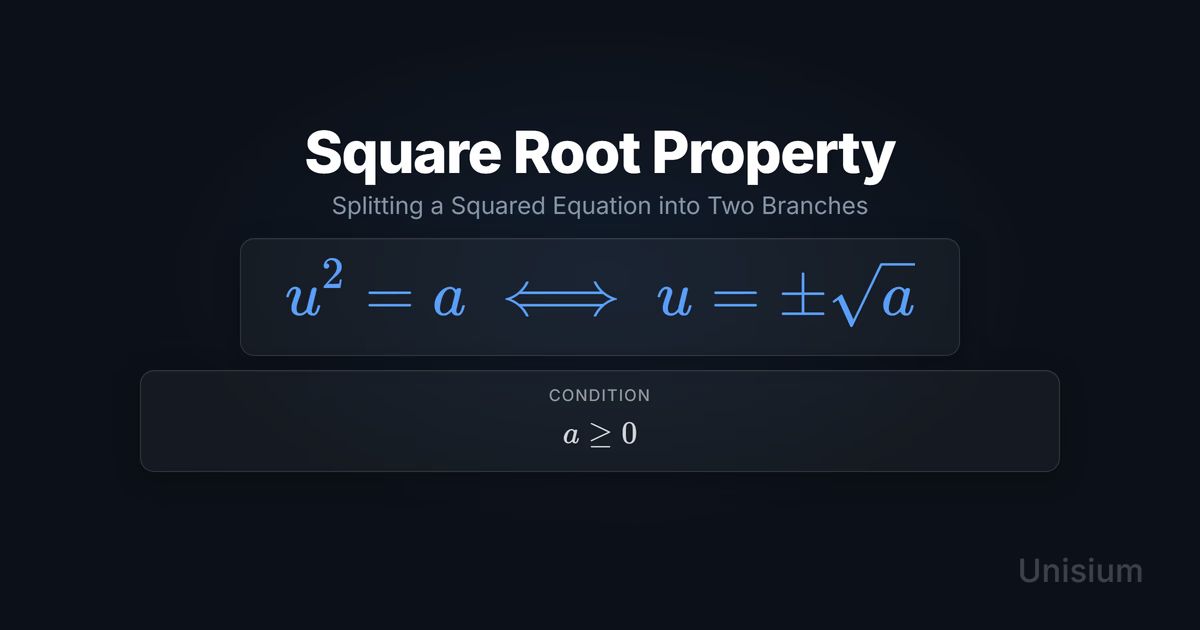
Square Root Property lets you solve a squared equation by splitting it into two branches: if and , then or . This preserves the solution set — every real solution of appears in exactly one of the two branches. Checking that the right side is nonnegative before taking roots, and keeping both branches, is a core algebra fluency skill practiced in the Unisium Study System.
This guide sits inside the Algebra study map, where you can see the neighboring moves, models, and next-step guides that connect this principle to the rest of algebra.
On this page: The Principle | Conditions | Failure Modes | EE Questions | Retrieval Practice | Practice Ground | Solve a Problem | FAQ | How This Fits
The Principle
The move: When a squared expression equals a nonnegative number, split into two equations — one positive root and one negative root.
The invariant: This preserves the solution set. Both and satisfy , and no other real values do.
Pattern:
| Legal ✓ | Illegal ✗ |
|---|---|
| (no real roots; ) | |
| only (dropped the branch) |
Conditions of Applicability
Condition:
Before applying, check: Confirm that the expression on the right side is nonnegative. If , the equation has no real solutions — do not take a square root.
If the condition is violated: Writing when produces an undefined expression over the reals, and any subsequent algebra is meaningless.
- First isolate the squared expression into the form before applying the property. Do not apply it to an expression that has not been isolated yet.
- The condition must be checked on the isolated right side — not on the original unsimplified equation.
Want the complete framework behind this guide? Read Masterful Learning.
This move starts from the principal-root convention in Radical Definition. Compare it with Absolute Value Cases Equations when two branches appear from a different algebraic structure, and use it next in Quadratic Formula work where radicals reappear inside a general solving method.
Common Failure Modes
Failure mode: writing only the positive root — e.g., — and losing the solution → the solution set is incomplete.
Debug: every time you take a square root of both sides, write immediately. If context later eliminates one branch (geometric length, domain restriction), state that explicitly.
Elaborative Encoding
Use these questions to build deep understanding. (See Elaborative Encoding for the full method.)
Within the Principle
- Why does squaring erase the sign, making two roots possible?
- What does the symbol represent in , and why is it required?
For the Principle
- How do you verify that the right side is nonnegative before applying the property?
- If , how many branches does the property produce?
Between Principles
- How does the Radical Definition (principal nonnegative root) interact with the in the Square Root Property?
Generate an Example
- Write one equation where both branches lead to valid answers, and one where a physical or domain constraint eliminates one branch. Explain which branch is dropped and why.
Retrieval Practice
Answer from memory, then click to reveal and check. (See Retrieval Practice for the full method.)
State the Square Root Property in one sentence: _____If a squared expression equals a nonnegative number, then the expression equals the positive or negative square root of that number.
Write the canonical pattern: _____
State the canonical condition: _____
Practice Ground
Use these exercises to build move-selection fluency. (See Self-Explanation for how to use worked examples effectively.)
Procedure Walkthrough
Starting from , reach the solved branches for .
| Step | Expression | Operation |
|---|---|---|
| 0 | — | |
| 1 | Square Root Property (, so two branches). | |
| 2a | Positive branch: add 3 (Additive Inverse). | |
| 2b | Negative branch: add 3 (Additive Inverse). |
Solutions: .
Drills
Goal micro-chain
Solve for all real values of .
Reveal
, so apply the Square Root Property:
Solutions: .
Solve for all real values of .
Reveal
. Apply the Square Root Property:
Branch 1: . Branch 2: .
Solutions: .
(Negative) Can the Square Root Property be applied here? Explain.
Reveal
No. The condition requires , but . The equation has no real solutions. Writing is invalid — .
Solve for all real values of .
Reveal
First isolate the squared term: .
. Apply the Square Root Property:
Solutions: .
Solve for all real values of .
Reveal
. Apply the Square Root Property:
Branch 1: . Branch 2: .
Forward step
Apply the Square Root Property once.
Reveal
:
Apply the Square Root Property once.
Reveal
:
Apply the Square Root Property once.
Reveal
. Apply the property:
There is only one value () because both branches coincide.
(Negative) A student solves and writes . What is wrong?
Reveal
The student dropped the negative branch. The Square Root Property gives . Since is also valid, the full solution set is .
Apply the Square Root Property once.
Reveal
:
(Negative) A student has and immediately writes . Identify the error.
Reveal
The student did not isolate first. Subtracting 9 from both sides gives . Since , the condition fails, and there are no real solutions. The student applied the property to the wrong value.
Apply the Square Root Property once.
Reveal
:
Solve a Problem
Apply what you’ve learned with Problem Solving.
Problem: Starting from , reach isolated form and then the solved branches for .
Full solution
| Step | Expression | Move |
|---|---|---|
| 0 | — | |
| 1 | Add 8 to both sides (Additive Inverse). | |
| 2 | Divide both sides by 2 (Multiplicative Inverse, ). | |
| 3 | Square Root Property (). | |
| 4a | Positive branch: subtract 3 (Additive Inverse). | |
| 4b | Negative branch: subtract 3 (Additive Inverse). |
Solutions: .
FAQ
What is the Square Root Property?
The Square Root Property says: if a squared expression equals a nonnegative number, the expression equals the positive or negative square root of that number. Formally, (with ) is equivalent to or .
When is the Square Root Property valid?
The equation must first be in the form — the squared expression must be isolated on the left. Then the isolated right-hand side must satisfy . If , the equation has no real solutions, and writing is undefined over the reals.
What goes wrong if I write only the positive root?
You lose a valid solution. For example, has solutions and . Writing only discards half the solution set.
How is the Square Root Property different from the Radical Definition?
The Radical Definition defines as the principal (nonnegative) root. The Square Root Property is a solving move that uses this definition to produce two branches () from a squared equation. The definition tells you what means; the property tells you how to solve .
Does the Square Root Property apply to equations, inequalities, or both?
This guide covers solving real equations of the form . The property does not transfer directly to inequalities as a “split into ” rule — inequalities need separate sign and monotonicity reasoning. For equations: the property applies whenever and the squared expression is already isolated.
How This Fits in Unisium
The Square Root Property appears whenever a squared expression needs to be undone — from simple equations like to the final step of completing the square or applying the quadratic formula. Unisium drills condition recognition () and the reflex to write through targeted state-transition exercises, building the fluency to apply this move correctly under time pressure.
Explore further:
- Principle Structures — See where the Square Root Property sits in the algebra principle hierarchy
- Elaborative Encoding — Build deep understanding of why the is required
- Retrieval Practice — Make the condition and pattern instantly accessible
Ready to master the Square Root Property? Check access and join the Unisium waitlist or explore the full learning framework in Masterful Learning.
Masterful Learning
The book behind these guides: a study system for physics, math, & programming built on retrieval, connection, explanation, and problem solving.
Ready to apply this strategy?
Unisium turns these evidence-based techniques into guided study sessions for math and physics. Places are limited during early access. Check current availability to start a trial; joining the mailing list is optional.
See plans and availability Read More GuidesAlready have access? Sign in